
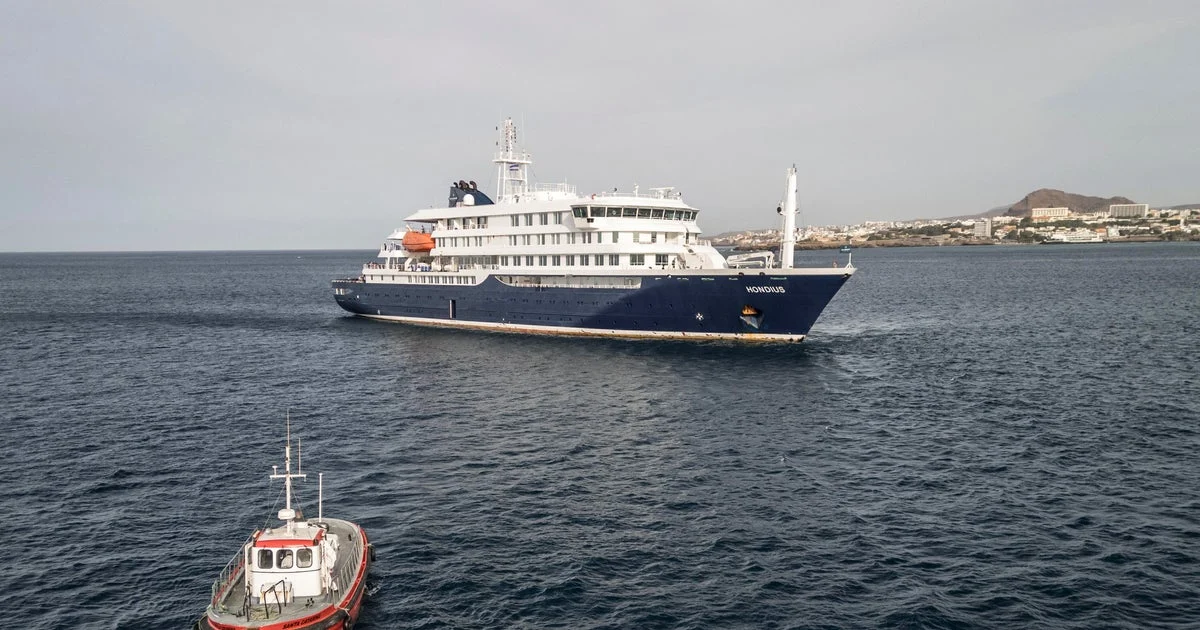
The World Health Organization’s Director-General, Dr. Tedros Adhanom Ghebreyesus, arrived in Tenerife, Canary Islands, on Saturday to supervise the evacuation of over 100 passengers and crew from the MV Hondius cruise ship amid a hantavirus outbreak. This rare virus outbreak has resulted in three deaths among those connected to the ship, prompting immediate public health actions.
The MV Hondius, a Dutch-flagged vessel, is expected to dock off Tenerife early Sunday. Officials report eight confirmed or suspected hantavirus cases linked to the ship, with none of the 147 people currently aboard showing symptoms, including 60 crew members, according to Oceanwide Expeditions, the ship’s owner.
Addressing the local population, Tedros acknowledged fears rooted in the COVID-19 pandemic but emphasized that hantavirus is a different illness with low risk of community spread. He stated, “This disease is not COVID” and reassured that the risk to locals remains low. He said his presence was to provide direct oversight and support, recognizing public anxiety.
Passengers will be evacuated by small boats and transported via planes arranged by their respective countries. Seventeen Americans aboard will be flown in a U.S. government-chartered plane to the National Quarantine Center at the University of Nebraska, Omaha, under CDC supervision. Each country is advised to isolate passengers for 42 days following their last potential exposure.
Hantavirus is typically acquired from rodents and is not usually transmitted person to person. However, the strain involved here—the Andes virus—is unique for its potential human-to-human transmission through close contact, though experts consider widespread transmission unlikely.
The outbreak likely originated from a Dutch couple who traveled through South America, where the Andes strain is endemic. The couple spent time bird-watching in areas known to harbor infected rodents. The husband died aboard the ship on April 11. The wife disembarked earlier in Saint Helena and later died after becoming too ill to continue flying.
Officials are monitoring dozens of individuals worldwide who had contact with the couple or disembarked at Saint Helena, including people in multiple U.S. states, none of whom are currently symptomatic.
Why it matters
The evacuation effort underlines international coordination in responding to rare but serious infectious disease outbreaks on cruise ships, a setting known for rapid disease spread. The WHO’s involvement aims to prevent local transmission in the Canary Islands and ensure infected passengers receive proper quarantine and care. The incident also highlights the particular risks posed by the Andes strain of hantavirus due to its potential for limited person-to-person transmission.
Background
Hantaviruses are a group of viruses commonly transmitted through rodent excreta. The Andes virus, found in South America, is distinct for its rare ability to spread between humans. Outbreaks are sporadic and typically linked to exposure to infected rodents or confined settings. The COVID-19 pandemic has heightened global sensitivity to viral outbreaks, contributing to public concern despite the differing transmission modes and risks of hantavirus.
The MV Hondius departed Argentina on April 1 and visited remote islands including Tristan da Cunha and Saint Helena before reaching the Canary Islands. The swift response by WHO and national health agencies aims to limit further casualties and reassure affected communities.
Sources
This article is based on reporting and publicly available information from the following source:
Read more Health & Public Health stories on Goka World News.