
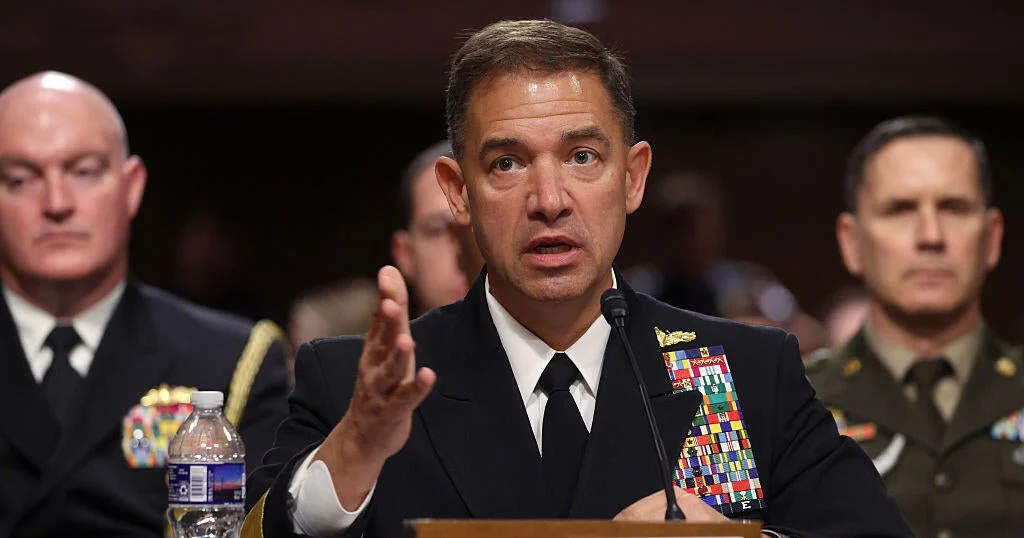
The commander of U.S. Central Command, Admiral Brad Cooper, testified before the Senate Armed Services Committee on May 14, 2026, that a recent U.S. bombing campaign against Iran, dubbed Operation Epic Fury, significantly degraded Tehran’s military capabilities, weakening its ability to control the strategic Strait of Hormuz. Although Iran’s capacity to impede maritime commerce has been substantially diminished, threats to shipping through the strait continue.
Operation Epic Fury’s Impact on Iranian Military Capabilities
Admiral Cooper detailed that the U.S. military has neutralized more than 90% of Iran’s estimated 8,000 naval mines to prevent their use in the Strait of Hormuz. Additionally, more than 1,450 strikes targeted weapons manufacturing facilities, damaging or destroying over 85% of Iran’s ballistic missile, drone, and naval industrial infrastructure. Cooper estimated it would take Iran “a generation” to rebuild its navy and several years to restore drone and missile production capacity.
Contrary to some reports, Cooper emphasized that Iran does not retain approximately 70% of its ballistic missile inventory, though he declined to disclose specific figures due to classification. The U.S. military began noticing an increase in Iran’s ballistic missile production capability and intent during late 2025, which factored into the decision to initiate Operation Epic Fury.
Ongoing Threats and Military Options
Despite the degradation of Iranian capabilities, Admiral Cooper acknowledged that Tehran maintains some capacity to threaten vessels transiting the Strait of Hormuz. He said, “The Iranian ability to stop commerce has been dramatically degraded through the straits, but their voice is very loud, and those threats are clearly heard by the merchant industry and the insurance industry.”
Asked about military options to reopen the strait if necessary, Cooper deferred to policymakers, noting that the waterway remains central to ongoing negotiations for a longer-term peace.
Conflict Status and Investigations
Cooper confirmed that the ceasefire agreed on April 7, 2026, remains in effect despite a continuing U.S. Navy blockade of Iranian ports and isolated exchanges of fire in recent days. The administration has informed Congress that hostilities with Iran have formally terminated.
The admiral also addressed concerns about civilian casualties, confirming that the military’s investigation into a strike on an Iranian girls’ school, which killed approximately 150 people earlier in the campaign, is still ongoing. Preliminary U.S. assessments suggest the strike was likely unintentional. Cooper expressed commitment to minimizing civilian harm and invited senators to review Central Command’s targeting processes firsthand.
When asked about reports of additional attacks on schools since the campaign began, Cooper stated the military had not verified those incidents but pledged to compile a report addressing possible damages to civilian facilities such as schools and hospitals.
Congressional Oversight and Unanswered Questions
Senators pressed for further transparency on the legal justification for the strikes. Democratic Senator Tim Kaine criticized the Department of Justice’s Office of Legal Counsel for withholding the legal opinion that authorized the campaign, questioning the administration’s reluctance to share it with Congress.
Cooper declined to comment on allegations of Chinese or Russian intelligence support to Iran, suggesting such sensitive matters be discussed in classified settings.
Why it matters
The Strait of Hormuz is a critical chokepoint through which a significant portion of the world’s oil supply passes, making Iran’s control and threat over the waterway a vital security concern. The degradation of Iran’s military capacity reduces immediate dangers to international shipping but leaves open risks that could affect global energy markets and regional stability. Ongoing investigations into civilian casualties emphasize the complexities of modern warfare and the importance of accountability.
Background
Iran has long leveraged its strategic position near the Strait of Hormuz to exert influence over global oil shipments. The U.S. launched Operation Epic Fury following increased tensions and perceived threats from Iranian ballistic missile and drone programs. The April 7 ceasefire marked a temporary halt to active hostilities amid diplomatic efforts to resolve the conflict.
Sources
This article is based on reporting and publicly available information from the following source:
Read more US News stories on Goka World News.