
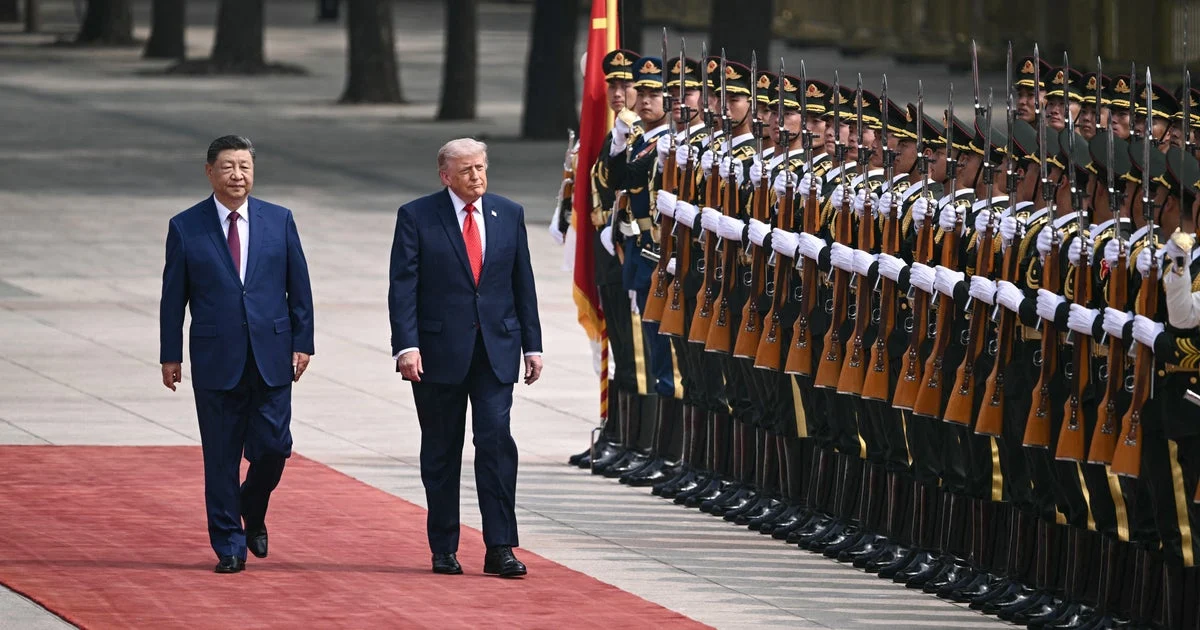
President Donald Trump and Chinese President Xi Jinping met in Beijing on May 14, 2026, for more than two hours of private talks focused primarily on stabilizing trade relations and addressing sensitive geopolitical issues including Taiwan. This was the first meeting between the two leaders since October and marked the first visit to China by a sitting U.S. president since Trump’s 2017 trip.
The summit began with a formal welcome ceremony at the Great Hall of the People, attended by members of the U.S. delegation including key cabinet officials and CEOs from major American companies such as Tesla, Nvidia, and Apple. These executives later met with Xi Jinping, who encouraged greater market access for U.S. firms in China, according to Chinese state media.
During the closed-door meeting, trade dominated the agenda. Trump emphasized eagerness to expand business with China, while Xi stressed the importance of partnership over rivalry to ensure global stability. The leaders discussed scaling back tariffs and revisiting export controls, including issues surrounding rare earth elements critical for technology manufacturing.
Taiwan, a longstanding point of contention, was also addressed, though neither leader commented publicly on the subject at the summit. A statement from China’s foreign ministry highlighted Xi’s warning that Taiwan remains the “most important issue” in bilateral relations. Xi reportedly told Trump that “Taiwan independence” and maintaining cross-Strait peace are irreconcilable and that mishandling this issue could lead to conflicts threatening the entire relationship.
The conflict between the U.S. and Iran loomed in the background but received less attention during the discussions. Trump noted that the U.S.-Iran truce was fragile, while U.S. officials signaled expectations for China to play a more active role in resolving disruptions to global oil supply caused by the conflict, given China’s status as Iran’s largest oil customer.
This summit follows a period of eased tensions after a severe trade war in 2025, when tariffs by both countries significantly escalated. While a comprehensive trade deal remains uncertain, both sides have expressed a preference for stability and cooperation over confrontation.
Why it matters
The meeting represents a diplomatic effort to de-escalate trade conflicts and manage strategic rivalries between the world’s two largest economies. How the U.S. and China handle Taiwan will be particularly consequential for regional security and global economic stability. The involvement of prominent U.S. business leaders signals an attempt to balance geopolitical issues with commercial interests in one of the world’s largest markets, potentially shaping future trade policies and technology access.
Background
Relations between the U.S. and China deteriorated in 2025 amid a tariff war that disrupted global supply chains and trade flows. The conflict included disputes over rare earth materials, semiconductor technology, and agricultural imports, reflecting broader strategic competition. Taiwan, a democratic island with critical semiconductor production, remains a critical flashpoint, as China asserts sovereignty claims while the U.S. supports Taiwan’s defense capabilities without explicit security guarantees. The ongoing U.S.-Iran war adds complexity, affecting energy markets and U.S.-China diplomatic dynamics.
Sources
This article is based on reporting and publicly available information from the following source:
Read more Politics stories on Goka World News.