
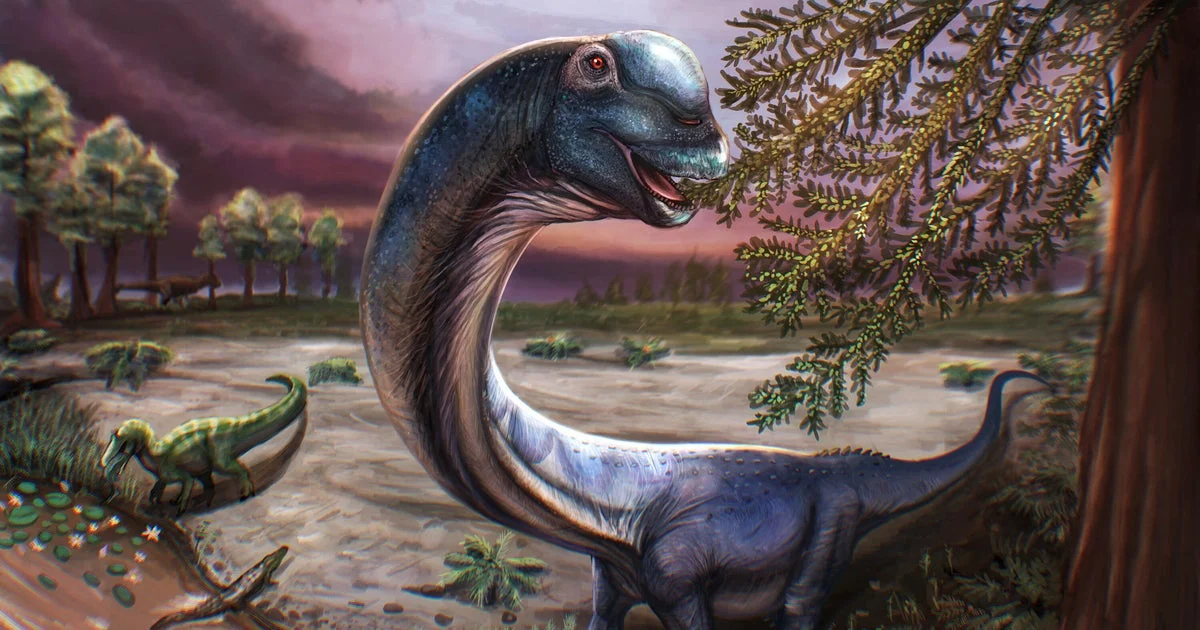
Scientists have identified a new species of massive dinosaur from skeletal remains found in northeastern Thailand, estimated to weigh about 27 tons—equivalent to nine adult Asian elephants. The long-necked herbivore, named Nagatitan chaiyaphumensis, measured approximately 88 feet in length, making it the largest dinosaur ever found in Southeast Asia.
The discovery was detailed in a study published in the journal Scientific Reports and involved researchers from University College London and Thai institutions. The fossilized remains were first unearthed by locals about a decade ago, with the full excavation completed in 2024. While some features resembled other known sauropods, the specimen showed unique traits justifying its classification as a new species.
Lead researcher Thitiwoot Sethapanichsakul, a Ph.D. student at University College London, referred to the dinosaur as “the last titan” due to its location in one of the youngest dinosaur-bearing rock formations in Thailand. This region later transformed into a shallow sea, indicating that Nagatitan could be among the most recently existing large sauropods discovered in Southeast Asia. An artist’s reconstruction and a life-size model of the dinosaur are displayed at the Thai Dinosaur Museum in Bangkok.
The name Nagatitan chaiyaphumensis combines references to a mythological serpent-like creature (naga) revered in northeastern Thai culture and “titan,” signifying the giant stature of the dinosaur. During the period it roamed, approximately 100 to 120 million years ago, its largest predator was a relative of Carcharodontosaurus, roughly 26 feet long and 3.5 tons. Compared to its predators, Nagatitan was enormous and likely faced little threat from predation.
Why it matters
This discovery expands understanding of dinosaur diversity in Southeast Asia, highlighting the region’s role in the late Cretaceous ecosystem. It also provides insight into sauropod evolution shortly before the area became submerged under a shallow sea. The remarkable size of Nagatitan chaiyaphumensis underscores the presence of some of the largest herbivorous dinosaurs in this geographic area during that era.
Background
Thailand has yielded several significant dinosaur fossils in recent years, including Minimocursor phunoiensis, discovered in 2023 and described as one of the best-preserved dinosaurs from Southeast Asia. The ongoing excavation and study of these fossils contribute to a growing body of paleontological knowledge about the prehistoric fauna of this region.
Sources
This article is based on reporting and publicly available information from the following source:
Read more Science Discoveries stories on Goka World News.