
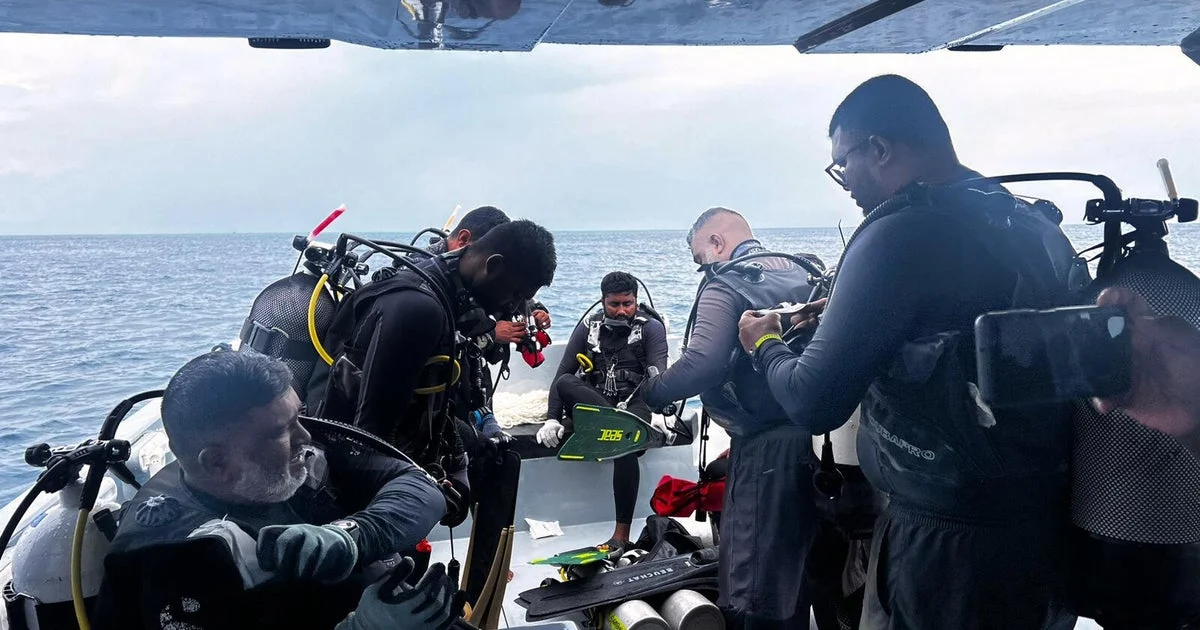
Three Finnish divers specializing in deep and cave diving arrived in the Maldives on Sunday to help plan a renewed search for the bodies of four Italian divers believed to be trapped inside an underwater cave system at Vaavu Atoll. The search was previously suspended after a Maldivian military diver died attempting to reach the missing divers.
The five Italian divers went missing while exploring a cave approximately 160 feet (50 meters) deep on Thursday, according to Italy’s Foreign Ministry. This depth significantly exceeds the local recreational diving limit of 98 feet (30 meters) in the Maldives.
The Maldivian National Defence Force (MNDF) reported that Mohamed Mahudhee, a member of the military diving team, died from decompression sickness after being hospitalized in the capital, Male, on Saturday. Mahudhee was buried with military honors in the presence of President Mohamed Muizzu, who had visited the search site to oversee the rescue efforts.
Following Mahudhee’s death, the new search strategy is being formulated in coordination with the Finnish cave diving experts and the Maldives coastguard. Rough weather has complicated earlier rescue attempts, and the initial search teams had entered and marked the cave entrance to aid recovery operations.
The missing Italians have been identified as Monica Montefalcone, an associate ecology professor at the University of Genoa; her daughter, Giorgia Sommacal; marine biologist Federico Gualtieri; researcher Muriel Oddenino; and diving instructor Gianluca Benedetti. Authorities recovered Benedetti’s body near the cave entrance on Thursday, while the other four divers are believed to be inside the cave system.
Montefalcone and Oddenino were in the Maldives conducting official scientific research on marine environments and climate change effects, but the dive during which the accident occurred was reportedly a private recreational activity, not part of the mission. Sommacal and Gualtieri were not involved in the scientific project.
Carlo Sommacal, husband of Montefalcone and father to Giorgia, expressed doubts about the accident’s circumstances on Italian television, highlighting the extensive diving experience of his wife and daughter.
The Italian tour operator managing the dive trip denied authorizing dives beyond the 30-meter limit, stating they were unaware of plans to exceed local depth restrictions. Technical diving beyond recreational limits requires special permissions and equipment, which the group reportedly did not use, according to the operator’s legal representative.
Cave diving is widely recognized as a high-risk sport that demands specialized training and gear. Divers face hazards such as disorientation and limited visibility in narrow, sediment-filled passages, with risks increasing at depths below standard recreational limits.
Italian officials describe the cave as having three chambers connected by tight passages. Recovery teams explored two chambers but had to halt operations due to oxygen and decompression constraints.
The Italian Foreign Ministry confirmed that about 20 other Italians on the expedition aboard the vessel Duke of York are safe. Italy’s embassy in Sri Lanka is providing support to those onboard and coordinating psychological assistance efforts through the Red Crescent.
The Maldives Tourism Ministry suspended the operating license of the Duke of York pending investigation into the incident.
Why it matters
The case highlights the dangers of exceeding regulated diving limits and underscores the challenges faced in cave diving rescue operations. The involvement of foreign expert divers reflects the complexity and risk of recovering bodies from underwater cave systems at significant depths. The investigation also raises questions about adherence to local regulations and safety protocols in international dive tourism.
Background
The Maldives enforces recreational diving limits of 30 meters to reduce risks associated with deep diving, which requires advanced training and equipment. Decompression sickness, a serious diving hazard caused by rapid ascent, has been a concern in this and prior incidents. Cave diving adds further complexity due to confined spaces and navigation challenges, factors that contributed to the suspension of initial rescue attempts after a fatality.
Sources
This article is based on reporting and publicly available information from the following source:
Read more World News stories on Goka World News.