
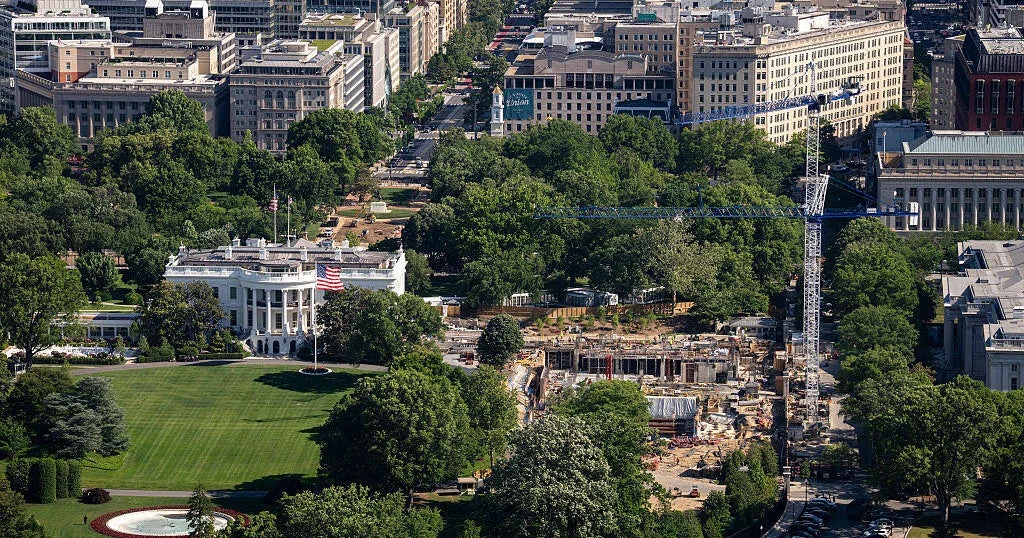
Senate Republicans are revising a funding provision for security upgrades tied to former President Donald Trump’s planned East Wing modernization, including a new ballroom, following a ruling by the Senate parliamentarian.
The disputed provision, part of a broader $72 billion bill to fund immigration enforcement within the Department of Homeland Security (DHS) through fiscal year 2029, originally included $1 billion allocated to the Secret Service for “security adjustments and upgrades” supporting the White House’s East Wing project.
Trump announced the East Wing overhaul in July 2025, which features revamped underground national security and healthcare facilities, alongside the proposed 90,000-square-foot ballroom. Senate Republicans indicated that about 20% of the Secret Service funds would specifically support security for this ballroom.
However, the Senate parliamentarian determined that this provision exceeded the jurisdiction of the Senate Judiciary Committee and violated the Byrd rule, which restricts provisions in budget reconciliation bills to matters directly related to the budget. This means the provision could not advance under the reconciliation process without 60 votes, a threshold the Republican majority lacks with its 53 seats.
Democrats criticized the provision, with Senate Budget Committee member Sen. Jeff Merkley stating that Republicans were prioritizing “a mission of chaos and corruption” over “the needs of the American people.” Senate Minority Leader Chuck Schumer also condemned the funds, warning that Democrats would fight the measure through procedural and legislative avenues.
Senate Republicans on the Judiciary Committee said that technical revisions to the bill are routine during reconciliation proceedings and confirmed that discussions and adjustments are ongoing to comply with Senate rules.
Previous parliamentarian rulings have also identified other parts of the immigration funding package as violating the Byrd rule, signaling ongoing challenges for Republicans in advancing the legislation without bipartisan support.
Why it matters
The parliamentarian’s ruling imposes a significant procedural barrier for Senate Republicans in using budget reconciliation to fund immigration enforcement and related projects, including the controversial White House ballroom security upgrades. With Republicans holding a slim majority, provisions requiring 60 votes face near-certain defeat, potentially delaying funding for key DHS agencies and affecting national security planning.
The dispute highlights the tension between legislative priorities—such as immigration enforcement—and high-profile expenditures linked to former President Trump’s initiatives, particularly those viewed unfavorably by the public, which could have political repercussions ahead of the 2026 midterm elections.
Background
Republicans have pursued funding for immigration enforcement agencies through budget reconciliation after Democrats repeatedly blocked appropriations for DHS immigration operations. The reconciliation process allows legislation to pass with a simple majority but is constrained by the Byrd rule, which limits content to budget-related items.
Senate rules and the parliamentarian’s role as arbiter ensure that reconciliation bills adhere to these limitations, shaping negotiations and often requiring changes to key provisions to secure passage without bipartisan support.
Sources
This article is based on reporting and publicly available information from the following source:
Read more Politics stories on Goka World News.