
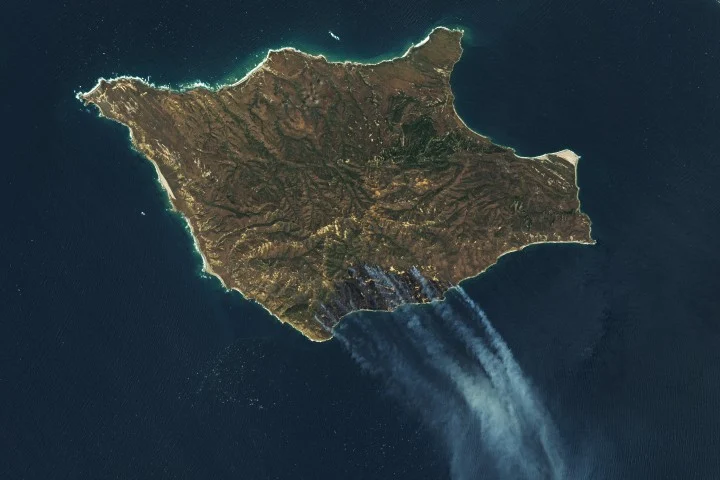
A wildfire ignited on May 15, 2026, on the southern side of Santa Rosa Island, the second-largest island in California’s Channel Islands National Park. The blaze rapidly spread through grassland, coastal sage scrub, and island chaparral, growing to consume approximately 16,600 acres by May 19. The National Park Service closed the island to visitors while firefighters worked to contain the fire.
The fire was first detected from aircraft on the morning of May 15 and confirmed by the National Park Service. Satellite imagery from Landsat 9, operated by the U.S. Geological Survey, captured the progression of the fire. False-color images revealed the extent of the burned area and active fire fronts, while natural color images showed thick smoke trailing over the Pacific Ocean.
Officials indicated the fire was human-caused, but investigators were still determining the exact circumstances as of May 19. The fire notably burned near a stand of Torrey pines, a rare pine species that naturally grows only on Santa Rosa Island and near San Diego in the United States.
Why it matters
Santa Rosa Island is part of Channel Islands National Park, often dubbed “North America’s Galapagos” for its ecological diversity and endemic species. The wildfire’s impact on rare and sensitive habitats, such as the Torrey pine stand, raises concerns over long-term ecological effects. The ongoing uncontained perimeter highlights challenges in managing wildfires on remote island ecosystems, especially those vulnerable to human activity.
Background
Channel Islands National Park consists of five islands off the coast of California, each hosting unique plant and animal communities. Santa Rosa Island is the second-largest island in the park and serves as critical habitat for numerous species. Wildfires in the park are infrequent but can be intensified by dry vegetation and limited firefighting access. The incident in May 2026 marks one of the more significant recent fires on the island, underscoring the vulnerability of island ecosystems to human-caused fires.
Sources
This article is based on reporting and publicly available information from the following source:
Read more Climate & Environment stories on Goka World News.