
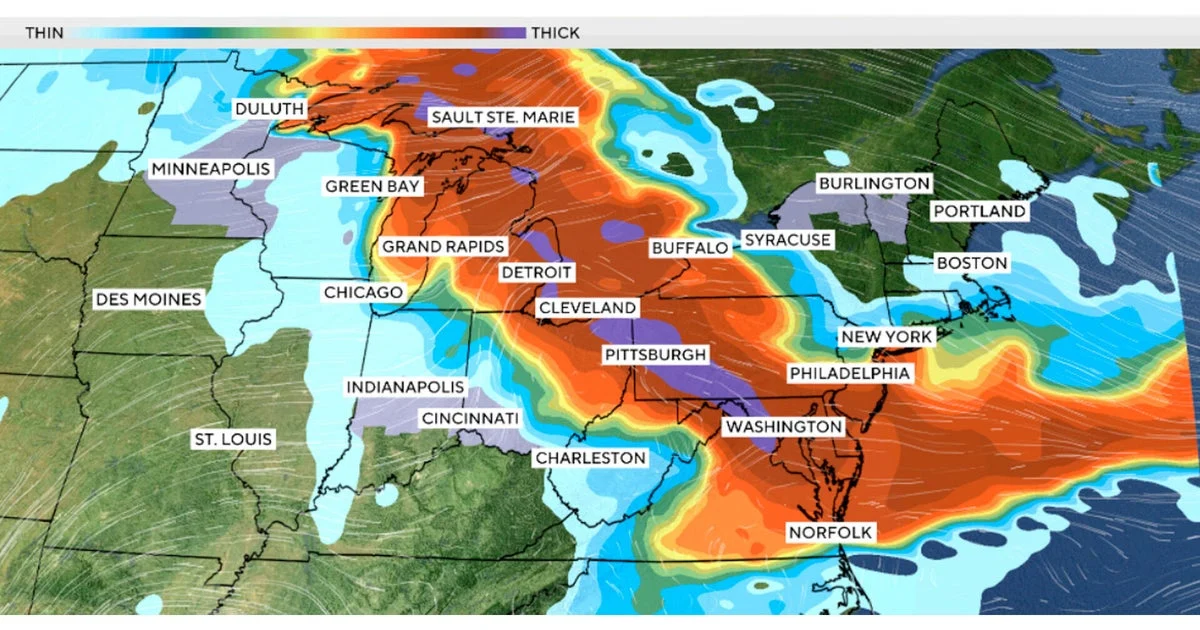
Wildfires raging in Canada and northern Minnesota have sent thick smoke across a vast swath of the United States, from the Midwest to the Northeast, causing hazardous air quality and prompting health alerts for millions of Americans. The smoke has degraded air quality in major cities, including Detroit and Washington, D.C., with some areas reaching dangerously unhealthy pollution levels.
What Happened
During July 16–17, 2026, hundreds of wildfires in Canada combined with multiple ongoing fires in Minnesota have produced vast smoke plumes driven southeastward by winds. This influx of wildfire smoke led to air quality alerts across at least a dozen U.S. states, including Michigan, Wisconsin, New York, New Jersey, Pennsylvania, Massachusetts, Vermont, New Hampshire, and Maine. The cities of Detroit and Washington, D.C., were ranked among the world’s most polluted urban centers on July 17. Minnesota officials issued statewide air quality alerts extending into the weekend, with the northeastern part of the state experiencing hazardous air pollution levels.
Key Facts
Authorities issued air quality alerts and advisories across multiple states, with Michigan placed entirely under an alert through at least Saturday. New Jersey and Pennsylvania issued Code Purple and Code Red air quality warnings, the latter indicating unhealthy air for all residents. Western New York remained under an air quality advisory while New York City experienced improving conditions from “unhealthy” to “moderate” on July 17.
Health officials and meteorologists warned that smoke fine particulate matter can cause respiratory problems, especially in sensitive groups, including children and those with heart or lung conditions.
The wildfire smoke rendered skies in some places an ominous yellow-brown hue, notably in Boston and parts of New England, as reported by state environmental departments and local CBS News bureaus.
The Canadian blazes alone encompass over 100 uncontrolled wildfires, driven by severe drought and heat. A notable incident near Armstrong, Ontario, involved a freight train trapped amid burning forests, prompting suspension of rail operations in the area.
What This Means
The widespread smoke represents a significant environmental and public health challenge across a broad region well beyond the immediate fire locations. Millions of people must contend with unhealthy air, exacerbating risks for respiratory and cardiovascular diseases and complicating management of chronic health conditions. The presence of such hazardous air quality can reduce outdoor activity and disrupt daily life, including major events like the World Cup final in New Jersey, which organizers are monitoring closely due to pollution concerns.
These events highlight how climate-driven extreme weather and drought can exacerbate wildfires and their transboundary impacts, stressing healthcare systems, affecting worker productivity, and raising public health costs. The disruption underscores the interconnectedness of environmental crises across national borders.
Background
Experts attribute the severity and frequency of these wildfires to a combination of prolonged drought conditions and rising temperatures linked to fossil fuel-driven climate change. Canadian and U.S. officials have invested billions in fire prevention, but current extreme conditions continue to challenge containment efforts.
What Remains Unclear
Casualty figures or specific damage assessments from the Canadian and Minnesota wildfires were not available in the sources. The complete duration of smoke impact and the full scale of health consequences remain uncertain as air quality alerts continue to evolve.
What Comes Next
Air quality alerts remain in effect across affected states into the coming weekend. Federal and local authorities continue to monitor the wildfire situation and track smoke dispersal, with public health advisories urging precautions such as staying indoors and using N95 or KN95 masks when outside.
Sources
This article is based on reporting and publicly available information from the following sources:
Read more Climate & Environment stories on Goka World News.