
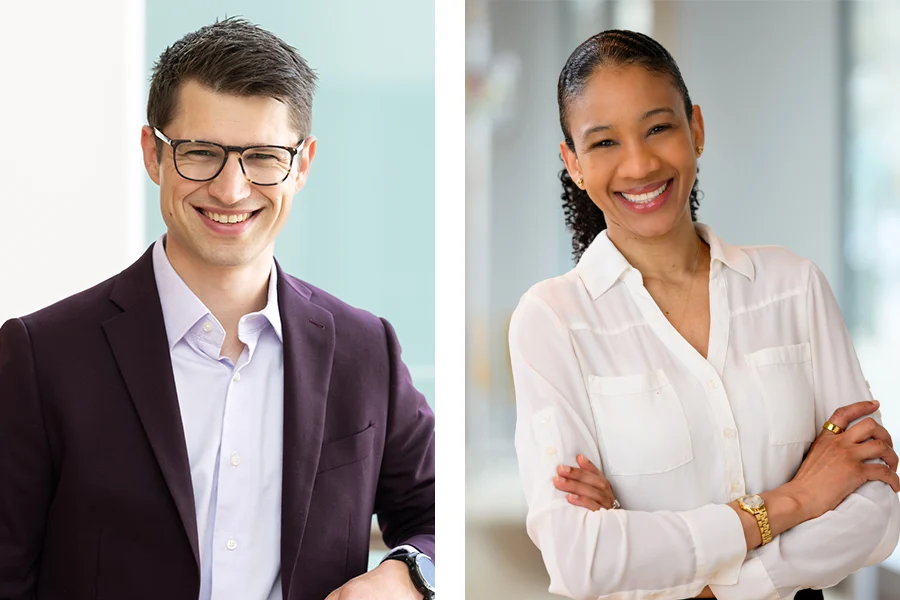
Four researchers affiliated with the Massachusetts Institute of Technology have been named 2026 Searle Scholars, each receiving $450,000 in flexible funding to advance their early-career research in biomedical sciences and chemistry.
The recipients include faculty members Sven Dorkenwald and Whitney Henry, along with alumni Irene Kaplow ’10 and Jared Mayers PhD ’15. The award, given annually to 15 exceptional young scientists, is selected by a scientific advisory board and recognizes innovative, high-risk research.
Searle Scholars from MIT Faculty
Sven Dorkenwald, an assistant professor in MIT’s Department of Brain and Cognitive Sciences and investigator at the McGovern Institute for Brain Research, focuses on computational neuroscience. His research aims to map and analyze synapse-resolution connectomes—the detailed neuronal wiring diagrams that underpin brain function. Dorkenwald’s work includes large-scale connectomic reconstructions of fruit fly and mammalian brains, shedding light on the architecture supporting complex neural computations. He joined MIT’s faculty in 2026 after earning degrees in physics, computer engineering, and a PhD in computer science and neuroscience.
Whitney Henry, assistant professor in the Department of Biology and a member of the Koch Institute for Integrative Cancer Research, investigates ferroptosis, an iron-dependent form of cell death. Her research explores how manipulating ferroptosis could target therapy-resistant cancer cell populations that drive metastasis and tumor relapse. Henry joined MIT in 2024 and holds the HHMI Freeman Hrabowski Scholar distinction. She has a background in biology and chemistry from Grambling State University and a PhD from Harvard University.
MIT Alumni Among Searle Scholars
Irene Kaplow ’10, now an assistant professor at Carnegie Mellon University, was recognized for her work deciphering transcriptional regulatory mechanisms linked to the evolution of mammalian dietary phenotypes. Kaplow graduated from MIT’s Department of Mathematics and integrates computational biology approaches in her research.
Jared Mayers PhD ’15, an assistant professor at the Fred Hutchinson Cancer Center at the University of Washington, received the award for developing a reverse-translational framework to identify metabolic vulnerabilities in bacterial pathogens. He completed his doctorate at MIT’s Department of Biology.
Why it matters
The Searle Scholars Program provides vital funding to early-career scientists pursuing innovative biomedical and chemical research that could lead to breakthroughs in understanding brain function, cancer therapy, and pathogen biology. The flexible support allows recipients to undertake high-risk, high-reward projects without restrictive constraints, fostering novel scientific directions.
The program is funded by the Searle Funds at The Chicago Community Trust and administered by the Kinship Foundation, illustrating the ongoing commitment to investing in transformative research talent.
Sources
This article is based on reporting and publicly available information from the following source:
Read more Science Discoveries stories on Goka World News.