
Neuroscientists at MIT’s Picower Institute for Learning and Memory have identified how neurons in the primary visual cortex organize their synaptic inputs to effectively process visual information. The findings, published in the open-access journal iScience, provide insights into how neurons select and integrate signals from thousands of synapses during visual perception.
Neurons Filter Synaptic Inputs Based on Location and Selectivity
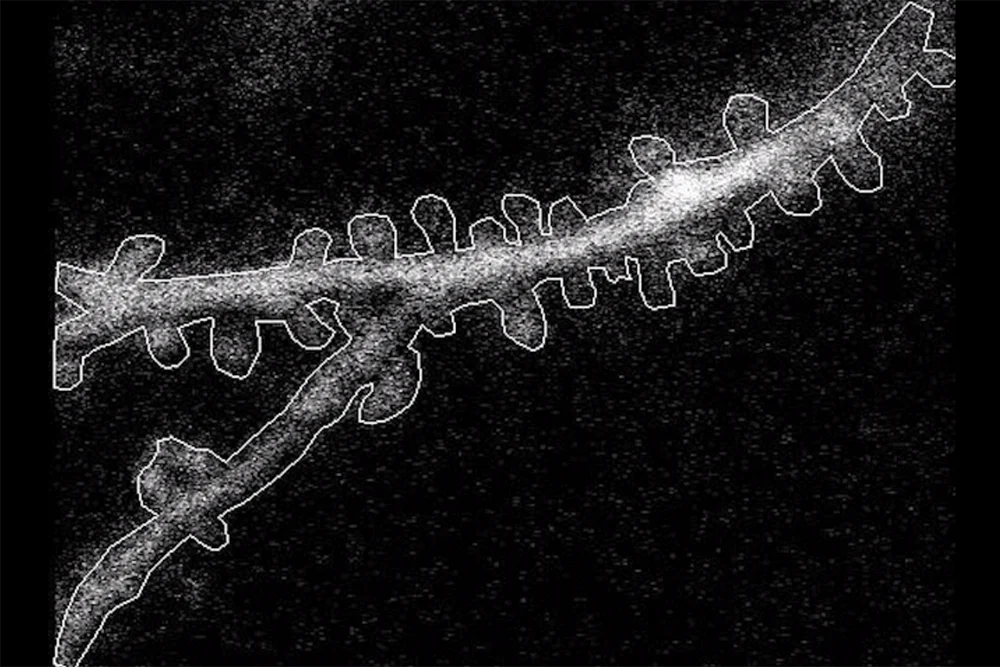
The research team, led by postdoctoral researcher Kyle Jenks and senior author Mriganka Sur, Newton Professor of Neuroscience, used genetically engineered mice with fluorescent markers that indicated calcium surges at individual dendritic spines—tiny protrusions where synapses form. By imaging these spines alongside entire neurons while mice viewed drifting black-and-white grating patterns, the scientists tracked how neurons and their synapses responded to specific visual stimuli.
This approach allowed the researchers to compare the responses of visual cortex layer 2/3 neurons that were either visually responsive or unresponsive. They found that spines closer to the neuron’s cell body (soma) showed responses more correlated with the overall neuronal activity than those farther away, suggesting spatial proximity influences synaptic contribution to neuron output.
Moreover, synapses formed clusters within approximately 5 microns on responsive neurons, acting as tightly coordinated enclaves, while spines outside these clusters were less likely to exhibit correlated activity. This spatial organization could amplify and sharpen the neuron’s response to visual stimuli.
Dendritic Branch Type and Orientation Selectivity Are Key Factors
The study differentiated between two dendrite types: apical dendrites, which receive diverse cortical inputs and extend from the neuron’s apex, and basal dendrites, which primarily receive raw visual signals. Although basal dendrites overall had more visual input, apical dendrites on visually responsive neurons contained significantly more visually active spines compared to those on non-responsive neurons.
Using statistical modeling, the researchers determined that the most critical factor predicting how well a synapse’s activity matched the neuron’s output was the synapse’s orientation selectivity—how tuned it was to the preferred angle of the visual stimulus. Other factors such as distance from the soma and dendrite type also influenced synaptic integration but to a lesser extent.
Why it matters
Understanding these organizational rules provides a fundamental framework for studying visual processing in the brain. It offers a baseline to investigate how genetic mutations that disrupt neuronal connectivity might impair visual functions. Additionally, the findings can inform computational models of how neurons integrate complex synaptic inputs during sensory perception.
Background
The primary visual cortex is crucial for interpreting visual signals from the eyes, transforming raw inputs into meaningful representations of the environment. Each neuron receives thousands of synaptic inputs, but only a subset effectively influences neuronal firing. This study clarifies how neurons discriminate among these inputs to reliably process orientation-specific visual stimuli—a key aspect of visual cognition.
The research was supported by the National Institutes of Health, the Simons Foundation Autism Research Initiative, and the Freedom Together Foundation. Besides Jenks and Sur, other contributors include Gregg Heller, Katya Tsimring, Kendyll Martin, Asrah Rizvi, and Jacque Pak Kan Ip.
Sources
This article is based on reporting and publicly available information from the following source:
Read more Science Discoveries stories on Goka World News.