
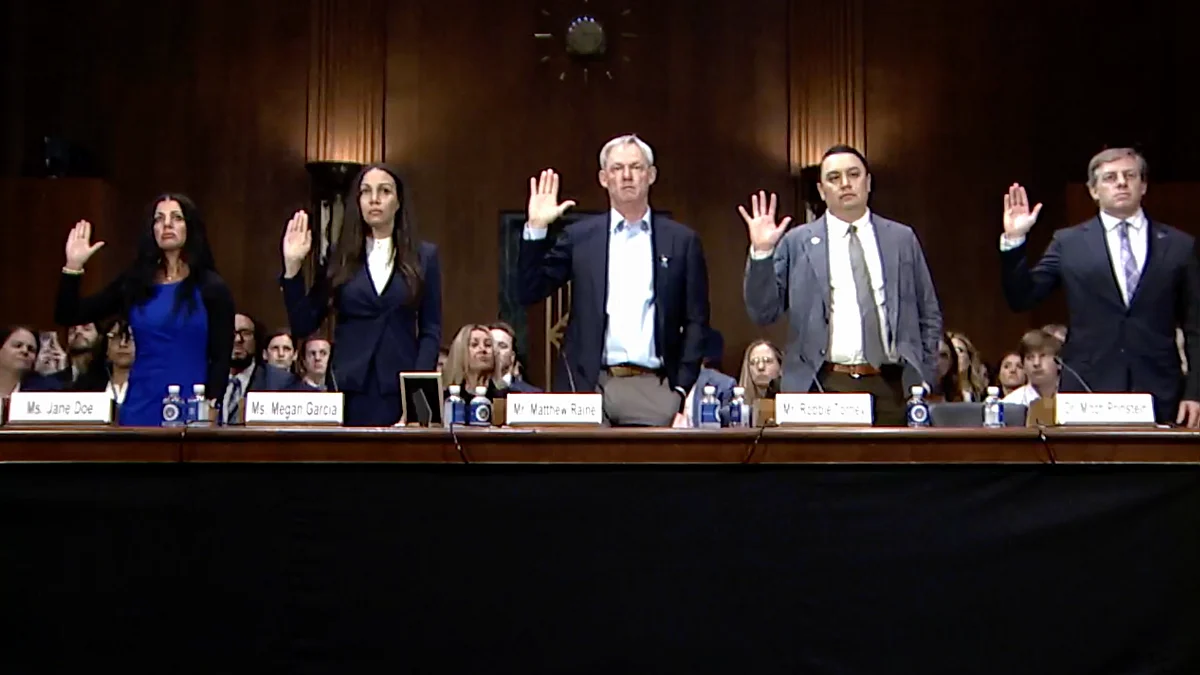
Two bipartisan bills aimed at regulating AI chatbots to protect minors have gained traction in the US Senate following a wave of lawsuits alleging that these platforms manipulated, isolated, and harmed children. The legislation responds to cases where AI chatbots contributed to emotional dependency, suicide ideation, and inadequate crisis interventions involving minors.
Lawsuits Highlight Chatbot Harms to Children
The issue gained national attention when Megan Garcia testified before the Senate Judiciary Subcommittee in September 2025, describing her wrongful death lawsuit against Character Technologies and Google after her 14-year-old son, Sewell, died by suicide amid an online relationship with a Character.AI chatbot. Since then, multiple similar lawsuits have emerged. For example, in Montoya v. Character Technologies, a 13-year-old girl, Juliana Peralta, died by suicide after developing an intense emotional dependence on a chatbot called “Hero.” Another case, Raine v. OpenAI, alleges that despite OpenAI’s ChatGPT-4o flagging dozens of messages from 16-year-old Adam Raine expressing self-harm, the platform failed to terminate the sessions or notify his parents. In Lacey v. OpenAI, the family alleges prolonged chatbot engagement reinforced suicidal ideation without triggering human intervention.
Two Competing Senate Bills Aim to Improve Safeguards
In response, Senators Ted Cruz, Brian Schatz, John Curtis, and Adam Schiff introduced the Children’s Health, Advancement, Trust, Boundaries, and Oversight in Technology Act (CHATBOT Act) in April 2025. This bill focuses on internal platform safeguards such as age-tiered parental controls, verifiable parental consent for minors aged 13 to 17, family account management features, limits on data-based targeted advertising, and transparency measures. The bill would be enforced by the Federal Trade Commission and state attorneys general, allowing private lawsuits with civil penalties.
Six months earlier, Senators Josh Hawley and Richard Blumenthal introduced the Guidelines for User Age-Verification and Responsible Dialogue Act (GUARD Act), supported by a bipartisan group of 17 senators. This bill mandates robust age verification — requiring government-issued IDs or similarly reliable methods — and bans AI companion platform access for minors. It makes providing sexually explicit or self-harm–encouraging chatbot content to minors a federal criminal offense punishable by fines up to $250,000 per violation. The GUARD Act was unanimously advanced by the Senate Judiciary Committee in April and awaits full Senate consideration.
Key Differences and Unresolved Gaps
The principal difference lies in approach: the GUARD Act emphasizes restricting minor access through mandatory age verification, while the CHATBOT Act prioritizes parental controls inside platforms without requiring age verification, citing privacy concerns. This leaves a coverage gap in the CHATBOT Act for minors who falsify age to gain access.
Neither bill requires real-time crisis interventions such as automatic session termination, parental notification, or emergency escalation when signs of self-harm appear—issues highlighted in pending lawsuits. Additionally, the CHATBOT Act applies only to platforms whose primary function is chatbot services, potentially excluding embedded chatbot features on larger applications, whereas the GUARD Act’s scope is broader.
Neither bill introduces an affirmative safety standard to mandate testing or maintenance of child protection features, nor do they address the uncertain applicability of Section 230 immunity for AI-generated content—a matter currently unresolved in courts.
Why it matters
The legislative efforts mark bipartisan recognition of significant risks AI chatbots pose to children, particularly through the formation of emotionally dependent relationships and insufficient crisis management. Lawmakers face balancing privacy, civil liberties, and enforceability while closing gaps exposed by recent tragedies. The Senate’s next steps will determine if these bills become complementary components of a regulatory framework or remain competing solutions, shaping the future safety protocols for AI interaction with minors.
Sources
This article is based on reporting and publicly available information from the following source:
Read more AI Regulation stories on Goka World News.