
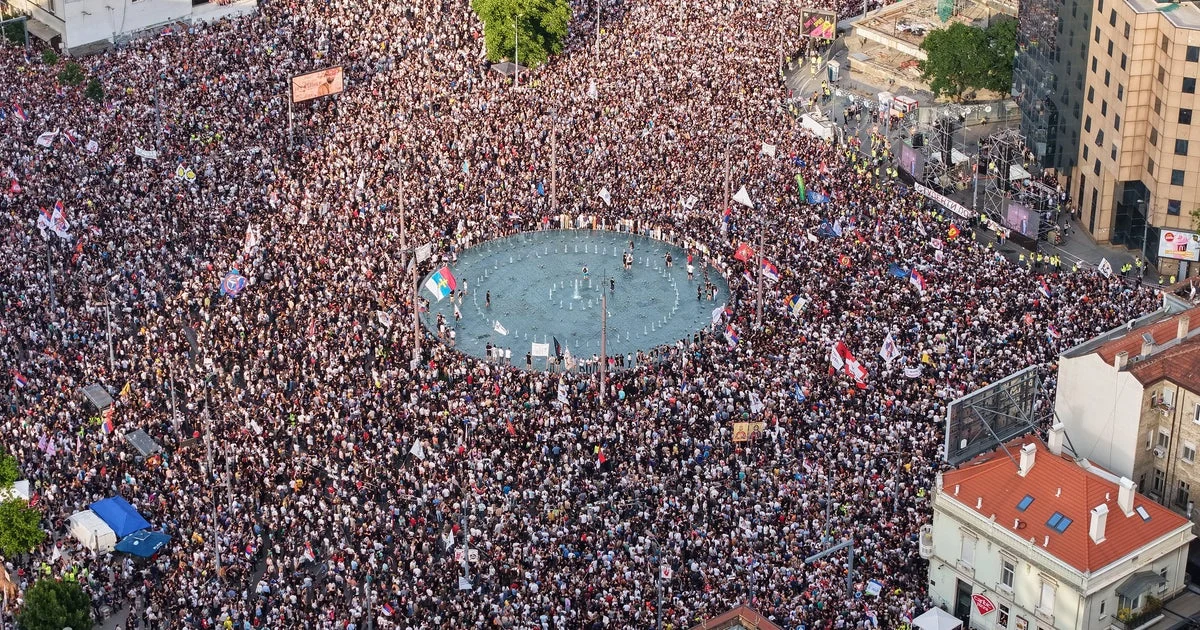
Tens of thousands of protesters participated in a large anti-government rally on May 23 in Belgrade, Serbia, led primarily by university students calling for major political changes, including early elections and the rule of law. The rally highlighted persistent public dissent against President Aleksandar Vucic, whose government has faced criticism over corruption and autocratic tendencies.
The peaceful demonstration in central Belgrade’s Slavija Square was followed by clashes between groups of young protesters and riot police. These confrontations escalated as protesters threw flares, rocks, and bottles while police responded with pepper spray and advanced to disperse the crowds. Police used anti-riot vehicles to block demonstrators from reassembling, and the violence eventually subsided.
The student-led movement revived concerns stemming from a tragic train station accident in northern Serbia in November 2024, which killed 16 people. Many Serbians blamed alleged graft and negligent renovation work involving Chinese companies for the incident. The ongoing protests have pressured the government since then, culminating in the resignation of former Prime Minister Milos Vucevic in January 2025 following anti-corruption demonstrations.
During Saturday’s rally, Prosecutor Bojana Savovic condemned selective law enforcement and called the Serbian state a “mafia organization” due to corruption and impunity accusations. The protesters expressed frustration with entrenched political elites and demand accountability and transparency in governance.
President Vucic responded via an Instagram video, condemning protesters for violence and reaffirming that the state functions within the law. He departed for a state visit to China shortly after making the remarks. Meanwhile, Serbian authorities had canceled all train services into Belgrade to limit the influx of demonstrators from other regions.
The crackdown on protests and broader human rights situation in Serbia have drawn international criticism. The Council of Europe Commissioner for Human Rights, Michael O’Flaherty, recently warned of deteriorating rights conditions, citing reports of police shielding masked assailants attacking journalists and demonstrators.
Despite Serbia’s formal bid for European Union membership, the government’s autocratic actions threaten critical EU funding, with warnings of potential losses amounting to 1.5 billion euros. The political climate remains highly polarized, with pro-government forces branding critics as foreign agents seeking national destabilization.
The student movement hopes to challenge Vucic and his ruling party in elections expected between September and November 2026. Their campaign has galvanized many citizens disillusioned by decades of political instability.
Why it matters
The protest underscores continuing public resistance to authoritarian governance in Serbia and emphasizes demands for democratic reforms amid stalled EU accession talks. The international community is closely monitoring the country’s civil rights situation, which could influence Serbia’s future aid and integration prospects.
Background
Mass protests erupted across Serbia after a deadly train station accident in November 2024 exposed alleged corruption and negligence linked to renovation projects involving Chinese companies. These demonstrations have persisted, evolving into a broader movement led by youth demanding transparency, justice, and political accountability. Previous mass rallies in Belgrade, including a major one in March 2025, ended with violent disruptions and drew significant domestic and foreign attention to Serbia’s internal political struggles.
Sources
This article is based on reporting and publicly available information from the following source:
Read more World News stories on Goka World News.