
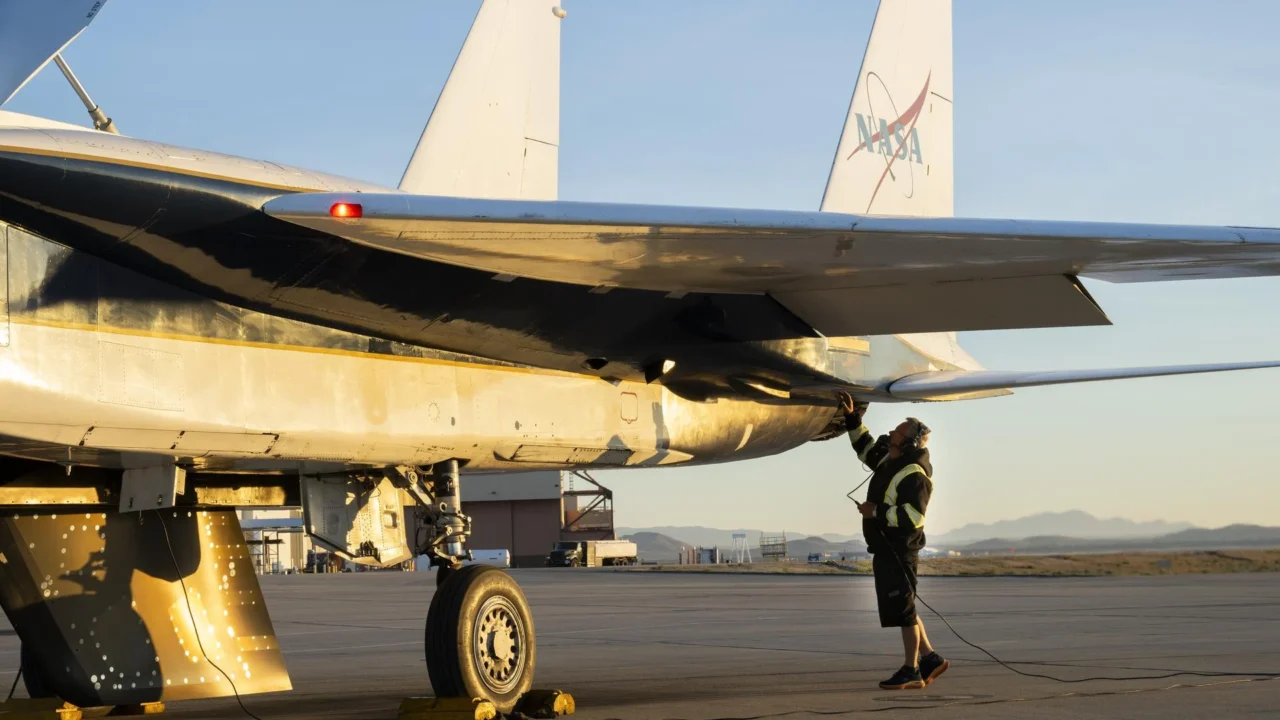
NASA’s Armstrong Flight Research Center in Edwards, California relies on specialized maintenance crews to keep its diverse fleet of aircraft safe, reliable, and mission-ready. This year, the center added two F-15s and a Pilatus PC-12 to complement existing platforms such as the high-altitude ER-2 and the experimental X-59 X-plane.
Each aircraft serves unique roles ranging from high-speed research and science missions to support operations like NASA rocket launches. Maintenance teams manage a wide variety of tasks including loading instruments, reconfiguring aircraft, repairing systems, and performing scheduled maintenance and hardware replacements.
Jose “Manny” Rodriguez, a Gulfstream G-IV crew chief at Armstrong, emphasized the crews’ adaptability: “One day you could have an instrument being loaded, and the next day it may be aircraft reconfiguration, all while other aircraft systems may need fixing. They adapt and they overcome any situation.”
Operational Demands on Maintenance Teams
The maintenance staff continuously inspects and services critical components such as ejection seats, fuel tanks, brakes, wheels, wiring, and avionics to ensure aircraft can perform as intended. On any given day, multiple Armstrong aircraft may be airborne supporting missions globally.
Currently, Armstrong’s C-20A is deployed to Peru and Panama, the X-59 frequently flies twice daily accompanied by a chase plane, and the ER-2 operates in Colorado supporting the Geological Earth Mapping Experiment (GEMx). Meanwhile, the crews remain ready to respond rapidly if an aircraft returns early or requires unplanned repairs.
Composition and Responsibilities of Crews
The maintenance teams comprise a crew chief, avionics technicians, quality assurance personnel, and additional mechanics. Crew chiefs hold primary responsibility for the aircraft’s integrity and safety, formally certifying flight readiness alongside the pilot.
Rodriguez noted that the workforce includes both military and civilian mechanics who gain expertise through extensive on-the-job training. After maintenance, the aircraft are towed to the flightline where pilots conduct final safety checks with the crew chiefs before missions commence.
Why it matters
NASA Armstrong’s maintenance operations underpin the agency’s ability to conduct cutting-edge aeronautics research and scientific experiments. Their work ensures aircraft sustain performance across varied mission profiles, advancing aerospace knowledge and technology safely and reliably.
Sources
This article is based on reporting and publicly available information from the following source:
Read more Space & NASA stories on Goka World News.