
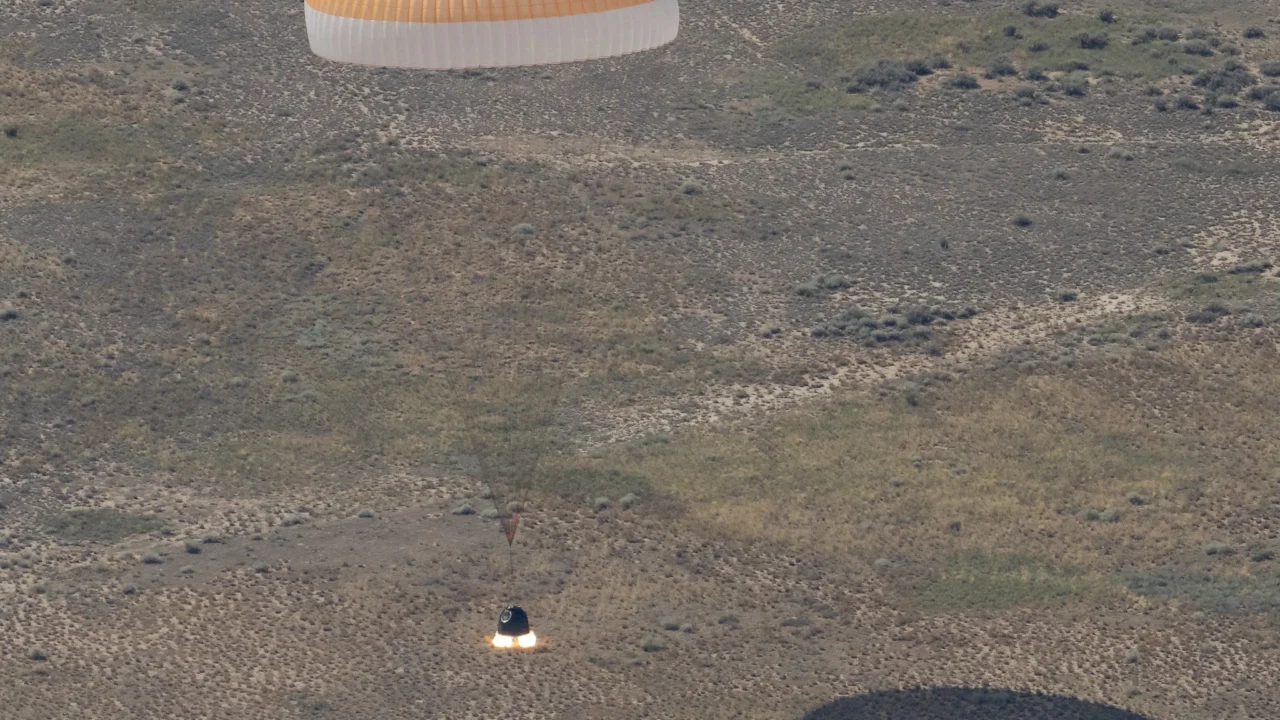
NASA astronaut Chris Williams, along with Roscosmos cosmonauts Sergey Kud-Sverchkov and Sergei Mikaev, safely returned to Earth following an eight-month mission aboard the International Space Station (ISS). The crew’s parachute-assisted landing occurred early Sunday southeast of Dzhezkazgan, Kazakhstan, marking the conclusion of their long-duration spaceflight.
What Happened
Williams and his crewmates departed the ISS at 2:03 a.m. CDT on Sunday, returning aboard the Soyuz MS-28 spacecraft. The trio touched down at 5:27 a.m. CDT (3:27 p.m. local time) after spending 241 days in orbit. They completed 3,856 orbits around Earth and traveled more than 102 million miles during their mission, which began with their launch to the station on November 27, 2025.
This mission marked Williams’ and Mikaev’s first trip to space, while Kud-Sverchkov was on his second. During their time aboard the orbiting laboratory, Williams contributed to a variety of scientific projects and technology demonstrations. His work included advancing research for new cancer treatments and improving methods for manufacturing materials used in high-performance electronics and computers. Additionally, Williams performed two spacewalks, preparing the station’s power system for upgrades and repairing a malfunctioning joint on the Canadarm2 robotic arm.
Key Facts
The crew spent a total of 241 days in space, orbiting Earth 3,856 times and covering over 102 million miles. They launched to the ISS on November 27, 2025, aboard the Soyuz MS-28. Their return involved a parachute-assisted landing near Dzhezkazgan, Kazakhstan, at 5:27 a.m. CDT on Sunday. Following landing, the crew underwent medical checks and were transported by helicopter to Karaganda, Kazakhstan, before Williams continued to the NASA Johnson Space Center in Houston by aircraft.
What This Means
This successful return from a long-duration mission underscores the ongoing significance of the ISS as a platform for scientific research and human spaceflight experience. The projects conducted by Williams and his colleagues not only deepen our understanding of cancer therapies and material production but also demonstrate the viability of complex maintenance tasks in space such as power system upgrades and robotic arm repairs.
Moreover, the crew’s mission contributes valuable insights to NASA’s preparations for future exploration beyond low Earth orbit, including upcoming Artemis missions to the Moon and eventual human expeditions to Mars. Their extended stay aboard the ISS provides critical data on human health and technology performance in microgravity, which are essential for planning longer, more distant journeys.
Background
The ISS has hosted continuous human presence for over 25 years, serving as a critical research hub for international partners. It enables studies not possible on Earth and helps address challenges related to long-term human spaceflight, commercial utilization of low Earth orbit, and preparations for lunar and Martian exploration.
What Comes Next
Following their return, NASA will analyze data and samples collected during this mission to inform ongoing and future research. Williams will participate in post-mission debriefs and continue work supporting NASA’s human spaceflight programs. The ISS continues to operate with rotating crews conducting experiments and station maintenance as planned.
Sources
This article is based on reporting and publicly available information from the following sources:
Read more Space & NASA stories on Goka World News.