
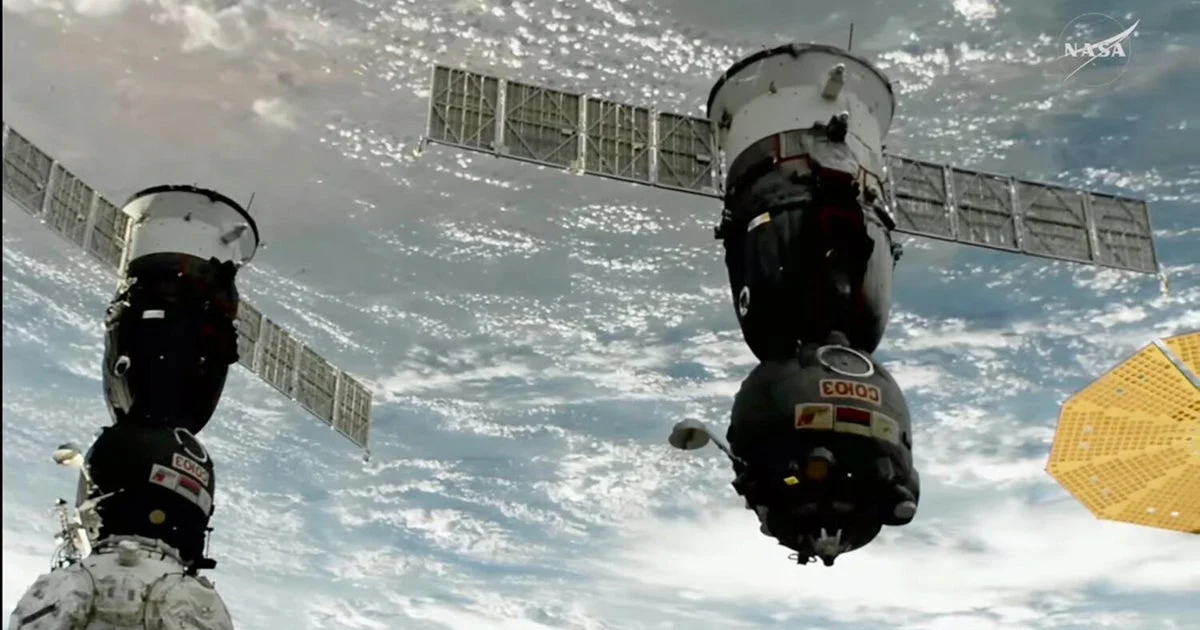
After spending eight months aboard the International Space Station (ISS), NASA astronaut Chris Williams and Russian cosmonauts Sergey Kud-Sverchkov and Sergey Mikaev returned safely to Earth early Sunday, landing on the Kazakh steppe to conclude their long-duration mission.
What Happened
At 3:03 a.m. EDT on July 26, the crew aboard the Soyuz MS-28/74S spacecraft undocked from the Russian Rassvet module of the ISS. The vehicle then gradually backed away from the orbital laboratory before firing its braking rockets approximately two and a half hours later. The four-minute, 42-second burn slowed the spacecraft sufficiently for atmospheric re-entry.
Following the fiery descent, the Soyuz’s parachute deployed, allowing for a 10-minute controlled landing near Dzhezkazgan, Kazakhstan, at 6:27 a.m. EDT (3:27 p.m. local time). Russian recovery teams quickly reached the capsule to assist the crew, who had just completed 241 days in orbit, traveling 3,856 times around Earth and covering 102 million miles since their launch on November 27.
Key Facts
The crew consisted of Soyuz commander Sergey Kud-Sverchkov, making his second spaceflight following a 185-day mission in 2020-2021; flight engineer Sergey Mikaev on his first spaceflight; and NASA astronaut Chris Williams, also on his first mission. During the flight, Williams participated in two spacewalks focused on robotic arm maintenance and the installation of new solar arrays, while the Russians performed an additional spacewalk for segment upkeep.
Upon landing, all three were given personalized Russian nesting dolls, a traditional welcome gift. After removing their pressure suits, the astronauts were transported by helicopter to Karaganda, about 285 miles from the landing site. Williams was scheduled to catch a NASA jet back to the Johnson Space Center in Houston, while his crewmates planned to return to Star City, Russia.
Before departure, a change-of-command ceremony took place aboard the ISS, transferring station leadership to NASA Crew 12 commander Jessica Meir. Also currently onboard the station are Crew 12 members and Soyuz MS-29/75S cosmonauts and astronauts, who arrived July 14 to replace the MS-28 team. The next crew rotation involving NASA personnel is set for September 12 launching from Florida.
What This Means
The successful return of Williams and his colleagues underscores the continuing collaboration between NASA and Roscosmos, maintaining uninterrupted human presence and scientific research aboard the ISS. For ordinary Americans and space enthusiasts alike, such missions exemplify international partnerships in space exploration despite geopolitical tensions elsewhere.
Williams’ mission also highlights the blend of science and human experience intrinsic to long-duration spaceflight. His reflections about gaining new appreciation for Earth’s beauty and the curiosity that fuels exploration connect to broader public interest in science and space. The mission’s scientific and maintenance activities contribute directly to the station’s ongoing function, enabling future research that could pave the way for deeper space missions.
Background
The Soyuz MS-28 crew launched from Baikonur Cosmodrome, Kazakhstan, last November, joining an international team conducting varied scientific experiments and essential station maintenance. The Soyuz spacecraft’s reliable design continues to be fundamental for transferring crews between Earth and the ISS, complementing recent commercial crew vehicles developed by NASA partners.
Chris Williams, a former firefighter and medical physicist, was selected for NASA’s astronaut corps in 2021 and earned a doctorate in astrophysics from MIT. This mission marks his first spaceflight, achieving a lifelong dream with notable contributions during his 241-day stay.
What Comes Next
The returned crew members will undergo medical evaluations and rehabilitation to readjust to Earth’s gravity. Meanwhile, the current ISS residents continue the station’s research and maintenance. NASA plans to launch its next crew in September, continuing the steady rotation of personnel vital to the ISS’s mission.
Sources
This article is based on reporting and publicly available information from the following source:
Read more Space & NASA stories on Goka World News.