
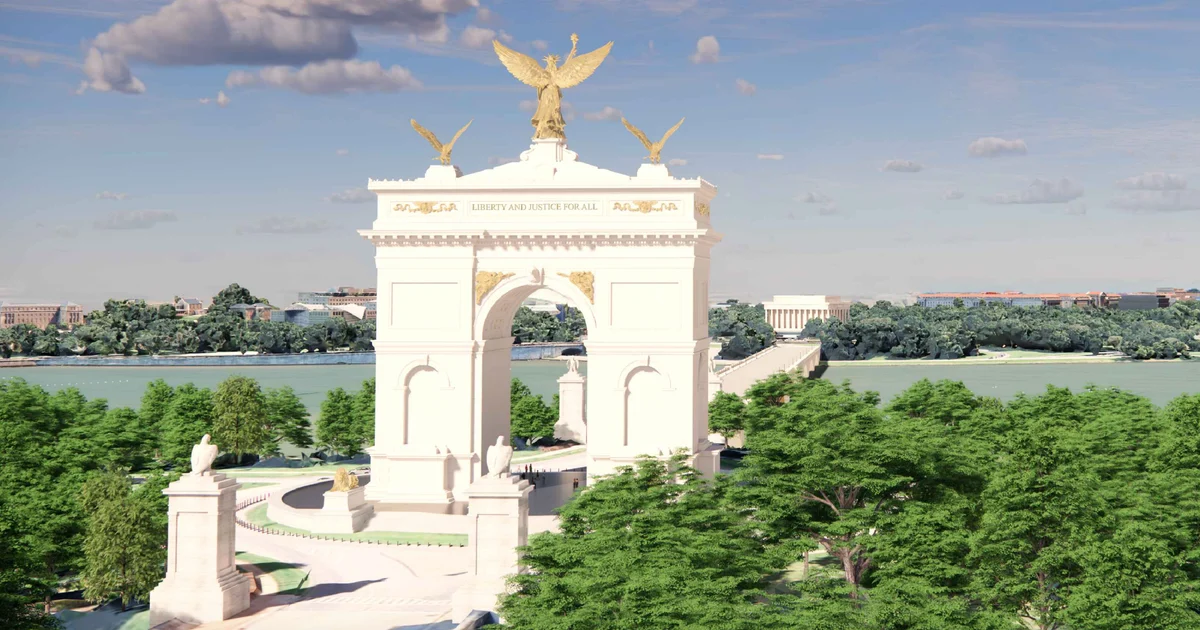
Two Vietnam veterans, Shaun Byrnes and Jon Gundersen, have filed a lawsuit aimed at stopping the construction of a 250-foot arch proposed by former President Donald Trump near Arlington National Cemetery. The arch is planned to be erected in a traffic circle between Arlington National Cemetery and the Lincoln Memorial.
The veterans argue that the project has been expedited without proper congressional authorization and that the monument would disrupt a historically significant sightline connecting the Lincoln Memorial and the nearby Robert E. Lee Memorial. According to the lawsuit, this sightline symbolizes unity following the Civil War and the proposed arch—more than twice the height of the Lincoln Memorial—would undermine that symbolism.
Byrnes, a Navy veteran who served two tours in Vietnam, emphasized that his involvement in the suit stems from respect for fallen comrades buried in Arlington and a sense of duty to those who did not return. Gundersen, a retired Army Special Forces officer, framed their legal challenge as an act of loyalty to the nation, separate from partisan concerns.
The Justice Department has sought dismissal of the lawsuit on the grounds that the plaintiffs lack proper legal standing. While Congress has not formally voted on the project, administration officials have referenced a century-old plan envisioning the construction of two tall columns—166 feet each—to honor the North and South.
Last month, a federal judge denied a motion to temporarily halt the arch’s construction, which has not yet started. The U.S. Commission of Fine Arts recently approved the project despite a public outcry in which officials noted unanimous opposition in the public comments submitted. The final approval may come soon from an urban planning commission aligned with administration interests.
The arch, which has been nicknamed the “Arc de Trump,” was personally promoted by Mr. Trump as a centerpiece for America’s 250th anniversary celebrations. When asked who the monument is meant to honor, Mr. Trump responded, “Me.”
Gundersen and Byrnes, both with experience in diplomatic and military roles in former Soviet states, noted that the monument evoked imagery of authoritarian regimes where grand monuments celebrate leaders rather than collective history. Gundersen criticized the arch’s funding model, which Mr. Trump suggested would rely on private donations, warning it risks undue influence from wealthy donors.
Why it matters
The lawsuit raises important constitutional and symbolic questions about presidential authority, congressional oversight, and the preservation of national memorial landscapes. Advocates for the monument see it as a patriotic celebration, while critics warn it threatens to personalize and politicize a space traditionally dedicated to collective sacrifice and unity.
Background
Arlington National Cemetery is a sacred military burial ground with numerous historic landmarks nearby, including the Lincoln Memorial and the Robert E. Lee Memorial. The proposed arch references triumphal monuments such as the Parisian Arc de Triomphe and reflects longstanding debates over how best to commemorate America’s history and leadership.
Sources
This article is based on reporting and publicly available information from the following source:
Read more US News stories on Goka World News.