
Amazon Web Services (AWS) has introduced a significant innovation in data center networking, deploying a new quasi-random design called Resilient Network Graphs (RNG) that enhances data speeds while reducing energy consumption and infrastructure costs. The company quietly implemented this technology in its data centers starting in late 2024.
What happened
The RNG design merges structured and random network elements to create a flat, efficient, and resilient architecture, overcoming longstanding bottlenecks inherent in traditional “fat-tree” topologies used since the 1980s. Unlike the vertically layered fat-tree networks, RNG flattens the data flow paths, enabling quicker and more flexible data transmission.
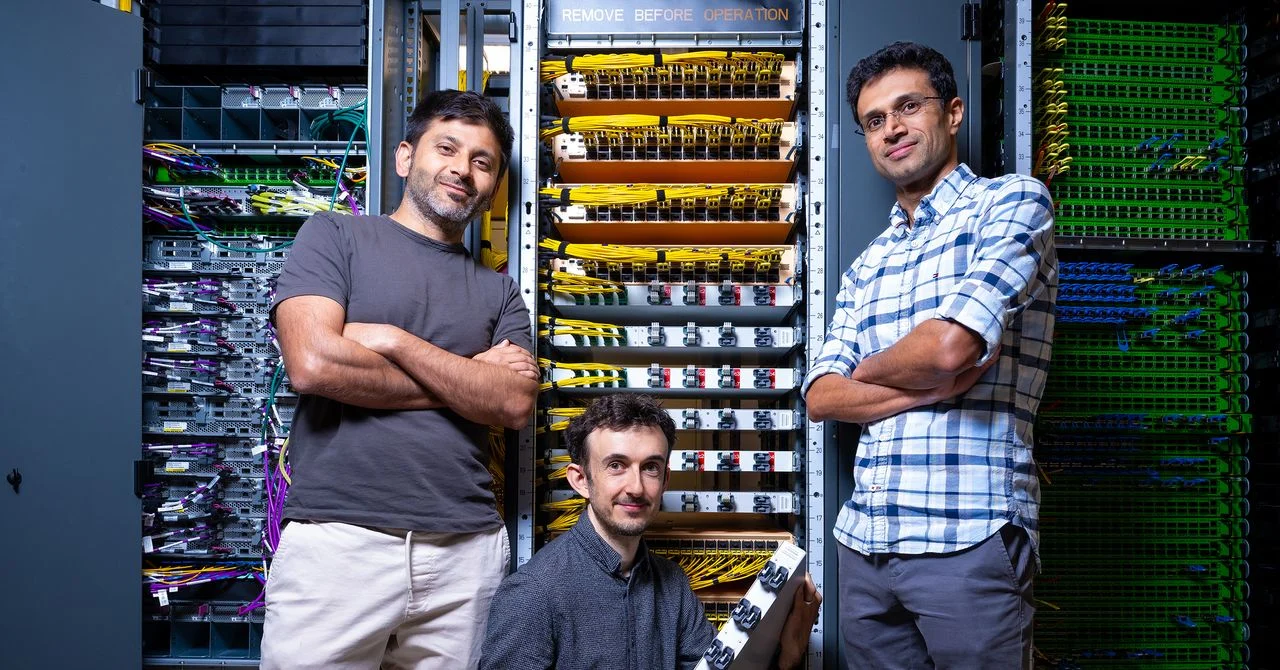
To facilitate this architecture, AWS developed a new hardware component called the ShuffleBox, an optical device that dynamically mixes cable connections internally, simplifying the historically complex and bulky cabling infrastructure required in data centers. This innovation reduces cabling complexity, a major cost and operational challenge for AWS’s global data centers, which currently utilize around 20 million kilometers of fiber-optic cables.
AWS reports that RNG uses 69% fewer routers and switches compared to traditional networks, increases data throughput by 33%, cuts network power use by 40%, and lowers operational expenses by 27%. The technology was first deployed in an AWS data center in Dublin in 2024 and has since expanded to facilities in Germany and Spain, with plans to integrate RNG in most newly built data centers.
Why it matters
This breakthrough addresses pressing challenges in cloud infrastructure scalability and energy efficiency, key factors as demand for faster, more reliable data centers grows worldwide. By significantly enhancing performance and reducing costs and power consumption, AWS strengthens its competitive edge in cloud services. The RNG network also marks a rare successful large-scale implementation of random network topologies, which researchers have explored for decades but struggled to scale practically.
As data center energy use becomes a growing environmental and financial concern, innovations like RNG contribute to more sustainable cloud computing operations. Furthermore, the deployment of RNG could influence industry-wide network design standards and accelerate similar advancements across other major tech companies.
Background
Traditional data center networks are commonly built on fat-tree topologies, designed to reduce bottlenecks by hierarchically arranging switches and routers. However, these designs are rigid, complex, and involve extensive cabling. In 2012, researchers from the University of Illinois Urbana-Champaign proposed a random network model called Jellyfish, aiming to create more flexible and scalable networks. Despite its potential, practical challenges in routing and cabling delayed adoption.
Industry leaders, including Google, experimented with optical circuit switching to add flexibility but faced high costs and engineering complexities. AWS’s RNG introduces a hybrid “quasi-random” network that embraces randomness in network design while maintaining manageability and scalability, powered by the custom ShuffleBox for cable management.
This project, initiated in 2023 by AWS engineers and researchers—including academics recruited from the University of Illinois—has achieved what experts consider a fundamental advance in data center network architecture.
Sources
This article is based on reporting and publicly available information from the following source:
Read more Major Tech Companies stories on Goka World News.