
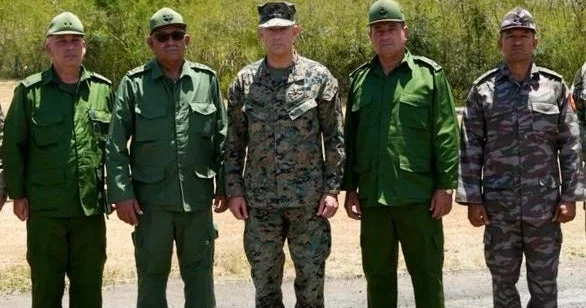
General Francis Donovan, head of the U.S. military’s Southern Command (SOUTHCOM), held a meeting with senior Cuban military officials at the perimeter of the U.S. naval base at Guantanamo Bay on May 29, 2026. The meeting occurred amid increasing tensions between the United States and Cuba under the Trump administration’s hardline approach.
What happened
The U.S. Southern Command confirmed that General Donovan engaged in a “brief exchange on operational security matters” with Cuban General Roberto Legrá Sotolongo, First Deputy Minister of the Chief of the General Staff. Cuba’s defense ministry described the encounter as “positive,” noting that both sides discussed “topics of interest to both parties.”
While procedural “fence-line meetings” between American and Cuban officers near Guantanamo Bay have taken place in the past to manage security concerns, it is unusual for the head of SOUTHCOM to participate in such discussions. SOUTHCOM oversees U.S. military operations across the Caribbean and most of Latin America.
This high-level engagement follows recent visits to Havana by CIA Director John Ratcliffe and State Department diplomats, signaling a strategic outreach amidst the Trump administration’s growing pressure on Cuba. The administration has imposed tighter sanctions, criminally charged former Cuban leader Raúl Castro, and threatened tariffs on oil-exporting countries that assist Cuba, contributing to energy shortages on the island.
Why it matters
The meeting highlights ongoing efforts for direct military and security communication between the U.S. and Cuba despite escalating political and economic confrontations. The Trump administration has emphasized demands for substantial political and economic reforms in Cuba and has not ruled out military options if these demands are unmet.
President Trump has publicly indicated interest in “taking Cuba in some form” following planned military action against Iran, raising concerns about regional stability. U.S. intelligence agencies have evaluated potential Cuban responses, including Cuba’s acquisition of attack drones and the presence of alleged Chinese and Russian intelligence operations on the island.
Cuban President Miguel Díaz-Canel denied any threat to U.S. security but warned that a U.S. military strike could result in severe consequences. The meeting at Guantanamo Bay may represent an attempt to manage operational risks amid these tensions.
Background
Guantanamo Bay has been a longstanding point of contention between the U.S. and Cuba since the naval base was established before the Cuban Revolution. The Trump administration’s recent Cuba policy marks a significant shift toward confrontation, reviving Cold War-era hostilities. Previous interactions at Guantanamo have focused mainly on limiting direct conflict or incidents near the base.
Recent U.S. diplomatic engagement, including visits from intelligence and diplomatic officials, reflects efforts to negotiate from a position of strength, with the U.S. pressing for “fundamental changes” in Cuba’s governance and international alignments.
Sources
This article is based on reporting and publicly available information from the following source:
Read more US News stories on Goka World News.