
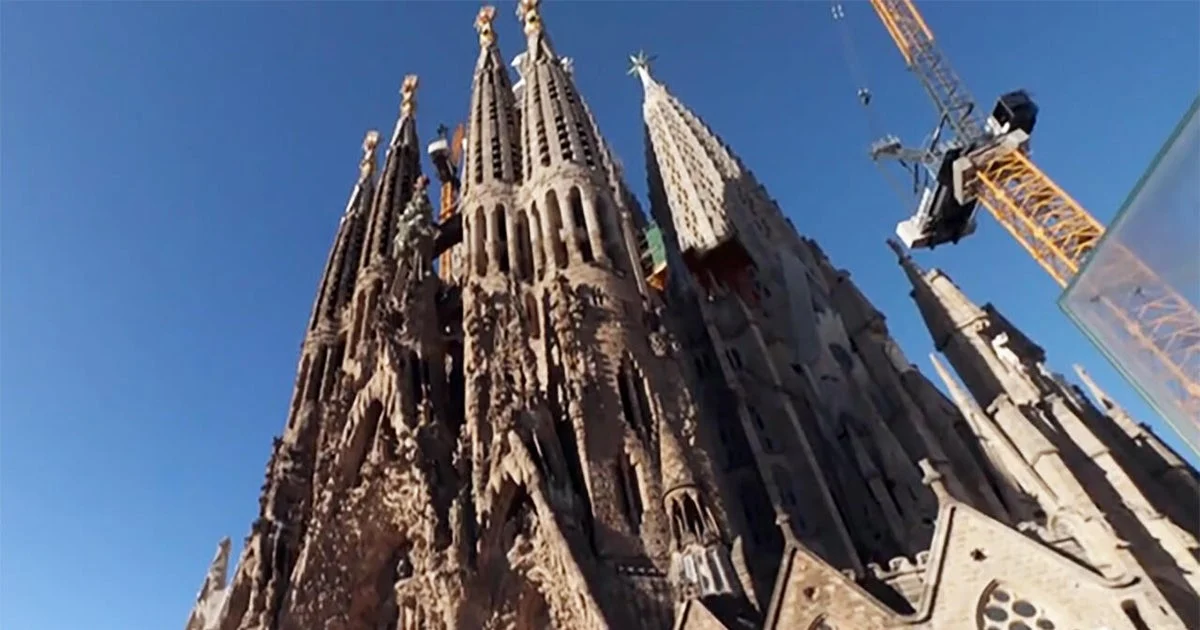
Barcelona’s Sagrada Família, the monumental basilica designed by Antoni Gaudí, recently saw the crowning of its tallest tower with a cross, a historic step forward in the church’s decades-long construction. This new tower, dedicated to Jesus, now makes the basilica the tallest church in the world at 566 feet, surpassing landmarks such as the Washington Monument.
What happened
The Sagrada Família has been under construction since 1883, with the basilica’s latest tower completed in February 2026. Architect Mauricio Cortes described the event as “like a dream come true,” highlighting the culmination of more than a decade of work for recent builders and five generations of contributors to Gaudí’s vision.
Antoni Gaudí, the visionary Catalan architect, envisioned the basilica as a “Bible out of stone,” incorporating natural forms and symbolic elements throughout the design. The church is noted for its forest-like interior columns, snail-shell staircases, and honeycomb-inspired details, all reflecting Gaudí’s unique style.
Despite Gaudí’s death in 1926, with only 10 to 15 percent of the project complete, construction has continued based on his remaining models, sketches, and geometric clues. Efforts to rebuild after damages during the Spanish Civil War and modern advances like software-assisted design and modular construction have helped accelerate progress.
Funding for the project comes entirely from ticket sales, generating over $150 million annually as it remains Spain’s top tourist attraction. Construction challenges remain, including plans to build a staircase that would require demolishing nearby structures. The completion timeline remains uncertain, with estimates ranging from 10 to 20 years or more.
Why it matters
The completion of the tallest tower on the Sagrada Família represents a significant achievement for a project that has become a symbol of Barcelona and Catalan identity. The basilica is a masterpiece of architectural innovation and religious art, attracting millions of visitors and sustaining significant economic impact for the region.
The continuation of construction honors Gaudí’s intent to create a sacred space reflecting both faith and nature. The project’s longevity and adaptive techniques illustrate the intersection of heritage conservation and modern engineering.
The basilica’s cultural importance and ongoing construction highlight debates over preservation, tourism, and urban development in one of Europe’s most visited cities.
Background
Commissioned in 1883 by a local book dealer rather than a traditional diocese, Gaudí worked on the Sagrada Família for 43 years, ultimately dedicating most of his life to the project until his death in 1926 after a tram accident. Posthumously recognized as a symbol of Catalan pride, the basilica’s construction has been carried out by successive architects using Gaudí’s original models, many of which were destroyed during the Spanish Civil War.
Despite setbacks, the project has integrated modern construction technologies while adhering closely to Gaudí’s original vision, guided by architects like Jordi Faulí, who has led efforts since 1990. Gaudí’s famous quote about his client being God, “and God is not in a hurry,” continues to resonate as construction progresses.
Sources
This article is based on reporting and publicly available information from the following source:
Read more Science & Technology stories on Goka World News.