
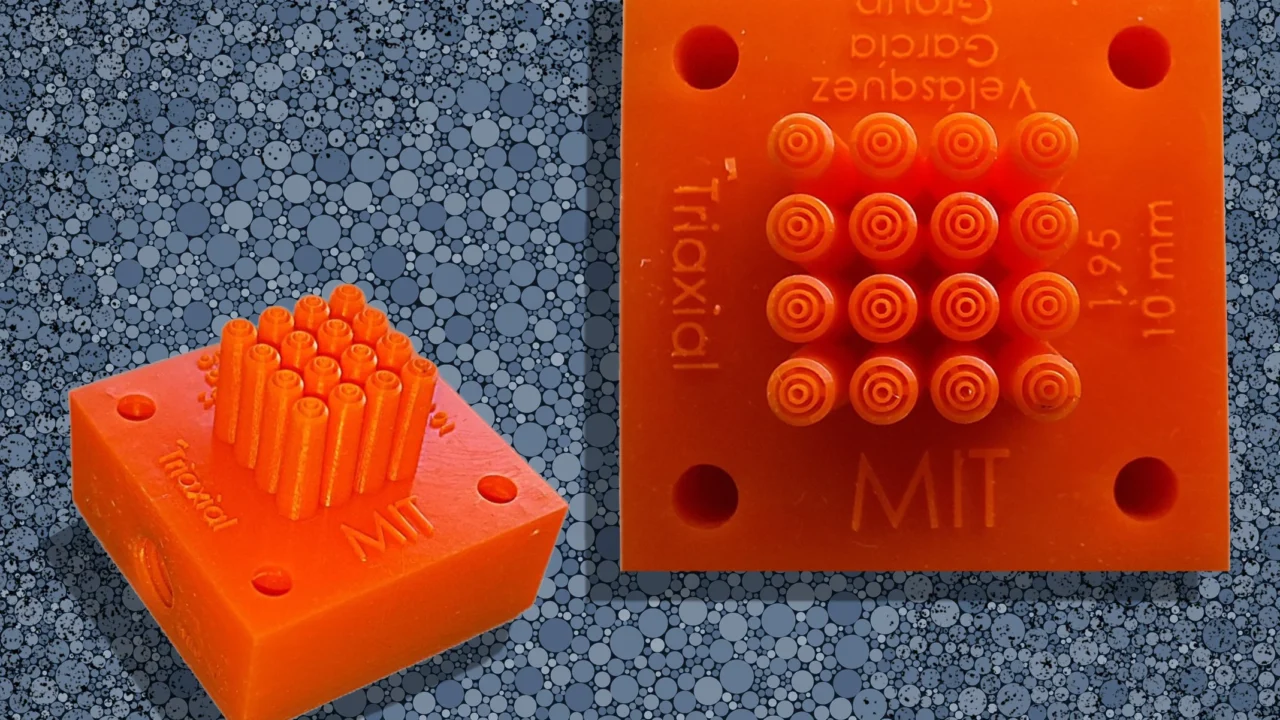
MIT researchers have developed a novel low-cost method using 3D printing to fabricate arrays of triaxial electrospray emitters that can produce multilayered microparticles for drug delivery and other applications. These devices promise scalable and precise manufacturing of bioactive particles with finely tuned release profiles.
What Happened
The MIT team designed and 3D-printed an array of triaxial electrospray emitters containing 16 microscopic nozzles. Each nozzle simultaneously dispensed three immiscible liquids to generate uniform, multilayered droplets. These droplets can solidify into layered microparticles potentially suitable for medicine delivery or self-healing materials. The entire device was produced using vat photopolymerization, enabling the creation of complex, three-dimensional microchannel networks and highly precise structures in a single fabrication step.
Key Facts
- The array measures about 1 square centimeter and contains 16 emitters with concentric nozzles.
- The devices produce consistent three-layered microdroplets essential for uniform particle manufacturing.
- The 3D-printing process took only a few hours, bypassing traditional semiconductor cleanroom fabrication.
- The design includes helical microchannels that uniformly supply fluids to each nozzle preventing interference or inconsistency.
- Adjusting flow rates and voltages allows tailored thickness of each droplet’s layer, key for controlled medicine release.
- The research was funded partly by the Tecnológico de Monterrey – MIT Nanotechnology Program and appears in Virtual and Physical Prototyping.
Why It Matters
This innovation lowers the cost and complexity of producing advanced electrospray emitter arrays, democratizing access to a technology previously limited by expensive microfabrication. It enables high-throughput production of microparticles with precisely engineered layered structures, which could revolutionize controlled drug delivery, biosensing, and regenerative medicine materials.
Background
Electrospray emitters work by applying a high voltage to liquids exiting microscopic nozzles, creating tiny droplets. Triaxial electrospray emitters advance this concept by simultaneously dispensing three immiscible liquids, forming droplets with multiple distinct layers. Traditional fabrication requires semiconductor cleanrooms, restricting device complexity and accessibility.
Analysis
The use of vat photopolymerization 3D printing allows intricate microchannel geometries and finely aligned concentric nozzles critical for stable layered droplet generation. The researchers identified that the viscosity of the middle fluid layer critically stabilizes droplet formation, a key insight for optimizing microparticle consistency. The compact, multi-nozzle arrays significantly increase throughput without compromising uniformity, a crucial factor for scalable manufacturing.
Who Is Affected
Scientists and companies developing controlled-release pharmaceuticals, biosensors, artificial cells, and self-healing composites stand to benefit from the ability to reliably produce complex layered microparticles at scale and lower cost.
Reactions / Official Statements
Senior author Luis Fernando Velásquez-García highlighted the novelty of 3D printing as essential for this device’s creation, stating that the technology “can have a big impact in many applications” and aims to democratize access for broader scientific and entrepreneurial use.
What Remains Unclear
This information was not confirmed in the reviewed sources regarding the detailed biocompatibility testing, long-term stability of produced microparticles, or specific clinical applications demonstrated.
What Comes Next
The team plans to refine fabrication processes to create even smaller devices and integrate conductive or dielectric materials, enabling more advanced electrospray emitter arrays with enhanced functionality.
Sources
This article is based on reporting and publicly available information from the following source:
Read more Science & Technology stories on Goka World News.