
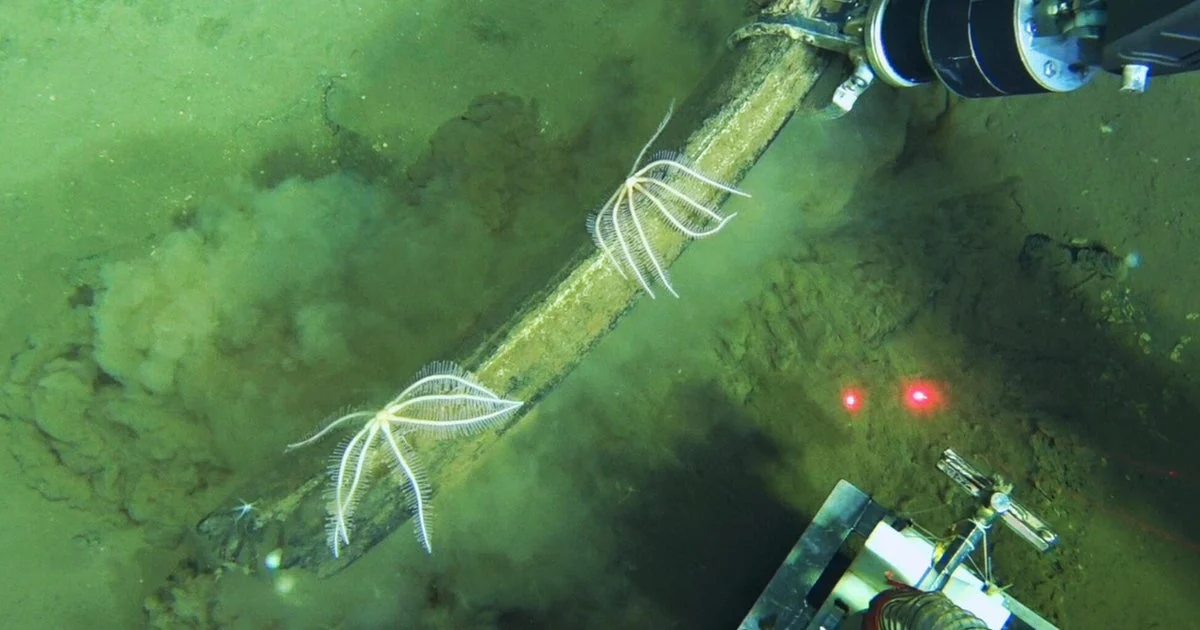
A team of Chinese scientists has uncovered the largest known whale graveyard at the bottom of the Indian Ocean, marking the deepest and oldest extensive assemblage of whale remains on Earth. This discovery highlights a unique ecosystem where fossilized whale carcasses have sustained diverse marine life for millions of years.
What Happened
Using the Fendouzhe submersible, Chinese researchers conducted 32 deep-sea dives in 2023 near the Diamantina Fracture Zone, west of Australia, at depths reaching 7,000 meters. They discovered nearly 500 whale skeletons lined along a 1,200-kilometer corridor. The site includes fossils dating back approximately 5.3 million years and features abundant marine organisms feeding off the carcasses.
Key Facts
- Discovery is the deepest and oldest known whale graveyard, with fossils dating 5.3 million years back.
- Nearly 500 whale skeletons, largely beaked whales, were catalogued along a 1,200-kilometer area.
- A new, extinct species of whale was identified from the fossil remains.
- The whale falls sustain diverse deep-sea wildlife, including jellyfish, brittle stars, bone-boring worms, and bivalves.
- Researchers estimate over 10 million whale carcasses may exist in the region.
- The whale remains represent roughly 6.7 million tonnes of sequestered carbon, supporting large ecosystems.
- The trench’s shape funnels carcasses to the seafloor, aiding accumulation.
Why It Matters
The whale graveyard serves as a critical ecological hotspot for life in the otherwise dark and nutrient-poor deep ocean. It acts as a carbon sink, sequestering millions of tonnes of carbon locked in whale bones and tissue. This discovery offers new insights into deep-sea biodiversity, evolutionary processes, and carbon cycling in marine environments.
Background
Whale falls are known phenomena where deceased whales sink to the seafloor, creating localized ecosystems fueled by their decaying bodies. However, such large-scale, ancient whale graveyards were previously unknown. The site’s unique geological features, such as a V-shaped trench, facilitate the concentration of carcasses. Earlier discoveries of whale falls were far smaller and shallower.
Analysis
This find supports the hypothesis that whale falls act as “evolutionary hotspots” and “biogeographic stepping stones” for sulfide-dependent fauna—organisms reliant on chemicals released during decay. The diversity of species using these carcasses parallels ecosystems found at hydrothermal vents and cold seeps. The large scale of whale carcasses suggests a historically rich marine environment with significant implications for paleontology and deep-sea ecology.
Who Is Affected
The discovery affects the scientific community focused on marine biology, paleontology, and climate science by providing crucial data on deep-sea ecosystems, whale evolution, and carbon sequestration. Economically and ecologically, understanding these systems could inform conservation and climate mitigation strategies.
Reactions / Official Statements
Lead author Xiaotong Peng of the Chinese Academy of Sciences expressed astonishment at the scale of the find. Other experts, including University of Hawaii oceanographer Craig Smith and paleontologist Stephen Godfrey, called the discovery “extremely exciting” and “truly unique,” noting its significance in understanding whale evolution and deep ocean ecosystems. Researchers emphasized this site’s potential to reveal new species and ecological dynamics.
What Remains Unclear
This information was not confirmed in the reviewed sources: the precise global distribution of similar large whale graveyards, and the full impact these ecosystems have had on global carbon cycles over geological time.
What Comes Next
Scientists recommend further submersible expeditions to explore similar deep-sea sites worldwide to assess the extent of whale fossil graveyards. Continued study aims to better understand their role in linking deep-sea communities and their contribution to carbon sequestration in oceans.
Sources
This article is based on reporting and publicly available information from the following source:
Read more Science Discoveries stories on Goka World News.