
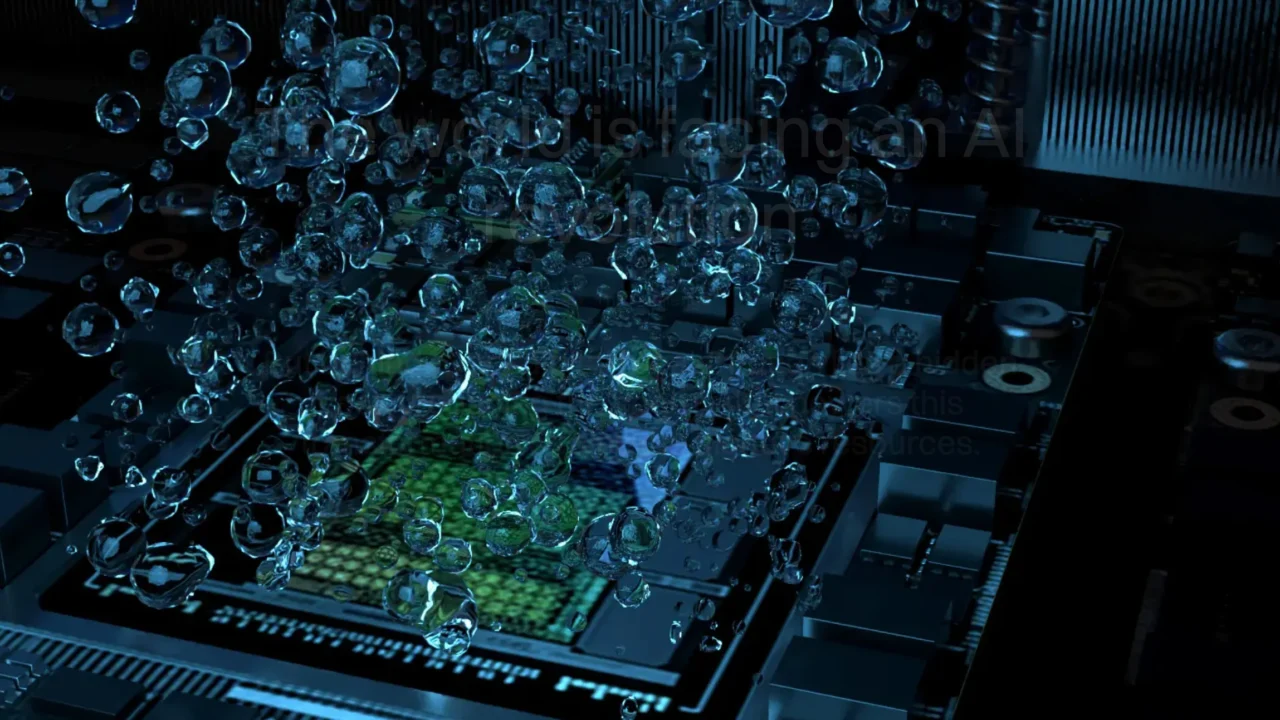
A startup co-founded by former MIT researchers has developed a novel cooling system for data centers that draws on nuclear reactor technology to improve energy efficiency and sustainability. The company’s approach uses a specialized liquid for server immersion cooling that avoids water consumption and significantly reduces electricity used for cooling, a major cost and environmental concern in the rapidly expanding AI-driven data center industry.
What Happened
The startup, Ferveret, founded by Reza Azizian and Matteo Bucci, has introduced an Adaptive Phase Cooling (APC) system that submerges servers in a liquid cooling medium. The system generates small, frequently detaching bubbles on server surfaces that accelerate heat transfer, resulting in more efficient cooling than conventional liquid or air cooling solutions. Ferveret is testing their technology with companies including CleanSpark, FuriosaAI, and Switch, and collaborating with UCLA on studies that have shown a 15% efficiency gain in computational power compared to existing liquid cooling technologies.
Key Facts
- Data centers currently consume a significant portion of U.S. electricity, with 30% devoted to cooling.
- Ferveret’s cooling liquid operates without water and excludes toxic PFAS chemicals.
- The APC system improves power efficiency by 15% over state-of-the-art liquid cooling and can increase token generation from AI models by 35% per unit of power.
- The cooling boxes are modular and rack-mounted, enabling simpler deployment and maintenance.
- Real-time control software adjusts server power and cooling conditions for optimal energy use.
Why It Matters
The rapid growth of AI demands more computational power, driving a surge in data center expansions that strain power grids and water resources. Ferveret’s water-free, energy-efficient cooling can reduce environmental impact and operational costs, enabling data centers to operate in regions with limited water access and increased reliance on renewable energy sources like solar power.
Background
Traditional data center cooling often relies on massive fans or immersion cooling with water or toxic fluorinated liquids. Azizian and Bucci brought expertise in heat transfer from nuclear reactor research at MIT, where managing thermal energy efficiently is critical to reactor performance and safety. Applying similar physics, they devised a subcooled boiling method that enhances heat removal without the complexities of boiling, such as pressure control.
Analysis
By producing smaller, more frequent bubble formation and reabsorption at chip surfaces, the APC system accelerates heat dissipation more effectively than standard immersion cooling. The modular design enhances scalability and integration in current data center infrastructure. Active management of cooling parameters further maximizes energy savings and server performance, positioning Ferveret’s solution as a promising innovation with direct impact on the efficiency challenges facing the AI hardware industry.
Who Is Affected
Data center operators, large cloud providers, AI hardware manufacturers, and ultimately AI service consumers stand to benefit from reduced energy costs and increased sustainability. The technology also opens opportunities for data centers in water-scarce regions, potentially transforming geographic limitations on data infrastructure deployment.
Reactions / Official Statements
Ferveret has disclosed testing partnerships with notable industry players such as CleanSpark, FuriosaAI, and Switch, as well as participation in Nvidia’s Inception startup program. The founders emphasize the goal of maximizing the useful computing output per watt with zero water use while planning wider partnership announcements later this year.
What Remains Unclear
This information was not confirmed in the reviewed sources: the precise timeline for commercial rollout, cost comparison to existing cooling systems, and regulatory approvals or certifications, if any.
What Comes Next
Ferveret intends to scale its cooling technology, expand partnerships with major cloud providers, and contribute to making AI growth more sustainable globally. The company is focused on enabling data centers to deliver more computing power without escalating water or power demands, addressing critical infrastructure challenges in an AI-driven economy.
Sources
This article is based on reporting and publicly available information from the following source:
Read more Science & Technology stories on Goka World News.