
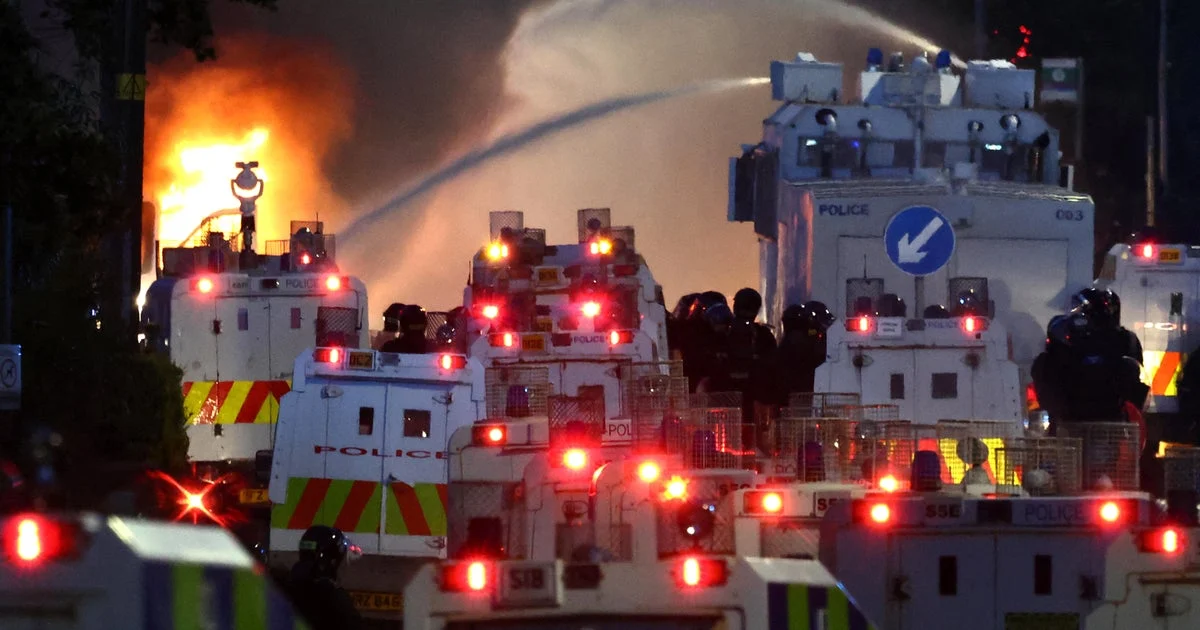
Violent protests erupted in Belfast following a stabbing incident, prompting police to employ water cannons to disperse demonstrators who set fires and threw objects at law enforcement. The unrest has heightened concerns over anti-immigrant violence in the region.
What Happened
Police used water cannons on June 10, 2026, to control crowds in Belfast where masked protesters engaged in setting small fires and throwing bricks, rocks, and bottles. Disturbances occurred after a Sudanese man was charged with attempted murder for a stabbing attack that severely injured a local man. Protesters also used dismantled fence sections as cover during clashes with police.
Key Facts
- Hadi Alodid, 30, appeared in court charged with attempted murder, possession of a knife, and threatening to kill during a stabbing that left Stephen Ogilvie seriously injured.
- Ogilvie was blinded in one eye and sustained multiple deep cuts.
- Following the stabbing, violence surged with houses believed to house migrants being set ablaze and a bus torched.
- Police and firefighters rescued families, including those with infants, from burning homes.
- Police deployed an additional 200 officers to anticipate continued unrest and called for support from other forces.
- Belfast’s transport services reduced operations early due to security concerns.
Why It Matters
The violence highlights underlying tensions around immigration in Northern Ireland, sparking concerns over racial hostility and public safety. It challenges the stability achieved under the 1998 peace accord by inflaming community divisions and fears.
Background
Northern Ireland remains sensitive to conflict related to sectarian and ethnic lines after decades of violence during “The Troubles.” Recent stabbings and anti-immigrant sentiments have fueled unrest reminiscent of past societal fractures. The open border between Northern Ireland and the Republic of Ireland is a critical yet contentious aspect tied to this conflict.
Analysis
The attack by Alodid and subsequent protests appear orchestrated by far-right activists using social media to mobilize unrest. The violence targets immigrant communities and has drawn condemnation for racist motives. The interplay between local paramilitary influence in working-class neighborhoods and political discord exacerbates the situation.
Who Is Affected
Residents of Belfast, particularly immigrant families and ethnic minority communities, have been directly impacted by the violence and displacement. Police, firefighters, and public services are strained. Broader Northern Ireland society faces renewed communal tension and instability.
Reactions / Official Statements
Chief Constable Jon Boutcher condemned the violence and emphasized that attacks targeted families across communities. Political leaders, including First Minister Michelle O’Neill and Deputy First Minister Emma Little-Pengelly, denounced the unrest as cowardly and racist. British Prime Minister Keir Starmer called the stabbing “sickening” and rejected all violence motivated by background or ethnicity. The victim’s family urged for peaceful protest and condemned using tragedy to foster division.
What Remains Unclear
This information was not confirmed in the reviewed sources: The precise motivations behind the stabbing and whether it was linked to any organized group beyond initial charges; the full extent of coordination among protest organizers; and the long-term impact on immigration policy or border arrangements.
What Comes Next
Authorities plan increased policing to prevent further violence, with calls to address underlying social and political issues. Discussions about immigration and border controls may intensify, as protests continue stirring debate over community relations and security in Northern Ireland.
Sources
This article is based on reporting and publicly available information from the following source:
Read more World News stories on Goka World News.