
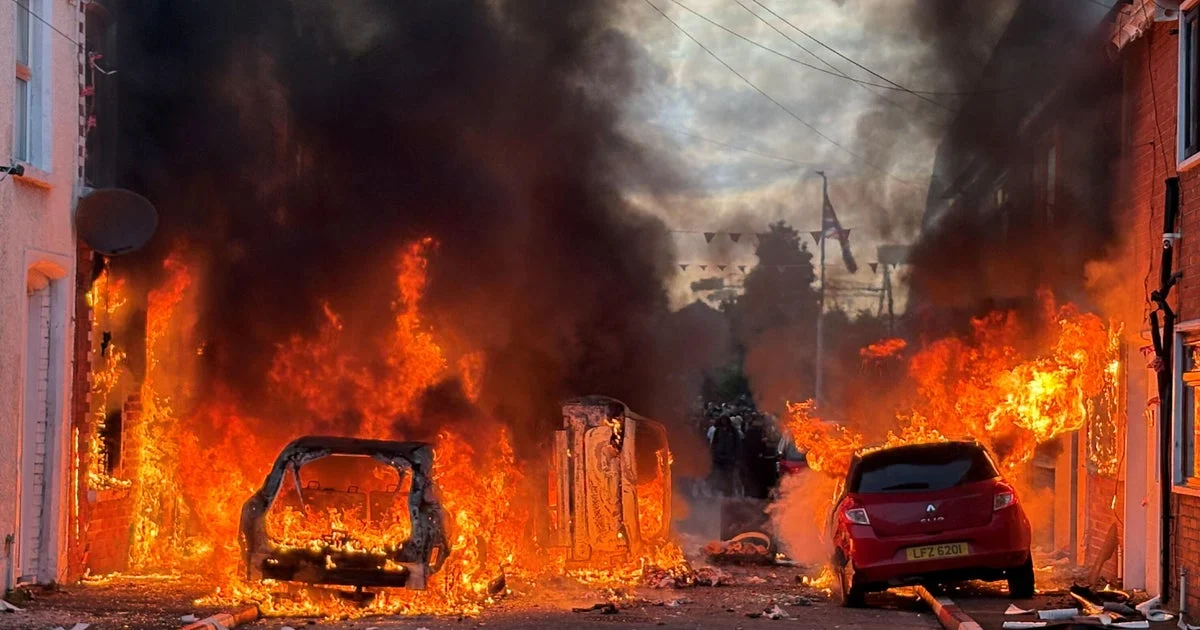
Violent anti-immigration riots erupted in Belfast, Northern Ireland, this week after a stabbing attack involving a Sudanese asylum seeker. The unrest was intensified by the online circulation of lists containing addresses believed to be immigrant homes, leading to arson, attacks on properties, and public safety concerns across the city.
What Happened
In Belfast, Northern Ireland, violent protests broke out on June 8 and 9, 2026, following a brutal knife attack on Monday, June 8. The attacker, a 30-year-old Sudanese man granted asylum in the UK, was charged with attempted murder. Shortly after the attack, lists of immigrant home addresses and immigration lawyers’ offices were shared on closed social media platforms like WhatsApp and on X. These lists circulated among groups calling for mass protests and appeared to incite targeted riots in parts of east Belfast.
Key Facts
- The stabbing suspect is a 30-year-old Sudanese man, charged with attempted murder, threatening to kill, and carrying a knife.
- The victim suffered blinding injury to the left eye and deep wounds to the head, face, and back. Civilians intervened to save the victim’s life before police arrived, according to the Police Service of Northern Ireland (PSNI).
- More than two dozen Belfast addresses believed to be immigrant homes were circulated on closed networks.
- A separate list of seven immigration lawyers and law firms’ addresses was shared publicly on social media.
- The Accountability Project of Northern Ireland has been reporting the circulation of such lists and related far-right activity to the PSNI since November 2025, with multiple reports filed.
- Several homes and vehicles were set on fire during the riots on Lendrick Street and Ligoniel Road in east Belfast.
- Some international staff working in healthcare reported feeling intimidated and frightened to come to work due to the unrest.
Why It Matters
The online sharing of immigrant home addresses directly facilitated targeted attacks on minority communities in Belfast, exacerbating tensions and causing distress among immigrant families and service workers. The violent outbreaks affected public safety, disrupted essential healthcare services, and raised questions about community protection and law enforcement preparedness amid rising xenophobic hostility.
Background
The riots followed a highly publicized stabbing incident on June 8, 2026, where the victim was attacked in an apparently brutal manner in the city. The attacker had entered Northern Ireland under asylum status and was legally residing there. Prior to this unrest, anti-immigration lists had been circulating online since August 2025, prompting warnings from monitoring groups about far-right targeting of Houses in Multiple Occupation, commonly used by migrants seeking affordable housing.
Analysis
The Accountability Project of Northern Ireland highlighted that it had repeatedly warned police about the circulation of these “hitlists” over several months. A spokesperson for the group criticized the police’s failure to act decisively, noting that attacks occurred on streets already identified months earlier. Claire Hanna, a Belfast Member of Parliament, described the unrest as a “race-based pogrom,” condemning the targeting of immigrant families by masked rioters and calling out prominent online figures who amplified the protest calls. The PSNI acknowledged the distress caused by social media users sharing addresses and called the behavior “totally unacceptable.”
Who Is Affected
- Immigrant families and residents living in affected Belfast neighborhoods.
- International staff working in Northern Ireland’s Health and Social Care service who reported feeling intimidated.
- Local communities where homes and vehicles were attacked during the riots.
- Police and emergency services responding to the unrest and managing public safety.
What Remains Unclear
- The precise origin and scale of distribution of the online address lists remain undetermined due to the private nature of closed social networks.
- Whether or how police will hold accountable those responsible for sharing targeting lists is not confirmed.
- The specific motive behind the initial stabbing attack has not been established.
What Comes Next
The PSNI continues its investigation into the stabbing and related civil unrest. Monitoring groups and law enforcement are expected to review and possibly increase actions against hate-driven online activity. Community leaders and law enforcement have signaled ongoing vigilance to prevent further violence targeting immigrant populations.
Sources
This article is based on reporting and publicly available information from the following source:
Read more World News stories on Goka World News.