
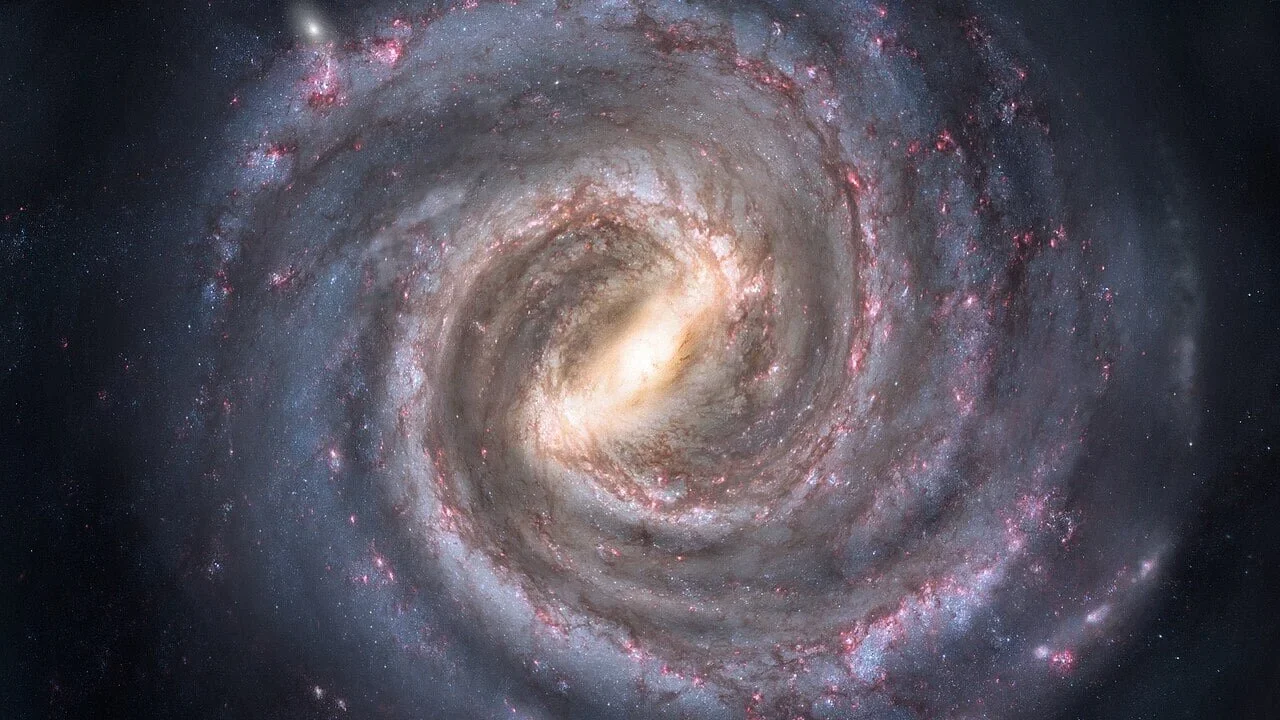
The Laser Interferometer Space Antenna (LISA), a European space mission designed to detect gravitational waves, will analyze the background “hum” produced by millions of pairs of dead stars in the Milky Way. Researchers from Paris have revealed that the Milky Way’s rotation causes a Doppler shift in this gravitational wave signal, affecting its interpretation and potentially enabling new insights into galactic structure and dark matter.
What Happened
On June 15, 2026, researchers published new findings describing how the rotation of the Milky Way alters the gravitational wave background that LISA is set to measure. LISA will consist of three spacecraft flying in a triangular formation, sensitive to ripples in spacetime generated by the orbital motion of numerous white dwarf binaries scattered throughout the galaxy. The Paris team derived the first exact formula for the Doppler effect induced by the galaxy’s rotation and assessed the impact of neglecting this effect in data analysis.
Key Facts
- LISA uses a triangular constellation of three spacecraft to detect spacetime distortions from gravitational waves.
- The Milky Way’s stars orbit the galactic center at approximately 230 kilometers per second (about 140 miles per second).
- Gravitational waves emitted by binary white dwarfs produce a continuous background hum that varies spatially due to galactic structure and spin.
- Ignoring the Doppler shift from galactic rotation causes errors comparable to LISA’s measurement precision, skewing estimates of binary counts and masses.
- The team employed two independent statistical methods to confirm the significance of including rotational Doppler corrections.
- Research documented in the preprint “The Doppler effect of the Milky Way rotation on LISA” is available on arXiv (DOI: 10.48550/arxiv.2606.11115).
Why It Matters
Accounting for the Doppler effect of galactic rotation improves the accuracy of interpreting LISA’s gravitational wave data, preventing biases in the inferred population and characteristics of compact stellar binaries. Moreover, the detected anisotropies in the gravitational wave background may provide an independent method to measure the Milky Way’s rotation curve, offering new constraints on the distribution of dark matter within the galaxy.
Background
Previous gravitational wave studies acknowledged that the Milky Way’s stellar distribution is uneven, stronger near the galactic center and weaker at the edges. The concept of a persistent gravitational wave background from numerous unresolved binary systems is established. However, earlier models had not incorporated the rotational Doppler modulation caused by stars orbiting with high velocity around the galaxy’s center. This novel analysis fills that gap.
Analysis
The researchers concluded that incorporating the Doppler effect due to galactic rotation does not introduce additional unknown parameters but requires updating the data analysis templates used by LISA scientists. This update will prevent systematic errors in population estimates and provide higher fidelity in gravitational wave signal interpretation. The authors emphasize that failing to include this effect could undermine the precision goals of the mission.
Who Is Affected
The findings directly affect astrophysicists and data analysts working on the LISA mission, as well as researchers studying compact binary populations in the Milky Way. Additionally, cosmologists and dark matter researchers may benefit from new constraints on galactic dynamics derived from gravitational wave data. The broader astronomy community gains a new observational tool independent of electromagnetic measurements.
What Remains Unclear
- How well the Doppler effect correction performs when applied to real LISA data remains to be tested after mission launch.
- Whether this method can resolve fine details of the Milky Way’s dark matter distribution beyond current models.
- The potential challenges in disentangling rotational modulation from other anisotropies in the gravitational wave background.
What Comes Next
LISA is currently in development by the European Space Agency and scheduled for launch in the 2030s. The Paris team’s formula will be incorporated into LISA’s data analysis frameworks as preparations continue. Further simulation and refinement of these corrections are expected before launch.
Sources
This article is based on reporting and publicly available information from the following source:
Read more Science Discoveries stories on Goka World News.