
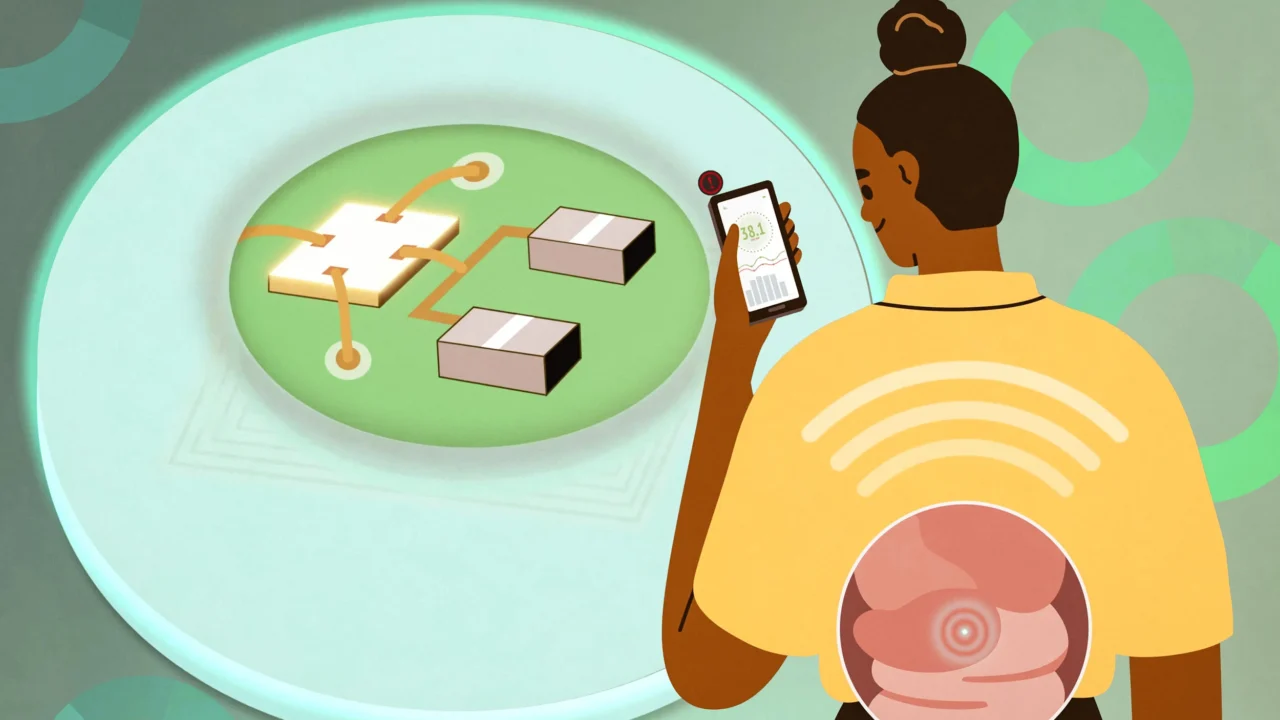
MIT engineers have developed a miniature ingestible sensor that continuously measures core body temperature from inside the gastrointestinal (GI) tract. Led by associate professor Giovanni Traverso and provost Anantha Chandrakasan, the team published their findings in Nature Electronics, demonstrating a sensor small enough to be safely swallowed and capable of providing highly accurate internal temperature readings.
What Happened
The team designed a sensor resembling a tiny blueberry, measuring just 6 millimeters in diameter and 4 millimeters in height, significantly smaller than existing ingestible sensors. Their approach utilized a custom silicon chip for temperature sensing, a miniature antenna, and a small coin cell battery to create a low-power device that broadcasts temperature data via radio waves. This sensor can transmit temperature readings once every second, enabling continuous monitoring. The device was successfully tested in animals under anesthesia and while moving freely, confirming its ability to record accurate body temperatures from within the GI tract.
Key Facts
- The research was conducted at MIT, with Giovanni Traverso and Anantha Chandrakasan as senior authors, and Saransh Sharma as lead author.
- The study was published in the journal Nature Electronics.
- The sensor measures 6 mm in diameter and 4 mm in height.
- The sensing circuit fits onto a 1-square-millimeter silicon chip and detects temperature changes with 0.01°C accuracy.
- Power consumption is around 10 nanowatts, supplied by a 1.55-volt coin cell battery (4.8 mm diameter, 1.6 mm thick).
- Data transmission uses backscattering radio technology to minimize on-board power use.
- Animal tests confirmed reliable temperature monitoring under anesthesia and in active states.
- The research was funded by the 711th Human Performance Wing, DARPA, and ARPA-H.
Why It Matters
This ingestible sensor promises to offer more accurate and continuous core body temperature measurements compared to traditional oral or forehead thermometers, which only capture external temperature and can be less reliable indicators of illness. The device could be particularly valuable for early infection detection in at-risk populations such as immunosuppressed patients, as well as for monitoring patients under anesthesia, fertility tracking, and temperature regulation in athletes or soldiers exposed to extreme conditions.
Background
Previous commercially available ingestible temperature sensors exist but tend to be larger—comparable in size to multivitamins—posing swallowing difficulties and higher blockage risks in the GI tract. These larger sensors also require bulkier batteries and more complex circuits, increasing device size. The MIT team’s work builds on the need for smaller, safer devices that maintain accuracy while reducing power consumption.
Analysis
Giovanni Traverso highlighted the safety advantage of the sensor’s small size, emphasizing its reduced risk of obstruction and ease of ingestion. Lead author Saransh Sharma noted that the integration of a custom silicon chip, low-power oscillator circuit, and backscatter communication was key to creating the smallest known ingestible temperature sensor to date. Traverso also expressed optimism that such sensors could eventually replace traditional thermometers by providing the most accurate method of temperature measurement.
Who Is Affected
The sensor has implications for medical patients needing close temperature monitoring, particularly those receiving chemotherapy or immunosuppressants, surgical patients under anesthesia, fertility patients tracking ovulation, as well as athletes and military personnel exposed to challenging environments.
What Remains Unclear
- Long-term safety and efficacy in human clinical trials are pending.
- The potential integration timeline with other biometric sensors remains to be determined.
- Applications beyond initial testing scenarios require further validation.
What Comes Next
The researchers plan to combine the temperature sensor with additional sensors for vital signs such as heart rate and hope to begin clinical trials in humans within the next few years.
Sources
This article is based on reporting and publicly available information from the following source:
Read more Science & Technology stories on Goka World News.