
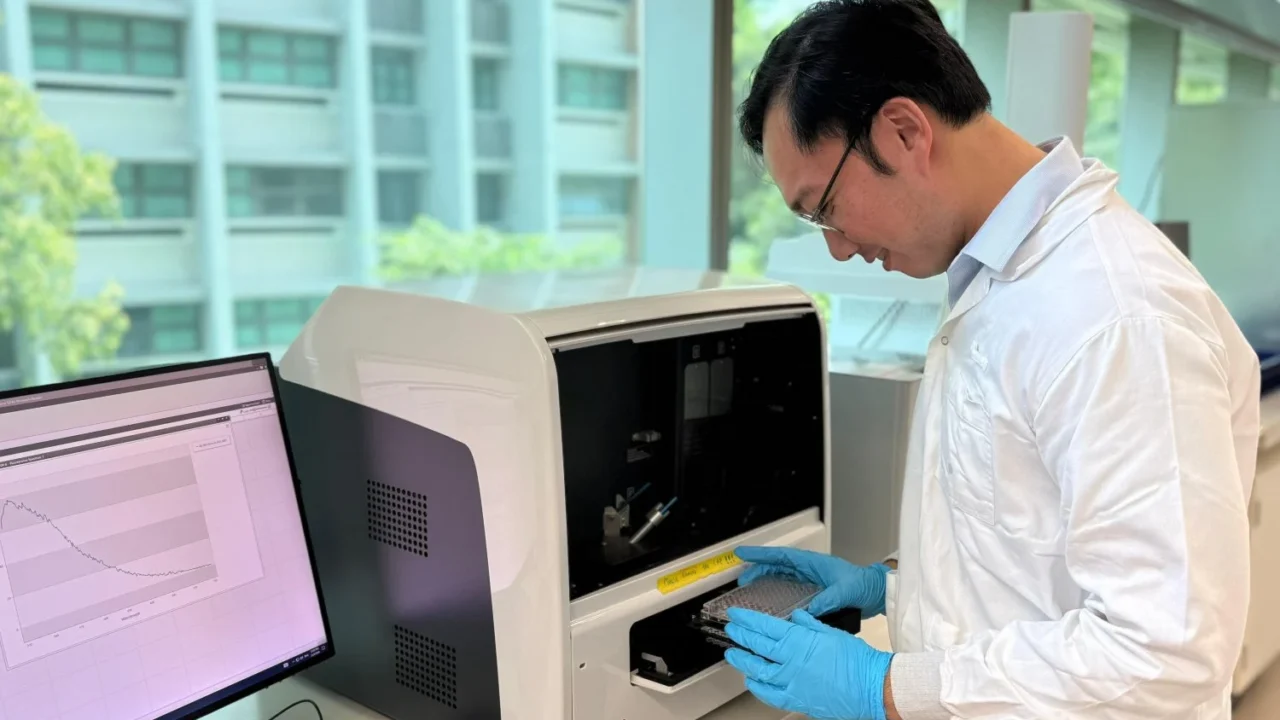
An international research team led by scientists at Nanyang Technological University’s National Institute of Education (NIE), MIT, and the Singapore-MIT Alliance for Research and Technology (SMART) has developed a novel fluorescent nanosensor powered by carbon nanotubes designed to rapidly detect indole-3-propionic acid (IPA), a key biomarker related to gut health. The findings were published in the open-access journal Advanced Healthcare Materials.
What Happened
The scientists created a nanosensor that uses fluorescence to detect IPA—a metabolite produced by gut bacteria during the breakdown of dietary tryptophan—in biological samples including blood plasma. Unlike traditional mass spectrometry techniques, which are costly and time-consuming, this sensor provides an optical readout within minutes. The platform showed high selectivity, differentiating IPA from closely related gut metabolites. Clinical validation occurred through testing of 125 human plasma samples from healthy individuals and patients with gastrointestinal diseases, including inflammatory bowel disease (IBD).
Key Facts
- Published in Advanced Healthcare Materials (date not specified in source)
- Research institutions involved: NIE (Nanyang Technological University, Singapore), MIT, Singapore-MIT Alliance for Research and Technology (SMART)
- Clinical collaboration with National University Hospital (NUH) and Yong Loo Lin School of Medicine, National University of Singapore
- Sample size: 125 human plasma samples
- Analyte detected: Indole-3-propionic acid (IPA), a gut bacterial metabolite from dietary tryptophan
- Detection method: Carbon nanotube-based fluorescent nanosensor providing visible and near-infrared optical readouts
Why It Matters
The invention directly addresses a longstanding challenge in gut metabolite sensing by providing a rapid, selective, and cost-effective alternative to mass spectrometry. Since IPA levels reflect gut health and have associations with chronic inflammatory diseases such as IBD, this nanosensor could greatly enhance clinical diagnostics, disease monitoring, and personalized healthcare. It offers practical potential for real-time and point-of-care gut health assessment, overcoming current barriers of complexity and delay in testing.
Background
This research builds upon prior SMART DiSTAP work developing nano and optical sensors to monitor plant health by tracking molecular signals. The team extended these technologies to human health by targeting IPA detection in the gastrointestinal system, a problem unmet by existing mass spectrometry approaches.
Analysis
Michael Strano, SMART DiSTAP’s principal investigator and Carbon P. Dubbs Professor of Chemical Engineering at MIT, stated that this molecular recognition platform shows promise for proactive, personalized healthcare by facilitating near-instant gut wellness insights and monitoring chronic diseases like IBD.
Jonathan Lee, senior consultant at NUH and co-first author, highlighted the clinical value of rapid IPA assessment in complementing current diagnostic methods and informing patient management.
Mervin Ang, co-first author and assistant professor at NIE, emphasized the transition potential from laboratory discovery toward point-of-care clinical tools and wearable device integration.
Who Is Affected
Patients suffering from inflammatory bowel diseases and other gut-related conditions stand to benefit directly from more accessible, rapid gut biomarker testing. Clinicians and researchers focused on gut health and disease diagnostics may also be impacted, as well as pharmaceutical developers utilizing the nanosensor for drug efficacy assessments.
What Remains Unclear
The precise timelines for clinical deployment and commercial availability of the sensor remain unspecified. The sensor’s performance in diverse real-world conditions beyond the initial plasma sample set awaits further validation. Additionally, integration into wearable or continuous monitoring devices is a future goal rather than a current reality.
What Comes Next
The research team has received an Innovation to Startup Grant to further validate and develop the sensor toward a clinical diagnostic tool. Plans include expanding the platform to detect multiple gut metabolites simultaneously and incorporating AI-driven signal processing for improved gut health profiling. Future development may also explore wearable, microneedle, and microfluidic technologies enabling continuous in vivo sensing.
Sources
This article is based on reporting and publicly available information from the following source:
Read more Science Discoveries stories on Goka World News.