
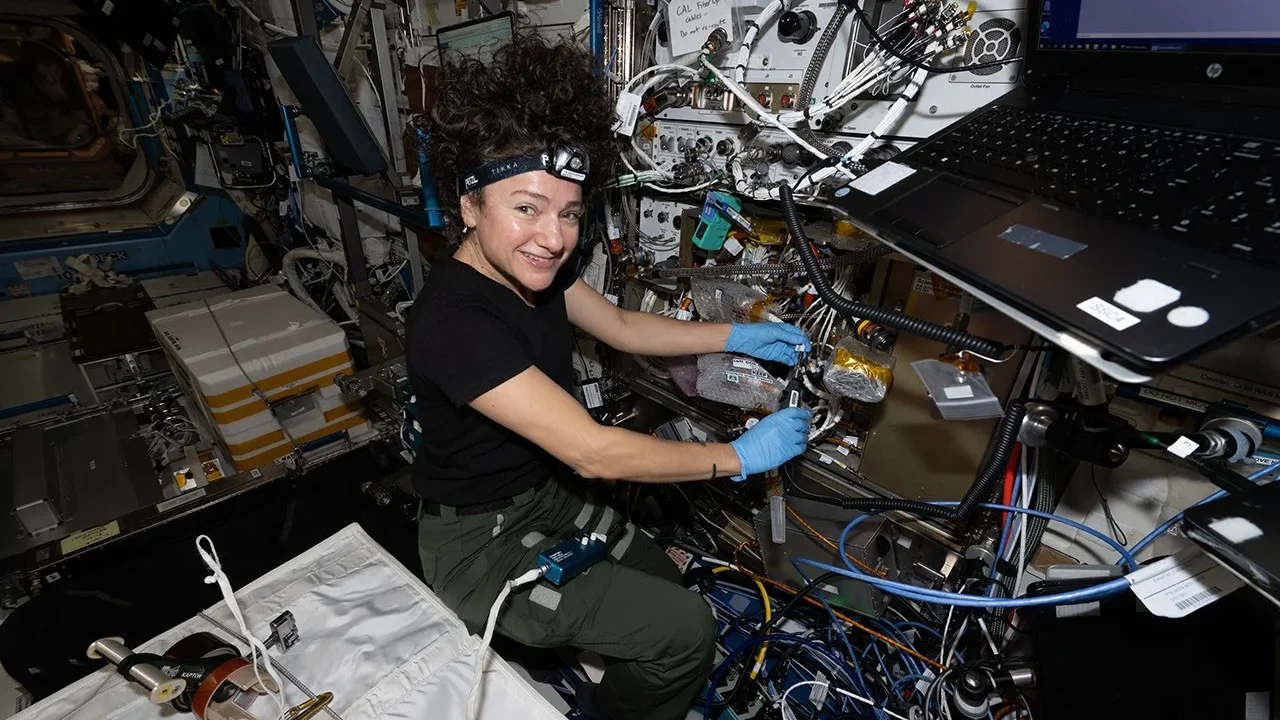
NASA astronaut Jessica Meir conducted hardware upgrades on the Cold Atom Lab (CAL) aboard the International Space Station (ISS) on May 8, 2026. The upgrades support the ongoing operation of this unique facility designed to study atoms at temperatures near absolute zero.
What Happened
On May 8, 2026, astronaut Jessica Meir installed new hardware components and inspected optical fibers on the Cold Atom Lab, which is approximately the size of a mini refrigerator and operates remotely from Earth. CAL is housed on the ISS, where it chills atoms to temperatures below minus 459 degrees Fahrenheit (minus 273.15 degrees Celsius).
Key Facts
- The Cold Atom Lab achieves temperatures close to absolute zero, forming Bose-Einstein condensates (BECs), a fifth state of matter.
- BECs enable the study of quantum properties of atoms visible to the naked eye, including wave-particle duality.
- CAL is managed by Caltech and operated by NASA’s Jet Propulsion Laboratory (JPL) in Pasadena.
- The hardware update included the inspection and installation of optical fibers critical for CAL’s function.
- The mission is sponsored by NASA’s Biological and Physical Sciences (BPS) division within the Science Mission Directorate.
Why It Matters
The hardware updates ensure the Cold Atom Lab continues to enable cutting-edge quantum physics research in microgravity. Understanding Bose-Einstein condensates informs fundamental physics and helps advance technologies that could impact future space exploration and terrestrial applications.
Background
Cold Atom Lab, launched and installed previously on the ISS, was designed to create ultracold atomic clouds in microgravity conditions, which are impossible to replicate on Earth. This environment allows scientists to study quantum phenomena without interference from Earth’s gravity, enhancing knowledge critical for space exploration and quantum science.
Analysis
NASA’s Jet Propulsion Laboratory noted that ongoing maintenance and hardware enhancements like those performed by Meir are vital to extending CAL’s operational lifespan and scientific output. Such meticulous updates ensure stable conditions for observing Bose-Einstein condensates and other quantum states.
Who Is Affected
Scientists in quantum physics and materials science worldwide benefit from the data produced by CAL. NASA’s space exploration programs also gain valuable insights into materials behavior in space, influencing long-term mission planning and technology development.
What Remains Unclear
This information was not confirmed in the reviewed sources.
What Comes Next
Cold Atom Lab will continue to operate aboard the ISS, with further data collection and experiments planned to explore quantum phenomena. Additional maintenance schedules or upgrades have not been specified.
Sources
This article is based on reporting and publicly available information from the following source:
Read more Space & NASA stories on Goka World News.