
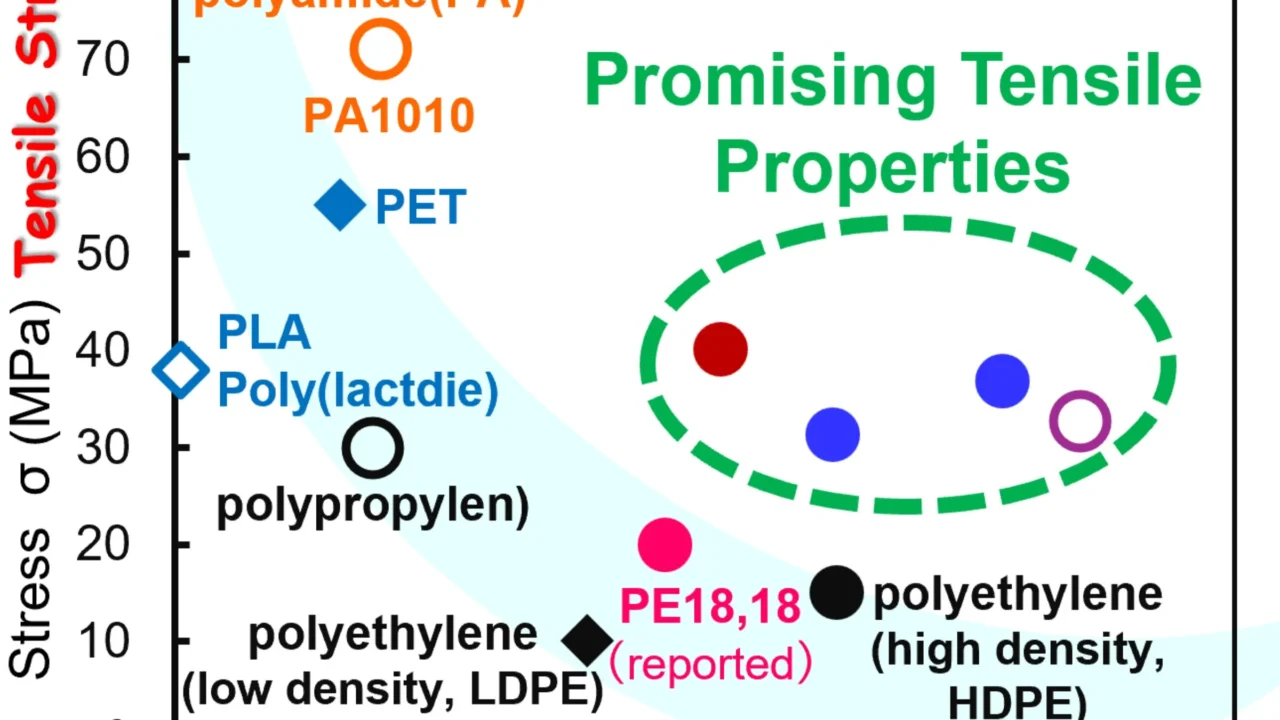
Scientists at Tokyo Metropolitan University, in collaboration with Osaka Research Institute of Industrial Science and Technology and The University of Shiga Prefecture, have developed novel biobased poly(ester amide)s demonstrating tensile properties that outperform widely used commodity plastics such as polyethylene and polypropylene. These polymers, derived from nonedible renewable resources, are also chemically recyclable, representing a significant advancement for sustainable polymer materials in the circular economy.
What Happened
The research group, led by Professor Kotohiro Nomura, published their findings in the peer-reviewed journal JACS Au in 2026. They synthesized high-molecular-weight biobased poly(ester amide)s by catalytic olefin metathesis polymerization using plant oils, amino acids, and sugars as feedstocks. This new polymer family exhibits superior tensile strength and elongation at break in film form compared to conventional polyolefins.
Notably, one variant containing the amino acid phenylalanine showed fast self-healing properties at room temperature, a novel feature for biobased polymers. The team demonstrated that these polymers undergo selective depolymerization back to their monomeric starting materials via catalytic transesterification reactions, supporting effective chemical recycling.
Key Facts
The poly(ester amide)s developed derive from nonedible vegetable oils combined with amino acids and sugars, ensuring no competition with food resources. The polymers have high molecular weights achieved through catalytic olefin metathesis polymerization. Their tensile strength and strain at break were confirmed superior to those of common plastics like polyethylene and polypropylene in film tests conducted by the research team.
Catalytic transesterification enables quantitative depolymerization, allowing the polymers to be recycled repeatedly by breaking and reforming ester bonds efficiently. This process was explicitly demonstrated by the researchers, confirming the chemical recyclability of the materials.
What This Means
This development addresses two critical challenges in polymer science: creating materials from renewable, non-food biomass and enabling a closed-loop lifecycle through chemical recyclability. Polymers with enhanced tensile properties and built-in recyclability have broad implications for plastics manufacturing, reducing reliance on fossil fuels and decreasing plastic waste accumulation.
Materials with self-healing properties at ambient temperatures could extend product lifespans and reduce material degradation, offering economic and environmental benefits. If scaled industrially, such polymers might replace conventional plastics in packaging, automotive parts, or consumer goods, where mechanical robustness and sustainability are increasingly mandated.
Moreover, chemical recycling via transesterification provides a viable route to recover monomers without significant degradation, a key advantage over mechanical recycling methods that often compromise polymer quality. This can lead to more efficient resource use and lower environmental impact.
Background
Biobased polymers from renewable resources such as plant oils and amino acids have been pursued as sustainable alternatives to petroleum-derived plastics. However, achieving mechanical performance that matches or exceeds commodity plastics, while retaining recyclability, has been rare to date. Prior research emphasized either biodegradability or renewability but often at the expense of tensile strength or durability.
Professor Nomura’s team builds on earlier studies of catalytic polymer synthesis and chemical recycling strategies, integrating these approaches to focus on tensile performance and self-healing features in a single material type. Their work is part of Japan Science and Technology Agency’s CREST program, aiming to promote creative research focused on sustainable materials science.
What Remains Unclear
The research has so far been demonstrated at laboratory scale, and the performance metrics are based on initial tensile tests in film form. The scalability of the polymerization and depolymerization methods for industrial production, as well as behavior under long-term mechanical stress or various environmental conditions, remain untested. Additionally, regulatory approval and cost competitiveness compared to existing plastics have yet to be assessed.
What Comes Next
The team’s paper was published in mid-2026, and ongoing research will likely focus on scaling synthesis processes, evaluating durability, and exploring other polymer compositions with enhanced self-healing and recyclability. Further collaborations with industrial partners may aim to transition these polymers from laboratory prototypes to commercial materials.
Sources
This article is based on reporting and publicly available information from the following source:
Read more Science & Technology stories on Goka World News.