
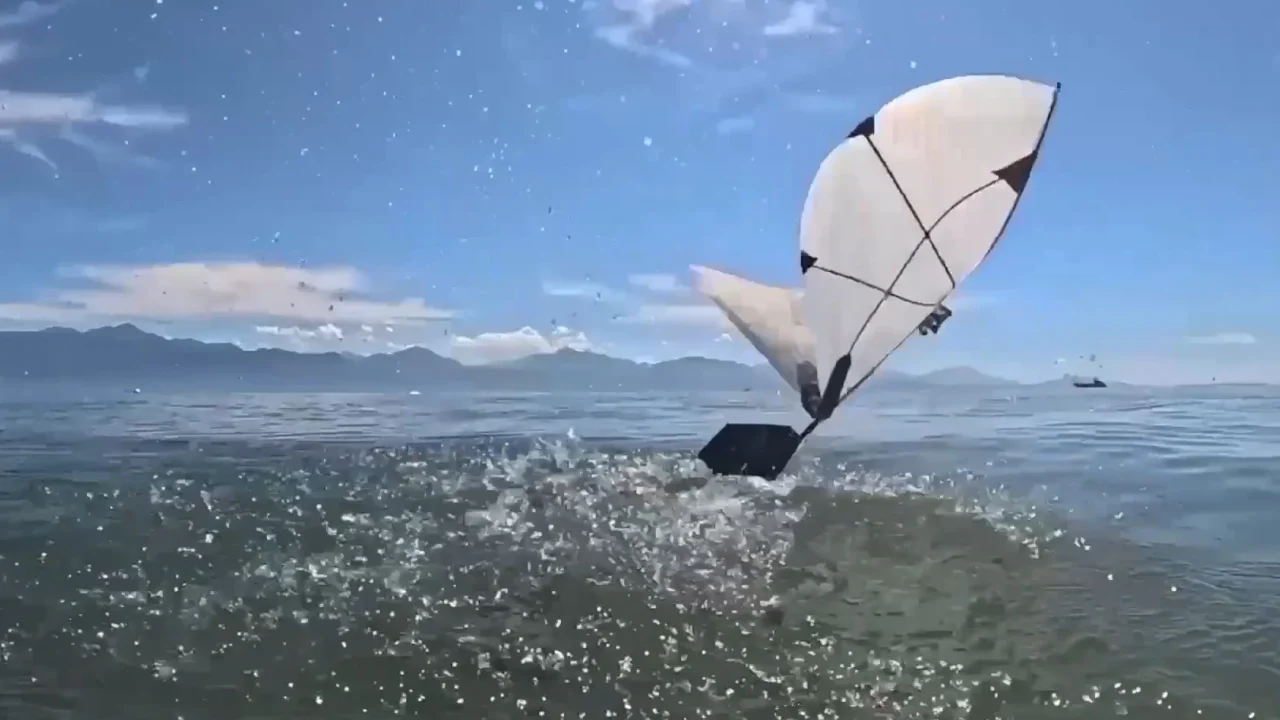
Researchers at MIT and EPFL in Lausanne, Switzerland, have engineered a novel lightweight robot capable of both swimming underwater and flying through air, emulating the behavior of diving birds. The findings of this innovative design, developed to better understand how certain bird species navigate two vastly different environments, were published in the journal Science.
What Happened
The team created a “flapping-wing aerial-aquatic vehicle” (FAAV) weighing less than 300 grams. Its design is inspired by diving birds like loons, puffins, and petrels, which can plunge underwater to hunt and then take flight from the water’s surface. The robot features a central body, two flexible flapping wings, and a steerable motorized tail. Various wing sizes—small (60 cm), medium (80 cm), and large (100 cm)—were fabricated to determine optimum performance combinations.
Extensive testing was conducted in both a controlled water tank and naturally in Lake Geneva. By adjusting wing size, flapping frequency, and tail pitch angle, the researchers identified conditions enabling the robot to smoothly swim up through water, break the surface, and transition into stable flight. Notably, the robot demonstrated swimming speeds near 1 meter per second at about five flaps per second and achieved flight speeds nearing 6 meters per second, mimicking the flapping rates and velocities observed in actual diving birds.
Key Facts
The research was led by Raphael Zufferey, assistant professor in mechanical engineering at MIT, with collaborators from EPFL and Northwest Indian College. Published in Science, the study leverages wing flapping frequencies measured in diving birds—around 10 Hz in air and 4 Hz underwater—and replicates these biomechanical features in robotics. The wings’ membranes are coated with hydrophobic nanoparticles to repel water, and tail adjustments allow for precise control of pitch during transitions. Data was gathered primarily from experiments in Lake Geneva and a specialized water tank using interchangeable wings and programmed motor frequencies.
What This Means
This robot not only advances our understanding of how diving birds can adapt their wing dynamics to permit seamless movement between two highly contrasting media—air and water—but also represents a major step forward in biomimetic engineering. The ability to replicate both swimming and flying within a single integrated system challenges previous assumptions that such transitions demand complex paddling maneuvers, as the robot successfully took off without using feet-like appendages.
Practically, this innovation paves the way for a new class of aerial-aquatic drones with significant potential in marine research and environmental monitoring. These robots could be deployed to sample and observe aquatic environments too challenging or hazardous for boats, enabling frequent, rapid data collection from coastal ecosystems, icebergs, or marine wildlife habitats. This could revolutionize how oceanographers and marine biologists gather high-resolution spatial and temporal data in real-world conditions more cost-effectively and flexibly than current methods.
From a broader perspective, the robot highlights how insights from natural biomechanics can inspire versatile machines, encouraging future explorations into adaptive hybrid vehicles and possibly influencing designs for environmental surveillance and rescue operations in aquatic settings.
Background
Diving birds such as the puffin and petrel navigate the physical challenges of flying and swimming by modulating wing flapping frequency and tail positioning. Previous studies have documented the flapping rates and swimming speeds of these species, but until now, no robotic system had integrated these capabilities in a single mobile platform to replicate this dual locomotion. This project builds upon biomechanical literature describing how these birds maintain efficiency in drastically different density environments.
What Remains Unclear
The researchers note some aspects remain to be refined, including enhanced maneuverability through wing turning and handling turbulence in dynamic, choppy water or windy air conditions. Further work is required to test how the robot performs under these variable environmental stresses before broader deployment in field research.
What Comes Next
The team plans to improve wing design for directional control, test the robot’s resilience in turbulent and challenging conditions, and ultimately develop operational protocols for its use in oceanographic monitoring. Deployment for frequent environmental sampling missions and extended autonomous operation remains a future goal.
Sources
This article is based on reporting and publicly available information from the following sources:
Read more Science & Technology stories on Goka World News.