
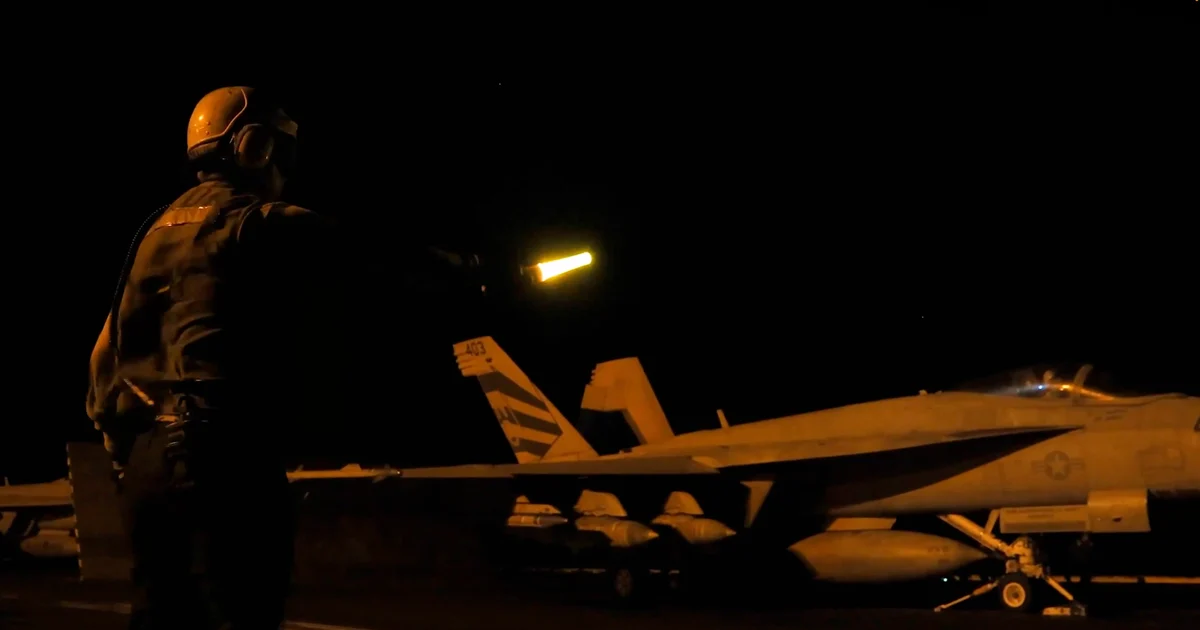
The United States intensified its military campaign against Iran by conducting multiple consecutive nights of airstrikes and reinstating a naval blockade of Iranian ports while asserting control over the strategic Strait of Hormuz. This deepening confrontation threatens the security and commercial flow through one of the world’s most vital maritime chokepoints, raising international concern over regional stability and global energy supplies.
What Happened
Beginning July 7, 2026, the U.S. military launched a series of airstrikes against Iranian targets following President Donald Trump’s declaration that hostilities with Iran had officially resumed after a ceasefire ended in early July. On July 13, U.S. Central Command announced the commencement of a third consecutive night of strikes aimed at degrading Iran’s military capabilities and deterring attacks on civilians and commercial shipping in the Strait of Hormuz.
President Trump publicly vowed on the conservative talk show hosted by Hugh Hewitt that the U.S. would “keep the Strait” of Hormuz and likely operate it directly. He also declared that the United States would reimpose a naval blockade on Iranian vessels starting July 14 at 4 p.m. Eastern Time and announced plans to impose a 20% fee on cargo shipments transiting the strait.
In response, Iran declared the Strait of Hormuz closed until “stability and calm are restored,” significantly disrupting maritime traffic. Diplomatic discussions are ongoing between Iran and Oman regarding the management of the strait.
Key Facts
The U.S. confirmed military action against Iran commenced on July 7 and notified Congress on July 10 in accordance with the War Powers Resolution. The strikes have targeted Iranian forces with the stated goal of reducing their threat to innocent civilians and commercial shipping.
The Strait of Hormuz remains a critical maritime route connecting the Persian Gulf to the Arabian Sea, through which a significant percentage of the world’s oil shipments pass.
Despite Iranian closure claims, some shipping continues, with maritime trackers reporting reduced vessel numbers and increased security risks, including threats from sea mines and potential Iranian scrutiny of ships seen as linked to the U.S. or Israel.
The International Maritime Organization (IMO) stated there is no legal basis for mandatory tolls on passage through the strait and reaffirmed the right of free transit passage consistent with international law.
Following President Trump’s announcement, Iranian Foreign Minister Abbas Araghchi acknowledged the principle that the “provider of security” for the strait should be compensated but criticized the 20% fee as excessive, pledging Iran would be “fair.”
The United Nations Secretary-General Antonio Guterres issued a statement expressing “deep concern” over escalating military confrontations involving Iranian attacks on shipping and U.S. strikes on Iran, calling for de-escalation in the Gulf region.
What This Means
The resumption of military action and the naval blockade mark a significant escalation in U.S.-Iran tensions with profound implications for international trade and energy security. The Strait of Hormuz is a pivotal artery for global oil exports, and disruption or contested control threatens higher energy prices and supply chain instability worldwide.
The U.S. assertion of control over the Strait challenges established international maritime rights, potentially complicating relations with regional neighbors and international shipping operators. The proposed toll on cargo shipments reflects an attempt by the U.S. to capitalize economically on the enforcement of maritime security, which could provoke diplomatic and economic retaliations.
Iran’s firm stance on the closure and its continued military operations signal the possibility of a protracted conflict that risks destabilizing the broader Gulf region. Civilian and commercial vessels navigating this area face increased dangers from military confrontations, mines, and heightened political tensions, endangering global supply chains.
Background
A fragile ceasefire between the United States and Iran ended in early July 2026 following months of underlying hostility and intermittent skirmishes. The conflict traces its origins to long-standing disputes over Iran’s nuclear program, regional influence, and control of strategic waterways.
Previous agreements, including a memorandum of understanding between Iran and Oman, aimed to establish coordinated management of the Strait of Hormuz to maintain stability and secure maritime transit.
Last month, both chambers of the U.S. Congress passed a war powers resolution to restrict President Trump’s ability to conduct prolonged military actions against Iran without legislative approval, reflecting domestic political debate on the conflict.
What Comes Next
President Trump is scheduled to deliver a primetime address to the nation on Thursday evening, July 16, likely to update the public on ongoing military operations and U.S. policy toward Iran.
Diplomatic talks between Iranian and Omani officials about managing the Strait of Hormuz will continue, seeking political and technical solutions amid the escalating conflict.
Congressional lawmakers, particularly Democrats, are considering legal avenues to challenge the administration’s military actions, while the international community watches closely for signs of further escalation or de-escalation.
Sources
This article is based on reporting and publicly available information from the following source:
Read more Politics stories on Goka World News.