
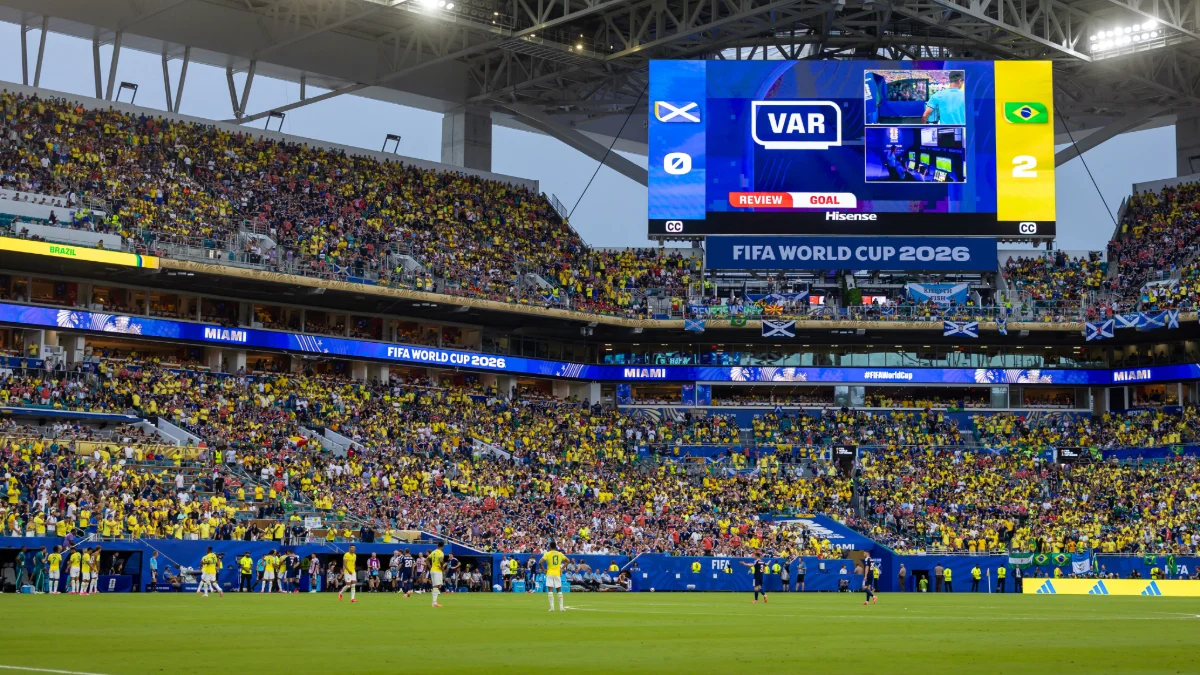
The 2026 FIFA World Cup showcased an unprecedented integration of AI technologies, such as video assistant refereeing (VAR) and real-time data analytics powered by sensor-laden equipment, fundamentally changing the sport’s dynamics. However, beneath the technological spectacle lies a complex economic and labor supply chain, revealing how global datafication and AI have reshaped not only the game itself but also the global workforce supporting it.
What Happened
During the Miami-hosted matches of the 2026 World Cup, FIFA deployed a highly sophisticated AI-augmented system in partnership with Lenovo, their official technology provider. The Competition featured the use of Football AI Pro, an AI assistant that processes thousands of in-game data points to generate tactical insights in real time, and the Adidas smart soccer ball equipped with motion sensors feeding data into the Video Assistant Referee (VAR) system. VAR interventions exceeded 100 during the tournament, providing faster and highly precise officiating that influenced critical match outcomes, including decisions that eliminated teams like Croatia, Iran, and Egypt.
Key Facts
FIFA’s collaboration with Lenovo and Adidas enabled the collection and real-time analysis of detailed player and ball data, visualized through 3D avatars and AI tactical recommendations. This technology facilitated enhanced fairness and precision in refereeing but sparked debates over the potential loss of soccer’s spontaneity.
Underlying this AI deployment is a global labor economy: data annotation work is largely outsourced to lower-income countries including the Philippines, Laos, Cambodia, and others, where workers manually label match footage to feed AI algorithms. This labor supports firms like Impect, Hudl, SkillCorner, and Sportradar, the main data providers serving clubs, federations, media, and betting markets.
The Premier League’s U.S. ownership influx and Arsenal’s early adoption of data analytics highlight the financialization of soccer data. Sony’s Hawk-Eye system operates many of the AI sensor technologies in use at the World Cup.
What This Means
The 2026 World Cup illustrates how AI regulation and governance in sports extend beyond technology to encompass intricate labor relations and economic inequalities, a phenomenon increasingly relevant as AI penetrates other industries. Compliance requirements around data stewardship, transparency, and fair labor practices will likely come under greater scrutiny as soccer’s datafication model—reliant on globalized, often invisible data workers—expands.
This digital transformation also signals a shift in power dynamics within sports, favoring well-funded clubs and tech companies dominating AI technology development and ownership, while data labor remains undervalued and concentrated in the Global South. For regulators, this raises questions about labor rights, data privacy, and the ethics of AI deployment in global entertainment and sports industries.
Fans and stakeholders should expect continued debates over the balance between AI’s promise of precision and fairness, and the preservation of human creativity and subjectivity in sports—a debate that echoes broader societal concerns about AI governance.
Background
FIFA’s embrace of AI is part of a broader trend toward the financialization and “datafication” of soccer that began with early analytics companies like StatDNA, founded in 2009 and later acquired by Arsenal. This introduced systematic data collection and analytics into European football. Outsourcing firms such as Digital Divide Data pioneered the use of low-cost labor in countries like Laos and Cambodia to annotate match footage—an approach reflecting similar global patterns in AI data annotation industries.
The Bigger Picture
Soccer’s AI-driven evolution mirrors trends in the global AI industry, where wealthier nations capture the technological and financial benefits while many of the menial data-processing jobs are offshored to workers in poorer regions. As AI technologies become embedded in more sectors, the social, ethical, and regulatory challenges observed in soccer’s digital transformation may serve as a microcosm for AI’s broader societal impact.
Sources
This article is based on reporting and publicly available information from the following sources:
Read more Artificial Intelligence stories on Goka World News.