
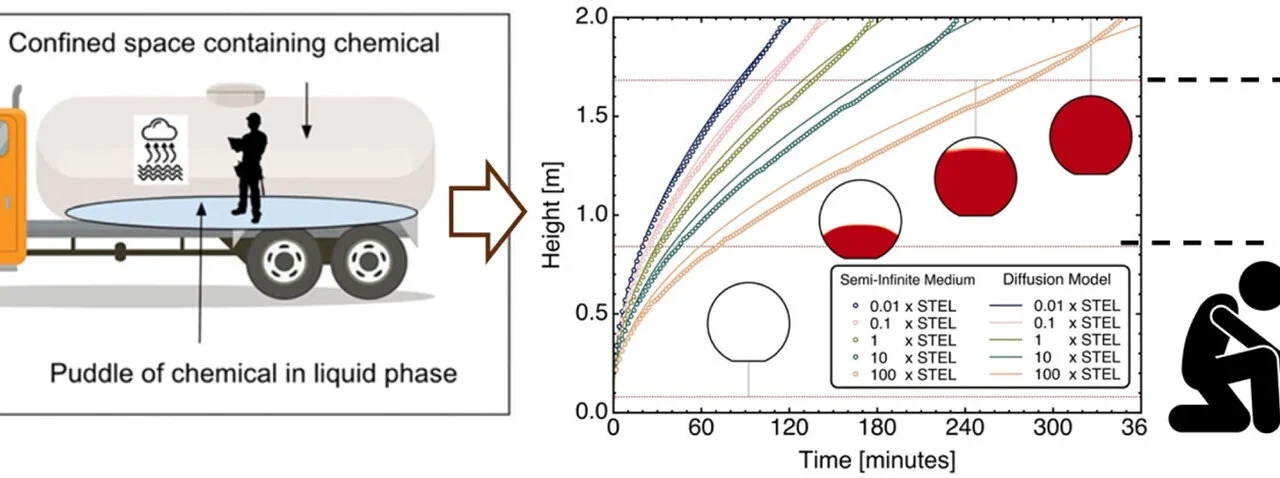
A team of students at the Georgia Institute of Technology developed a computational model designed to estimate the accumulation of hazardous chemical vapors in confined spaces. This model aims to improve safety responses to chemical spills or open containers in work environments, particularly where rapid exposure assessment is critical.
What Happened
During a course within Georgia Tech’s Vertically Integrated Projects (VIP) program, focused on chemical equity and reducing exposures in vulnerable populations, students created a model that simulates time-dependent chemical concentrations in enclosed areas such as tanker trucks. The project culminated in the publication of a research paper titled “Modeling Time-Dependent Chemical Concentrations in Confined Spaces for General Safety Applications” in the journal ACS Chemical Health & Safety in 2026.
Diya Godavarti, then a second-year chemical and biomolecular engineering student, played a leading role in the yearlong interdisciplinary project, which included participants from chemistry, biochemistry, biology, computer science, and neuroscience. The model particularly focuses on simulating benzene vapor, a common industrial solvent, to predict how concentrations change over minutes to hours following a spill or residual chemical pool.
Key Facts
The computational model addresses key factors such as chemical evaporation and dispersion in enclosed environments. It can estimate vapor levels at different heights, accounting for whether individuals are standing or crouching in affected areas. The model simulates chemical concentration dynamics primarily for benzene, chosen as a relevant test case due to its widespread industrial use and health risks.
The model’s development involved oversight and mentoring by chemistry Ph.D. student John Pederson and collaboration with occupational health expert Jenny Houlroyd of Georgia Tech’s Enterprise Innovation Institute’s Safety, Health, and Environmental Services Program.
What This Means
This model offers a practical tool for industrial hygiene scenarios where time is essential in assessing chemical hazards, such as during spills or container breaches in transportation or sanitation sectors. Conventional industrial hygienist assessments can be costly and slow to deploy, but this computational approach provides immediate estimates of exposure risk, potentially improving emergency response and worker safety.
By incorporating factors like chemical vapor buildup over time and space, the model realistically captures exposure scenarios that are often overlooked in less controlled environments. This is particularly important for workers exposed to solvents, coatings, and cleaning products in various industries who may face acute or chronic health risks.
Moreover, the interdisciplinary nature of the project demonstrates how bridging academic disciplines can yield valuable applied research with direct workplace impact. The students’ goal to develop a user-friendly app based on this model could facilitate broad accessibility to safety assessments beyond specialist use, potentially benefiting diverse industries and communities.
Background
The initiative emerged from a recognized disconnect between controlled laboratory chemical safety research and real-world occupational exposures. Pamela Pollet, a faculty member in Georgia Tech’s School of Chemistry and Biochemistry, noticed this gap after consulting on incidents involving commercial workers accidentally exposed to hazardous chemicals. She partnered with occupational health expert Jenny Houlroyd to create a course addressing this divide through interdisciplinary collaboration.
What Comes Next
While the initial model and research paper mark significant milestones, ongoing work focuses on refining the tool and developing an accessible software application for practical use in workplace safety scenarios. The team aims to expand beyond benzene to other chemicals and confined environments, enhancing the model’s versatility and industry relevance.
Sources
This article is based on reporting and publicly available information from the following sources:
Read more Science & Technology stories on Goka World News.