
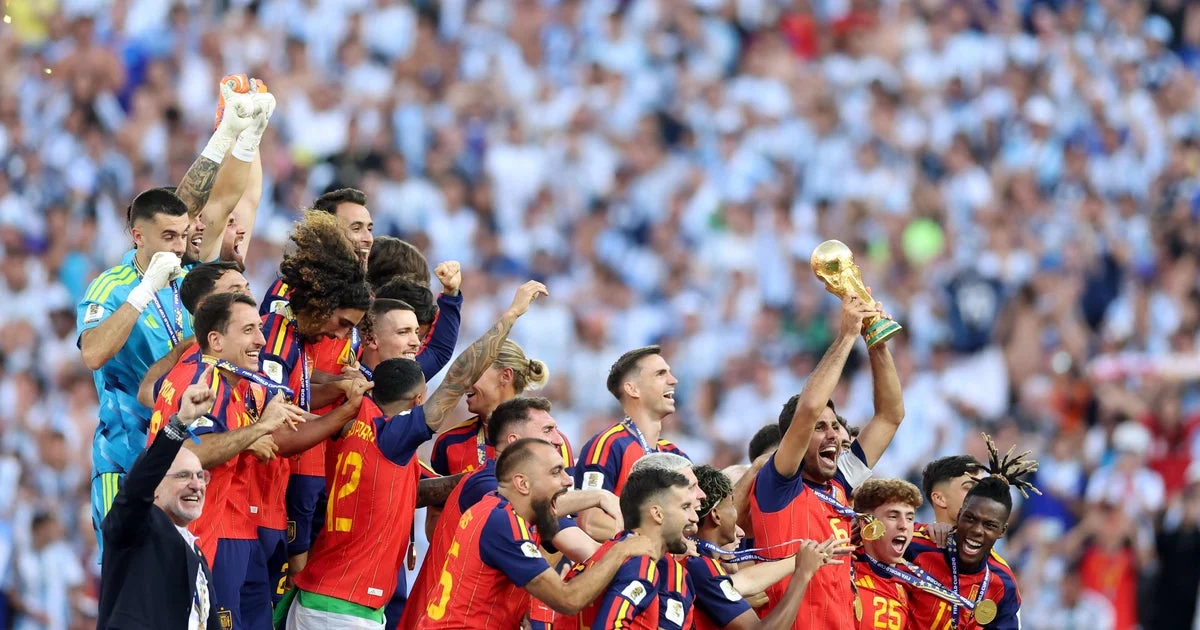
Spain captured the 2026 FIFA World Cup with a hard-fought 1-0 win over Argentina in East Rutherford, New Jersey, showcasing dominant play and resilience in a match watched worldwide. The victory marks Spain’s second men’s World Cup title and distinguishes the country as the first to simultaneously hold both men’s and women’s soccer crowns, underscoring their rising stature in global soccer.
What Happened
The final took place on July 19, 2026, at MetLife Stadium in New Jersey, one of the three host countries for the largest World Cup ever, featuring 48 national teams. Spain controlled much of the match, outshooting Argentina by 20 to 3 but failed to score in regular time. Argentina faced a major setback late in the second half when Enzo Fernández received a second yellow card in stoppage time, reducing his team to 10 men for extra time.
In the second period of extra time, substitute Ferran Torres scored the decisive goal at 106 minutes by placing a left-footed shot just under the crossbar past Argentina’s goalkeeper Emiliano Martínez. Torres’s strike was his first goal in the tournament and came after he entered the match in the 62nd minute. Despite a late free-kick attempt by Spain’s Lamine Yamal that was saved by Martínez, Spain maintained control until the final whistle.
Key Facts
Spain’s defensive strength was notable as they conceded only one goal throughout the eight-match tournament, setting a record for the fewest goals allowed by a World Cup champion. Spain remained unbeaten in their last 38 games, the longest streak ever by a European team. Argentina, the defending champion, was seeking to become the first nation since Brazil in 1962 to win back-to-back titles but fell short.
Goalkeeper Emiliano Martínez recorded 12 saves, the most ever made in a World Cup final, demonstrating Argentina’s defensive effort under pressure. The tournament saw over six million fans attend matches across Canada, Mexico, and the United States. Noteworthy attendees at the final included world leaders and celebrities, reflecting the event’s global prominence.
What This Means
Spain’s victory solidifies its position as a powerhouse in international soccer, reflecting a golden generation that has now set multiple records and achieved significant milestones. The dual holding of men’s and women’s World Cup titles highlights the country’s comprehensive development programs and commitment to soccer across genders. The tournament’s success in North America, involving three host countries and record attendance, signals a broadening of soccer’s global footprint, especially in regions historically less dominant in the sport.
For Argentina, the loss represents a halt in hopes of historic consecutive World Cup wins. The final’s tense moments and disciplinary setbacks underline the high stakes and emotional intensity surrounding the clash of two soccer giants. Globally, the tournament has brought unprecedented attention to the sport, with cities and host nations benefiting from heightened international engagement and tourism.
Background
This was Spain’s second World Cup final appearance, their first being in 2010 when they won the title in South Africa. Argentina, with seven final appearances and three prior titles, entered the tournament as the defending champions. The two teams last met in a World Cup group stage in 1966, where Argentina won 2-1. The 2026 championship thus represented a notable rematch decades later under vastly different circumstances.
What Comes Next
Following the final, Spain will continue to build on its unbeaten run and prepare to defend its dual titles in future international tournaments. The 2026 FIFA World Cup has set expectations for forthcoming events, including the women’s tournament, where Spain also holds the crown. The success of multi-nation hosting may influence future World Cup bids and organizational structures. For Argentina, rebuilding and strategizing for upcoming competitions will be critical after the narrow final defeat.
Sources
This article is based on reporting and publicly available information from the following source:
Read more World News stories on Goka World News.