
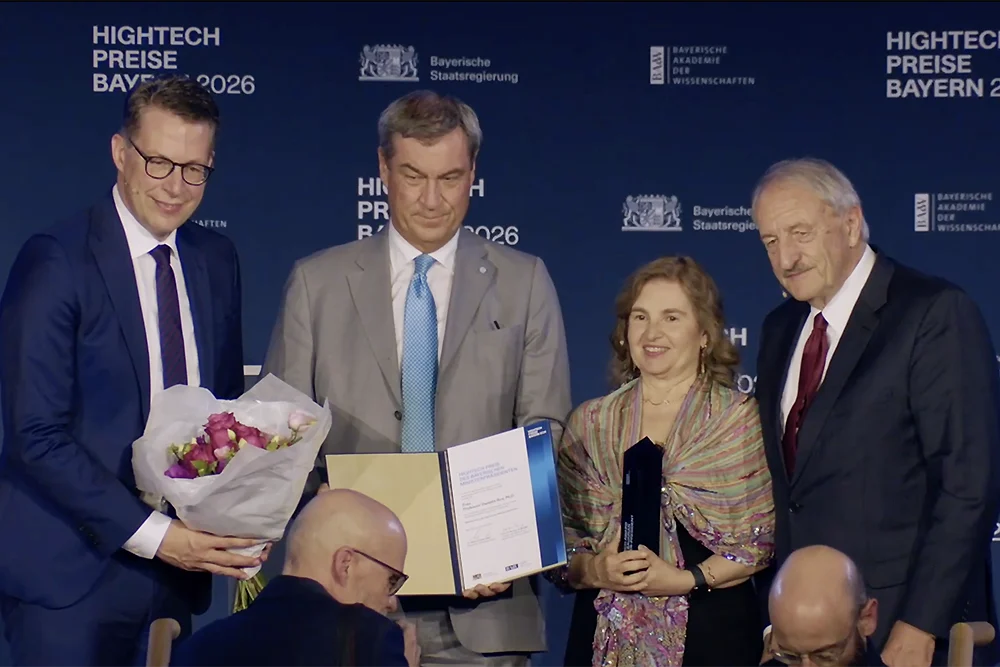
Daniela Rus, director of the Massachusetts Institute of Technology’s Computer Science and Artificial Intelligence Laboratory (CSAIL), has been awarded the prestigious 2026 High-Tech Prize by the Bavarian Minister-President. This accolade, the most financially significant award for technology and engineering in Germany, recognizes Rus’s pioneering work in robotics, autonomous systems, and artificial intelligence, including advances in soft robotics and brain-inspired AI.
What Happened
On July 23, 2026, Rus formally received the Bavarian Minister-President’s High-Tech Prize at the Herkulessaal of the Munich Residence. The award is jointly bestowed by the Bavarian State Government and the Bavarian Academy of Sciences and Humanities. The selection committee highlighted four major contributions in Rus’s 30-year career: self-organizing robot collectives, soft robotics, autonomous mobility, and brain-inspired artificial intelligence. These innovations exemplify sustained efforts to develop physical AI systems capable of adapting and functioning outside controlled laboratory environments.
Key Facts
Daniela Rus is the Panasonic Professor of Computer Science and director of MIT’s CSAIL. Her work spans software algorithms and physical robotics, including the development of ingestible origami robots for medical applications and autonomous modular boats that can assemble into bridges or other infrastructure. Her research group also developed liquid neural networks, inspired by the nervous system of simple organisms, supporting efficient AI control with minimal computational requirements. Rus’s innovations have led to spinoff companies such as Liquid AI, focusing on lightweight, hardware-efficient AI models.
The Bavarian High-Tech Prize represents Germany’s highest-endowed technology award. Rus’s prior distinctions include the 2025 IEEE Edison Medal, the 2024 John Scott Award, and election to prestigious institutions like the National Academy of Engineering and the American Academy of Arts and Sciences.
What This Means
Rus’s recognition underscores the increasing importance of physical artificial intelligence—robots and AI systems that operate in unpredictable real-world settings rather than confined lab environments. Her focus on soft robotics and adaptive algorithms addresses challenges in safety, efficiency, and flexibility, which are critical for expanding robotics applications into industries like healthcare, transportation, agriculture, and environmental monitoring.
This award highlights a shift in how technology hubs and governments value the integration of AI with tangible hardware systems capable of dynamic interaction with their surroundings. For consumers and industries alike, Rus’s work paves the way for more versatile, resilient, and human-compatible robotics, moving beyond static or narrowly programmed machines to collaborative tools that extend human capabilities in everyday and professional contexts.
Background
Daniela Rus has been a leading figure in robotics and AI research for decades, directing MIT’s Computer Science and Artificial Intelligence Laboratory since 2012. She has consistently pushed the boundaries of how AI can be embedded in physical devices, founding the Distributed Robotics Laboratory to explore autonomous cooperation among robot teams. Her research into soft robotics seeks to overcome limitations of traditional rigid robots, emphasizing safety and adaptability.
Rus’s leadership also contributed to advances in neural network design, pioneering liquid neural networks that are computationally efficient and able to generalize across environments. These developments are influencing the emerging field of physical AI, which integrates perception, reasoning, and motion in robots that operate autonomously outside the lab.
What Remains Unclear
Details about the specific financial value of the Bavarian High-Tech Prize were not disclosed in the sources. Furthermore, while Liquid AI’s commercial ambitions and technology are noted, exact product timelines, market impacts, and partnerships have not been publicly detailed.
What Comes Next
Rus’s pioneering work continues at MIT CSAIL, where ongoing research into brain-inspired and autonomous robotic systems is expected to expand. Announcements regarding new projects, commercial developments from Liquid AI, or further collaborations have yet to be confirmed.
Sources
This article is based on reporting and publicly available information from the following sources:
Read more Science & Technology stories on Goka World News.