
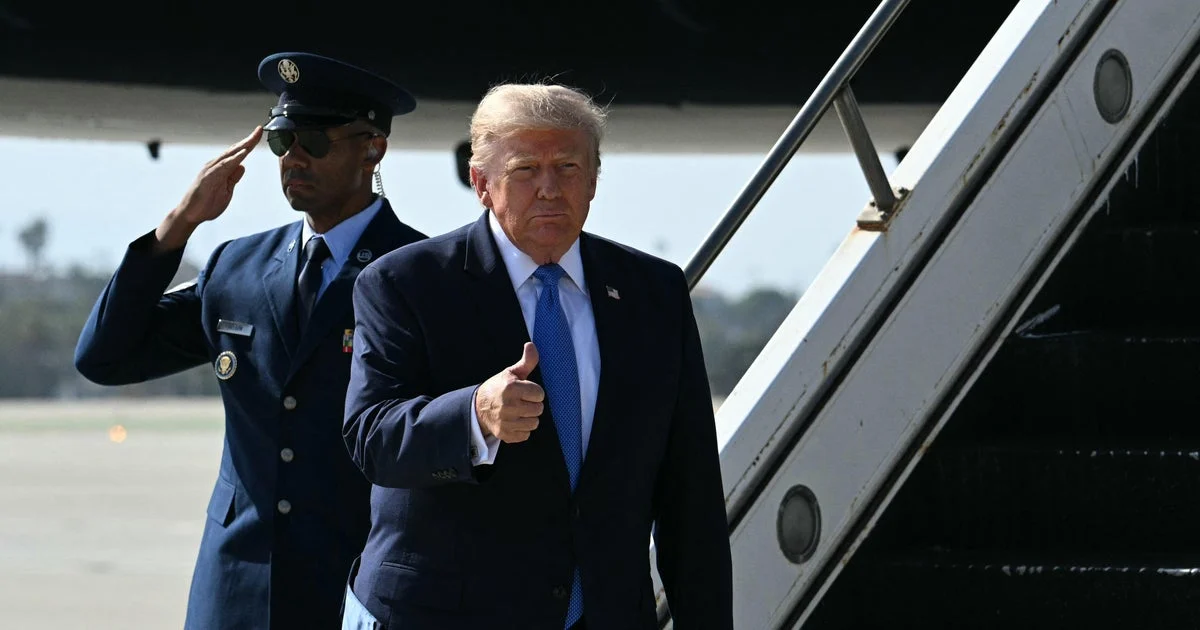
President Donald Trump suggested on August 4 that an agreement to reopen the Strait of Hormuz, a critical maritime chokepoint, could be finalized as soon as Wednesday or Thursday, reflecting progress in ongoing talks between Iran and Oman. This potential deal aims to establish a safe and jointly managed route for shipping traffic amid heightened tensions in the Persian Gulf region.
What Happened
During a press interaction while traveling in California, President Trump stated that “a lot of progress had been made” toward reopening the Strait of Hormuz, and that a formal announcement may occur soon. His remarks came amid reports that Iran and Oman had agreed on a route for ships transiting the strait and were finalizing a joint management framework.
Tehran’s foreign ministry confirmed the agreement on the geographical coordinates for the route and indicated the joint statement covering the terms was being drafted. According to Iranian officials, the arrangement would allow ships to enter the strait via a route near Iran, coordinated by Tehran, and exit through a route near Oman, overseen by Muscat. Despite the progress, the Iranian government noted that “certain third parties,” referring implicitly to the United States, continue to present security challenges that could impact safe passage.
The potential agreement reportedly would not include transit fees or tolls for ships. However, reports conflict on this point, with some officials mentioning service fees to cover security and environmental protection, a proposal publicly opposed by President Trump.
Key Facts
The key elements of the negotiations include:
- Iran and Oman have agreed on the precise route for maritime transit through the Strait of Hormuz, a strategic waterway through which about a fifth of the world’s oil passes.
- The deal is part of a memorandum of understanding from June, which envisions a 60-day free transit period through the strait.
- President Trump has publicly opposed any tolls or fees imposed on vessels transiting the waterway, warning that if fees are charged, the U.S. would impose reciprocal fees.
- The U.S. administration has simultaneously maintained a naval blockade and other measures directed against Iran amid broader conflict tensions.
What This Means
This emerging agreement could mark a significant diplomatic breakthrough in a region that has long been a flashpoint for military confrontations and economic disruptions. The Strait of Hormuz is vital for global energy security, as an estimated 20% of the world’s petroleum passes through it.
If successfully implemented, the joint Iran-Oman management would provide a structured mechanism to reduce the risk of maritime incidents and bolster the security of one of the world’s most strategically critical sea lanes. It may ease some immediate tensions tied to the ongoing regional conflict involving Iran and coalition forces, potentially revitalizing diplomatic channels between the U.S. and Iran.
For international shipping companies and global energy markets, a stable and secure Strait of Hormuz would reduce the threat of disruptions that have previously led to spikes in oil prices and insurance costs. However, ongoing uncertainty about U.S. objections and Iran’s stance on third-party actions means that the sustainability of the agreement remains delicate.
Background
The Strait of Hormuz has been a longstanding point of tension, particularly since the U.S. and Israel initiated military action against Iran in February. The U.S. has since mounted naval operations aimed at blockade and containment of Iranian activities. Negotiations for safe transit through the strait have been ongoing, with Oman acting as a key mediator.
In June, a memorandum of understanding was established for a 60-day period of free vessel transit, paving the way for the current talks to define the physical route and management arrangements.
What Remains Unclear
It remains uncertain whether the final agreement will satisfy all parties’ conditions, especially regarding security guarantees and transit fees. It is also not confirmed if the U.S. will formally endorse or participate in joint management under the terms discussed. The actual implementation timeline and enforcement mechanisms have yet to be disclosed publicly.
What Comes Next
The Iranian and Omani governments are expected to finalize and publicly announce the joint statement shortly. Following this, the U.S. and Iran are anticipated to return to the negotiating table to discuss terms of free transit and related security arrangements, based on the June memorandum of understanding.
Sources
This article is based on reporting and publicly available information from the following source:
Read more World News stories on Goka World News.