
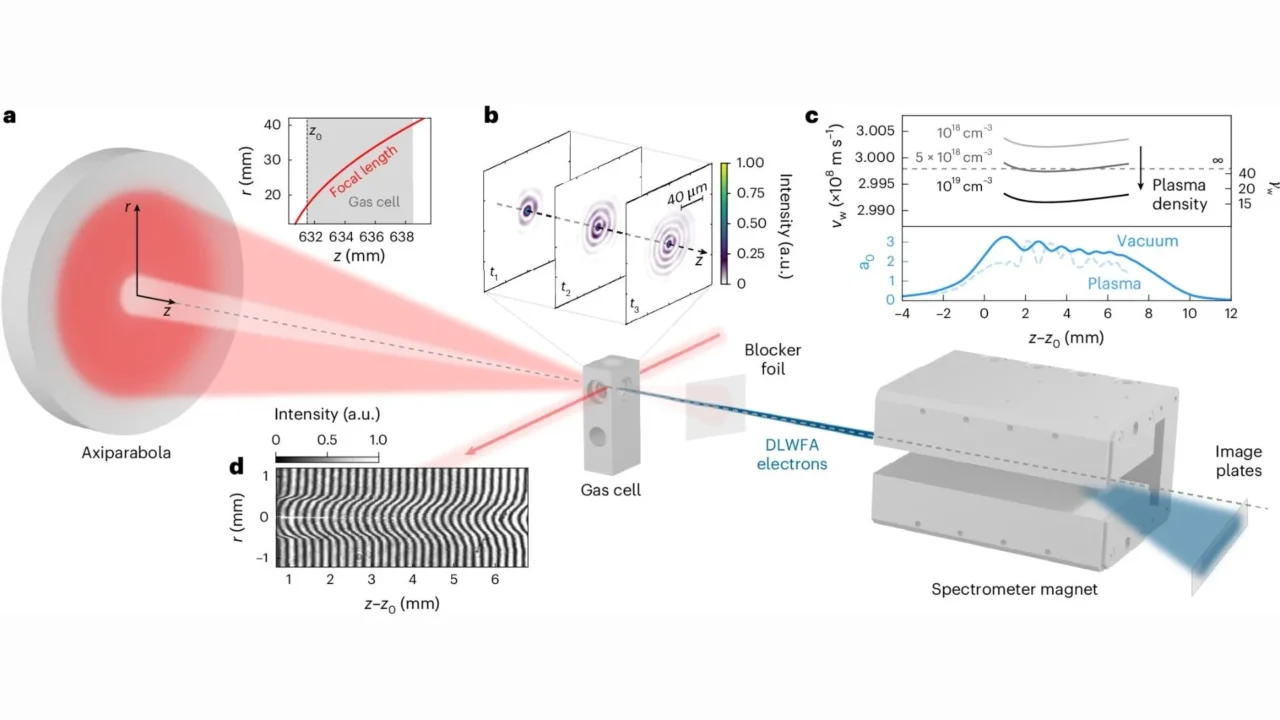
A team from the University of Rochester’s Laboratory for Laser Energetics has demonstrated a laser technique that overcomes the longstanding energy limitation in plasma-based particle accelerators. By using a specially engineered laser pulse known as a “flying focus,” the researchers accelerated electrons to energies more than twice the traditional dephasing limit, signaling a key advance toward more compact and efficient accelerator designs.
What Happened
In a study published in Nature Physics in 2026, the researchers developed and applied a flying focus laser pulse to eliminate the dephasing effect that limits energy gain in laser-plasma accelerators. The experiment used a hydrogen-argon gas mixture and sophisticated optics, including an axiparabola mirror, to produce a laser intensity peak that could sweep forward at nearly the speed of light independently of the laser pulse’s group velocity. This innovation enabled the driving plasma wave to travel at a speed closely matched to the ultra-relativistic electrons.
The technique, referred to as dephasingless laser wakefield acceleration (DLWFA), allowed electrons to gain energy over a longer distance without outrunning the accelerating plasma wave. Electron beams achieved energies up to 396 ± 14 MeV, more than double the 185 MeV energy limit expected under conventional setups for the same plasma density and distance.
Key Facts
The study reports that the plasma density was critical, with successful dephasingless acceleration occurring only within a narrow window of 4.5 to 5.4 × 1018 cm–3. The accelerating electric field in the plasma wakefield exceeded 1 gigavolt per centimeter, significantly stronger than traditional radio-frequency accelerators. The flying focus pulse was generated by the axiparabola optic, whose radius-dependent focal length produced an extended focal line allowing the intensity peak to propagate forward at a controllable speed close to light speed. Ionization injection, enabled by argon atoms, permitted controlled electron injection directly into the accelerating wave.
What This Means
This advance addresses a fundamental obstacle in laser-plasma acceleration: the speed mismatch between electrons and their driving plasma wave that causes premature energy gain cessation known as dephasing. By tuning the plasma wave’s velocity to match electron speed, flying focus pulses extend the effective acceleration length within a compact setup. For practical applications, this could dramatically reduce the size of accelerators needed to reach very high particle energies—potentially shrinking devices that currently require tens of meters to under a meter in length.
Such compact accelerators could find uses in medical radiation therapy, ultrafast imaging, and particle physics experiments, where large-scale accelerator infrastructure poses cost and logistical challenges. Moreover, the flying focus approach allows fine control over the electron injection and acceleration process, potentially improving beam quality and stability essential for precision applications.
Background
Laser-plasma accelerators rely on ultrashort, high-intensity laser pulses to ionize gas and create plasma waves whose electric fields can accelerate electrons at gradients orders of magnitude higher than conventional accelerators. However, electrons traveling near light speed eventually outrun the slower plasma wave driven by the laser pulse group velocity, limiting maximum energy — a problem known as dephasing. Previous approaches lowered plasma density to prolong this limit, but this required impractically long plasmas to reach energies above 10 GeV.
The flying focus concept, theoretically proposed in 2020, aims to decouple the plasma wave velocity from the laser pulse group velocity by engineering the spatial and temporal laser focal structure, enabling velocities near light speed. This experiment is the first to demonstrate this concept experimentally.
What Remains Unclear
The current demonstration is a proof of concept at sub-GeV energy levels, and further research is needed to scale the technique toward the 100 GeV range. Additionally, improvements in beam quality, energy spread, and reproducibility remain necessary before practical adoption. The use of additional optical components such as echelons to further control the wakefield velocity and electron bunch positioning has been proposed but not yet tested.
What Comes Next
The researchers plan to incorporate supplementary optics to refine the velocity matching between wakefield and electrons, aiming for finer acceleration control. Scaling the setup to higher energies and improving beam parameters will be essential milestones toward practical, compact laser-plasma accelerators.
Sources
This article is based on reporting and publicly available information from the following sources:
Read more Science & Technology stories on Goka World News.