
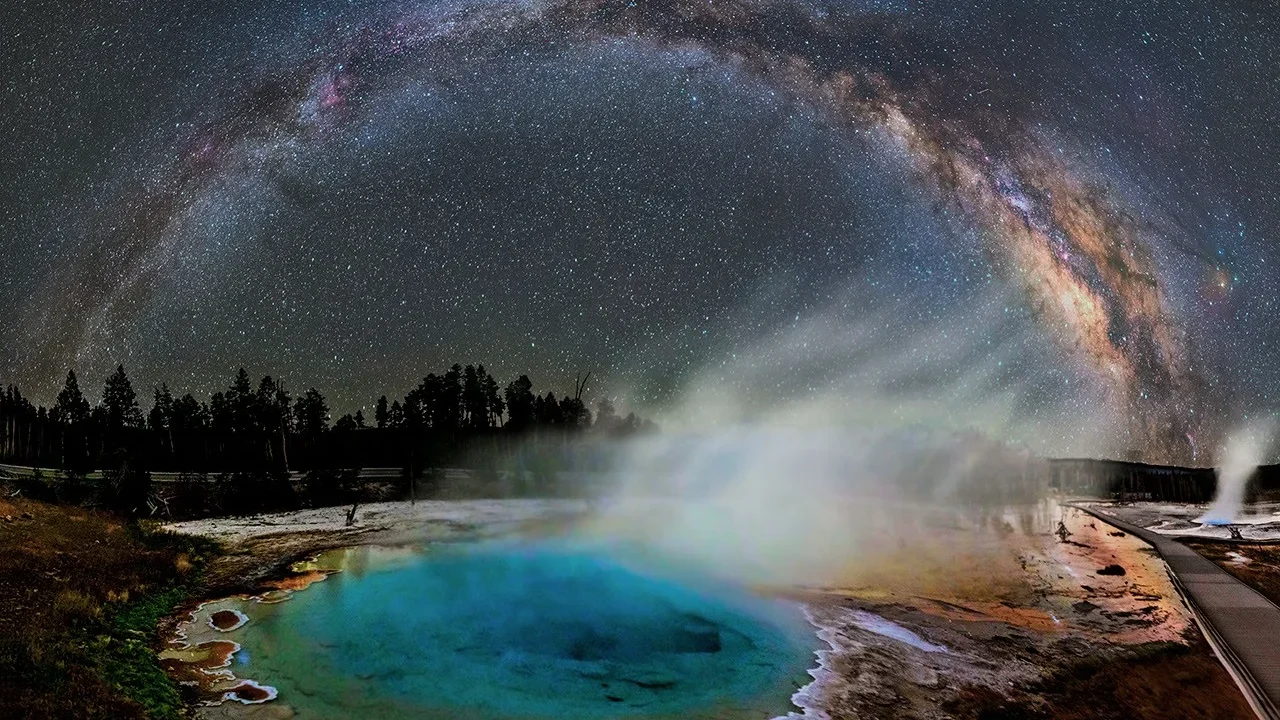
An extraordinary panoramic photograph taken in 2014 showcases the central band of the Milky Way galaxy arching high over Yellowstone National Park’s Silex Spring in Wyoming, USA. The image, comprising 16 stitched exposures, captures the natural spectacle of our galaxy’s star-filled core set against the vibrant colors and steaming heat of a Yellowstone hot spring.
What Happened
The panoramic photograph was created in 2014 using 16 images merged to produce a wide-angle view of the night sky over Yellowstone National Park. The featured location is Silex Spring, a roughly 10-meter-wide geothermal pool illuminated artificially to highlight its layered bacterial mats that produce striking colors. Steam visibly rises from the spring, which is heated by magma beneath the Yellowstone Hotspot. Far beyond, the Milky Way’s central band, illuminated by billions of stars, arches prominently overhead.
Key Facts
Silex Spring is powered by underground magma linked to the Yellowstone Hotspot, generating geothermal activity visible as steam and vibrant microbial mats in the spring. The Milky Way band, independent and billions of light-years away, is the dense plane of stars comprising our galaxy’s core. The composite panorama consists of 16 individual photographs captured in 2014 that reveal the interplay of earthly geothermal activity and distant cosmic light.
What This Means
This image elegantly juxtaposes terrestrial and astronomical phenomena, emphasizing the stark contrast between the dynamic geology of Earth and the vast, ancient universe beyond. For observers and the general public, it vividly demonstrates how natural wonders on our planet—like Yellowstone’s hot springs, shaped by volcanic forces—exist alongside the expansive cosmos. It fosters a deeper appreciation of both the planet’s geological processes and humanity’s place within the galaxy.
Moreover, the photograph reminds viewers of the ongoing volcanic threat posed by the Yellowstone Hotspot, which caused a supervolcanic eruption approximately 640,000 years ago, an event with continent-wide implications. Seeing the Milky Way framed above this scene connects cosmic cycles with geologic timescales, grounding space science within a familiar Earthly context.
Background
Yellowstone National Park sits atop the Yellowstone Hotspot, a volcanic plume responsible for ongoing geothermal phenomena including geysers, hot springs, and steam vents. About 640,000 years ago, a massive supervolcanic eruption reshaped the region, a reminder of the potential risk the hotspot poses today. The Milky Way, by contrast, is the spiral galaxy that contains our Solar System, with its bright central band visible in dark-sky locations worldwide.
What Remains Unclear
While the image’s artistic and scientific value is clear, the exact future activity of the Yellowstone Hotspot remains uncertain. Scientists continue to monitor the area closely to detect any signs of major volcanic activity, but no imminent eruption has been confirmed.
Sources
This article is based on reporting and publicly available information from the following sources:
Read more Science Discoveries stories on Goka World News.