
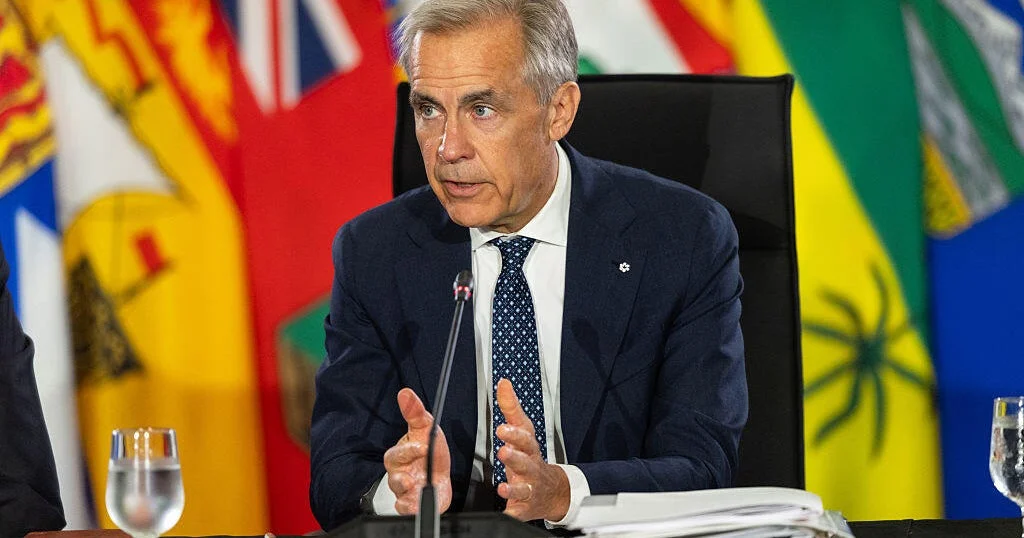
The United States imposed 50% tariffs on $20 billion worth of Canadian products early Saturday following the breakdown of last-minute trade talks, escalating tensions between the two longstanding allies. In response, Canadian Prime Minister Mark Carney announced an immediate decision to match these tariffs “dollar for dollar” to protect Canadian workers and businesses.
What Happened
The tariff escalation unfolded after negotiations between U.S. and Canadian officials failed to produce a final trade agreement. The events centered on the strained trade relations despite ongoing dialogue. U.S. Trade Representative Jamieson Greer told reporters on Friday that Canada declined to accept the terms agreed upon earlier that week, prompting the U.S. to move forward with tariffs at midnight. Canadian Prime Minister Carney responded by halting trade talks and recalling Canadian negotiators to Ottawa.
The tariffs target about 5% of Canadian exports to the U.S., affecting a diverse set of products including hockey sticks and medical supplies like tongue depressors. Originally set to take effect Wednesday at 12:01 a.m., the Trump administration delayed the tariffs for three days in a final attempt to reach a deal, but no agreement was reached.
Key Facts
The U.S. had maintained a 10% tariff on Canadian goods for some time, though the majority of imports from Canada remain exempt under the USMCA (United States-Mexico-Canada Agreement). The new 50% tariffs are a major increase and apply to roughly $20 billion in goods. Canada is the U.S.’s second-largest trading partner, with bilateral goods and services trade totaling $880 billion last year.
Canada’s retaliation plan includes imposing equivalent tariffs on American products to shield domestic industries. The broader US-Canada economic relationship, including previous disputes over NATO funding and infrastructure projects such as the Detroit-area bridge, has been notably contentious during the Trump administration.
What This Means
The immediate imposition of these tariffs marks a significant escalation in the trade friction between two of the world’s closest economic partners. While the dollar value of goods affected may represent a fraction of total bilateral trade, the move signals deepening protectionist policies under the current U.S. administration. For American consumers and Canadian producers, this could mean increased costs and disruptions in supply chains, particularly in sectors reliant on cross-border manufacturing and trade.
Canada’s pledge to respond with matching tariffs underscores the risk of a full-scale trade conflict that could ripple through North American markets. Businesses on both sides face uncertainty as companies weigh the impact of tariffs on product pricing and competitiveness. The broader political fallout may further strain U.S.-Canada diplomatic relations, as economic disputes feed into existing tensions over security and infrastructure cooperation.
For policymakers and businesses, the situation highlights the fragility of the USMCA framework and the challenges of navigating bilateral trade amid shifting political priorities. It also raises questions about the future of negotiations and whether a new agreement or compromise is achievable, given the current impasse.
What Comes Next
At this time, Canadian officials have recalled negotiators to Ottawa, signaling a pause in direct talks. The U.S. Trade Representative’s office has not indicated immediate plans for renewed negotiations, leaving the situation in a holding pattern for the moment. Both countries face pressure to manage the economic repercussions and explore pathways to de-escalate this tariff standoff.
Sources
This article is based on reporting and publicly available information from the following source:
Read more Politics stories on Goka World News.