
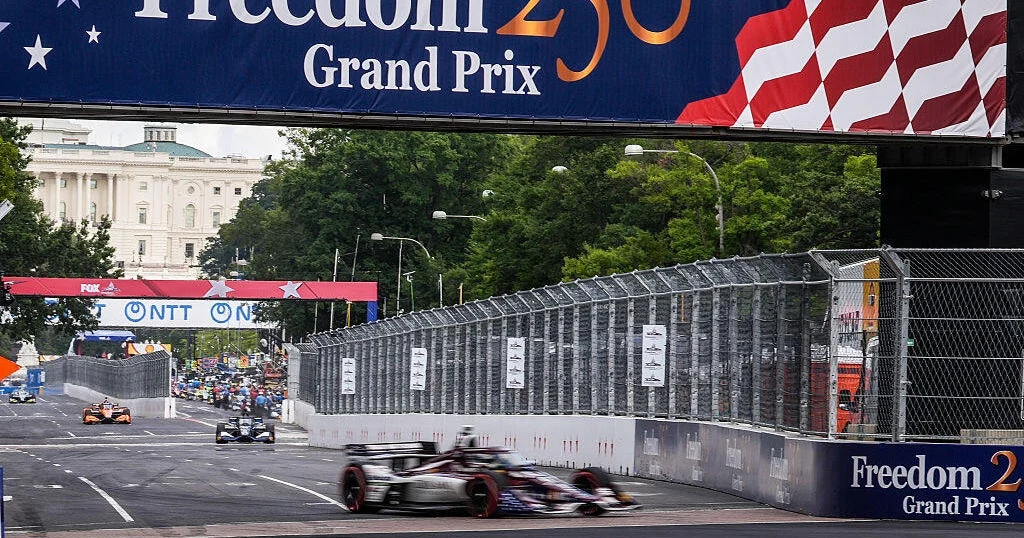
IndyCar’s Freedom 250 Grand Prix made history on August 23, 2026, as the first major auto race held in Washington, D.C., in over two decades. The event, part of America’s 250th birthday celebrations, received direct support from President Trump, who initiated the race start with a ceremonial lap and green flag wave. The race followed an extensive planning process involving federal executive orders and close collaboration between city and national authorities.
What Happened
The Freedom 250 Grand Prix took place on August 22 and 23 along a newly designed 1.7-mile circuit running through the National Mall and surrounding streets, including a stretch of Pennsylvania Avenue near the White House. Twenty-five drivers competed, with American Kyle Kirkwood winning, followed by Denmark’s Christian Lundgaard and teammates Will Power and Marcus Ericsson placing third and fourth.
The race weekend included practice sessions and qualifying rounds on Saturday, setting the starting grid for Sunday’s main event. President Trump and First Lady Melania Trump began the race with a ceremonial slow lap in the presidential limousine, known as the Beast, and Trump’s wave of the green flag officially launched the competition. This marked the first IndyCar event in Washington, D.C., a milestone more than 24 years after the city last hosted a major auto race.
Key Facts
- The 1.7-mile course spanned six left turns and one right turn, wrapping around key landmarks such as the U.S. Capitol, National Mall, and several Smithsonian museums.
- Organizers closed multiple tourist spots and roads in the area, including three Smithsonian museums, the National Gallery of Art, and the National Archives, limiting access during the event.
- The race was largely funded by Penske Corp., owner of IndyCar, with an approximate budget exceeding $21 million, well above the company’s cost for its Detroit Grand Prix.
- Federal support came through a January executive order signed by President Trump, which authorized the race’s route and facilitated permits without congressional approval.
- The Secret Service and local law enforcement provided security, with the government bearing these specific costs while the race organizers covered most expenses.
What This Means
The successful hosting of the IndyCar race in Washington, D.C., underscores a rare instance of federal executive action enabling a major sporting event that intersects national heritage and urban space. It highlights how executive authority can circumvent traditional legislative hurdles to achieve large-scale event planning, especially in sensitive locations like the National Mall and Pennsylvania Avenue.
For residents and visitors, the event brought considerable disruption to routine access and tourism, illustrating the logistical challenges of staging such events in a capital city. Politically, the race serves as a high-profile celebration aligning with President Trump’s agenda to mark the nation’s 250th anniversary with bold, visible festivities.
The race also reflects the growing cultural significance of auto racing beyond traditional venues, elevating the sport’s profile in the U.S. capital and possibly setting a precedent for future events that blend entertainment and national symbolism. However, the cost and scale of infrastructure changes and security measures also prompt questions about balancing public access, governmental priorities, and private organization interests in public spaces.
Background
IndyCar, ranked among the world’s premier open-wheel racing series, traditionally stages its marquee event at the Indianapolis 500. This marked the first IndyCar race in D.C. since the Cadillac Grand Prix in 2002. The Freedom 250 concept originated over a year ago, led by Penske Corp.’s Bud Denker, who faced initial congressional resistance until the executive order paved the way.
President Trump’s administration aimed to make the 250th anniversary celebrations elaborate, incorporating diverse public spectacle events, including UFC fights at the White House lawn earlier in the summer. Hosting an IndyCar race in the capital ties into this broader effort to generate patriotic-themed national events.
What Comes Next
Following the race, dismantling barriers and reopening closed roads and facilities is expected to take until mid-September. Organizers indicated any race profits will be donated to charities selected by D.C. Mayor Muriel Bowser. The lasting effects on the Capitol grounds and National Mall usage, in terms of precedent and operational policy, remain to be seen.
Sources
This article is based on reporting and publicly available information from the following sources:
Read more US News stories on Goka World News.