
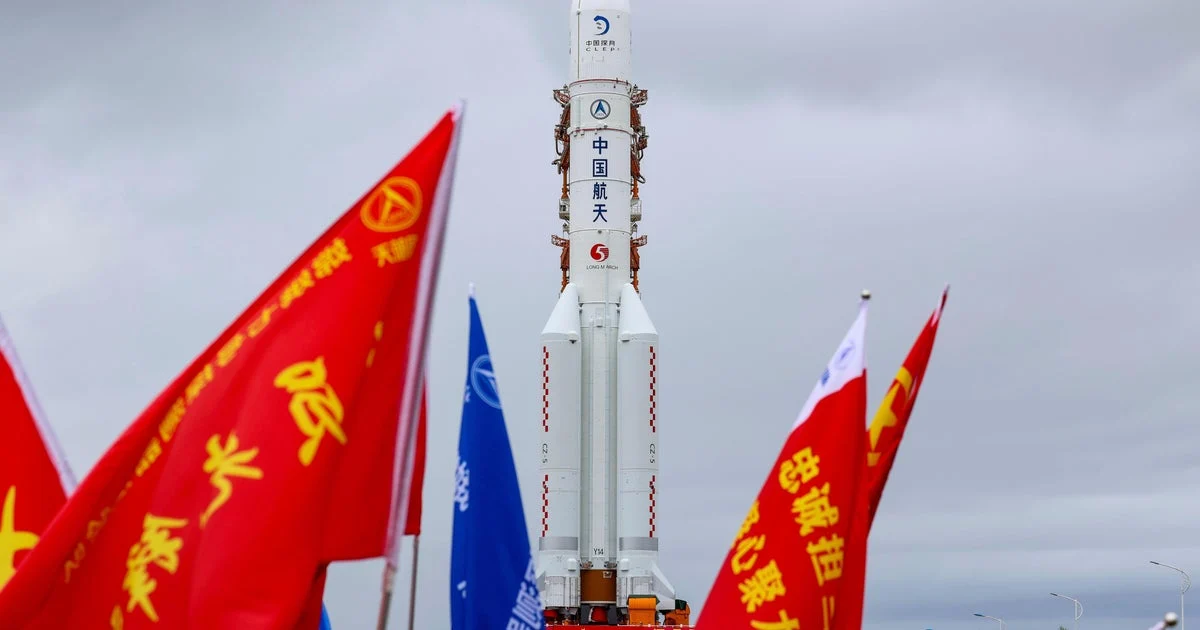
China has announced the postponement of its Chang’e-7 lunar mission after officials determined that the mission did not meet the necessary launch conditions. This decision delays China’s plans for lunar exploration this year and impacts its ongoing ambitions in the space race, particularly concerning the moon’s south pole.
What Happened
The China Manned Space Agency declared on Sunday, August 23, 2026, that the Chang’e-7 mission, originally scheduled to launch from the Wenchang Space Launch Site on Hainan Island in southern China, would be postponed. The postponement is due to the mission not satisfying the required launch criteria, and it “cannot take place during the planned window this year.” The announcement followed a comprehensive evaluation prioritizing prudence, reliability, and mission success, though no specific reasons beyond these principles were provided.
Key Facts
The Chang’e-7 mission is the seventh in China’s Chang’e lunar exploration program. It aims to conduct important research, including exploring permanently shadowed craters and performing environmental and resource surveys of the lunar south pole, areas believed to hold water ice and other resources vital for sustained lunar presence. Preparations at the Wenchang launch site had been underway for several weeks. The Chang’e series is named after a Chinese moon goddess, with Chang’e-6 notably returning moon samples from the far side of the moon in 2024, marking a global first. China competes with the United States in the space race, with both countries pursuing crewed moon missions and plans to establish near-permanent lunar bases.
What This Means
The delay of the Chang’e-7 mission underscores the challenges inherent in lunar exploration and the meticulous caution China is exercising to ensure mission success. The postponement could slow China’s timeline for establishing a continuous lunar presence, impacting its strategic ambitions in space. Globally, it reflects the intense competition with the United States and other space-faring nations, which are all striving to secure a foothold on the moon for scientific, strategic, and potentially economic reasons.
For international observers and the broader scientific community, the pause demonstrates the complexity and risk of lunar missions. It also signals China’s prudence amid a high-stakes space race, where technical readiness and reliability are crucial amid geopolitical rivalry. The mission’s focus on the lunar south pole aligns with growing global interest in this region for its resource potential, making the delay consequential beyond China’s borders.
Background
The Chang’e lunar exploration program has steadily expanded China’s capabilities on the moon. The Chang’e-6 mission in 2024 marked a milestone as the first to return lunar samples from the moon’s far side. Meanwhile, the United States has intensified efforts with NASA’s Artemis program, including the recent Artemis II crewed mission in April 2026, the first human travel around the moon in over 50 years. NASA Administrator Jared Isaacman recently characterized the current lunar efforts as a renewed “space race” between the U.S. and China, both aiming for astronauts—referred to as “taikonauts” in China—to visit and potentially settle on the moon in the coming years.
What Comes Next
The China Manned Space Agency has not specified a new launch date for Chang’e-7 but stressed that mission timing will proceed once all conditions ensure success. Observers will watch for further updates on China’s lunar agenda and how this postponement affects its broader space exploration timeline, particularly as NASA and other countries advance their own efforts.
Sources
This article is based on reporting and publicly available information from the following source:
Read more Space & NASA stories on Goka World News.