
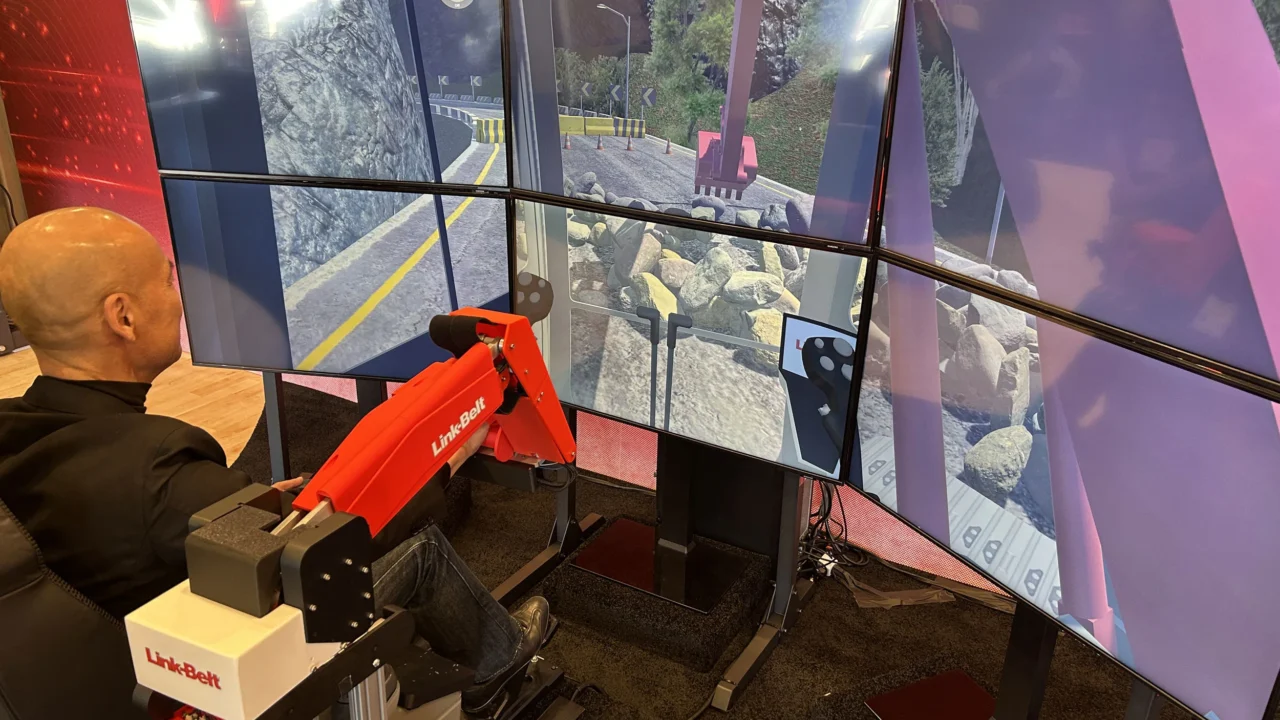
MIT engineers have designed a novel controller that mimics the natural movements of an excavator’s arm and bucket, dramatically simplifying the operation of construction diggers. This new interface, paired with an immersive six-screen virtual simulator, was reported in the Journal of Computing and Civil Engineering and promises to reduce the extensive training period operators typically require.
What Happened
In collaboration with Sumitomo Heavy Industries of Japan, MIT researchers led by Hermano Krebs developed a controller shaped like a miniature excavator arm. Users operate the controller by physically moving their own arm and hand to mirror typical digging motions. These movements are translated in real-time to a digital excavator displayed in a virtual environment, spanning diverse and realistic excavation tasks such as scooping gravel, grading trenches, and clearing debris. Over a seven-day trial comparing this World-Space Interface (WSI) to traditional joystick simulators, novices using the new system matched expert-level performance from the outset, while joystick users showed a typical slower learning curve.
Key Facts
The findings appeared in the Journal of Computing and Civil Engineering. The research team includes MIT engineers Hermano Krebs, Moises Alencastre-Miranda, Joao Buzzatto, and Eran Beeri Bamani, alongside Sumitomo Heavy Industries collaborators. Volunteers trained on 15 virtual excavation scenarios replicating construction sites, mining areas, highways, and other environments across a weeklong period. The interface was tested against traditional joystick controls, which require operators to mentally map joystick movements to the excavator’s arm, bucket, and cab motions. The new design replaces this map with a direct physical mimicry.
What This Means
This development has the potential to revolutionize the training and operation of heavy construction machinery by removing the steep learning curve associated with joystick controls. Novice operators can achieve proficiency rapidly, which is significant in contexts like Japan’s aging construction workforce where new qualified operators are needed urgently. Beyond training, the interface could transform remote operation capabilities, enhancing safety in hazardous environments by allowing operators to control diggers from secure locations using natural arm motions. The intuitive design may also reduce operator fatigue and cognitive load, potentially improving productivity and safety on job sites.
Background
Traditional excavator operation heavily depends on mastering the coordination of joysticks to manipulate multiple machine components simultaneously, a process that can require months or years of experience. Current virtual simulators also rely on these joysticks, limiting effectiveness in accelerating training. MIT’s expertise in human-robot interaction and physical rehabilitation informed the design of the World-Space Interface, aimed at naturalizing the control motions to eliminate abstract mental mapping.
What Remains Unclear
The research team noted that while the initial studies demonstrate strong performance equivalence between novices and experts, further testing is needed to assess long-term skill retention and applicability in actual excavator operation. Additionally, the integration of haptic feedback to simulate physical sensations is still under development and its impact on user performance remains to be validated.
What Comes Next
The next phase in this research involves incorporating haptic technology to provide tactile feedback through the mechanical arm, allowing operators to ‘feel’ the resistance or weight of objects they are manipulating virtually. The team envisions deploying the system both as an on-site control alternative to joysticks and as a teleoperation tool. Collaboration with industrial partners aims to explore real-world adaptations and potential commercialization, promising a new era of operator training and construction machinery control.
Sources
This article is based on reporting and publicly available information from the following sources:
Read more Science & Technology stories on Goka World News.