
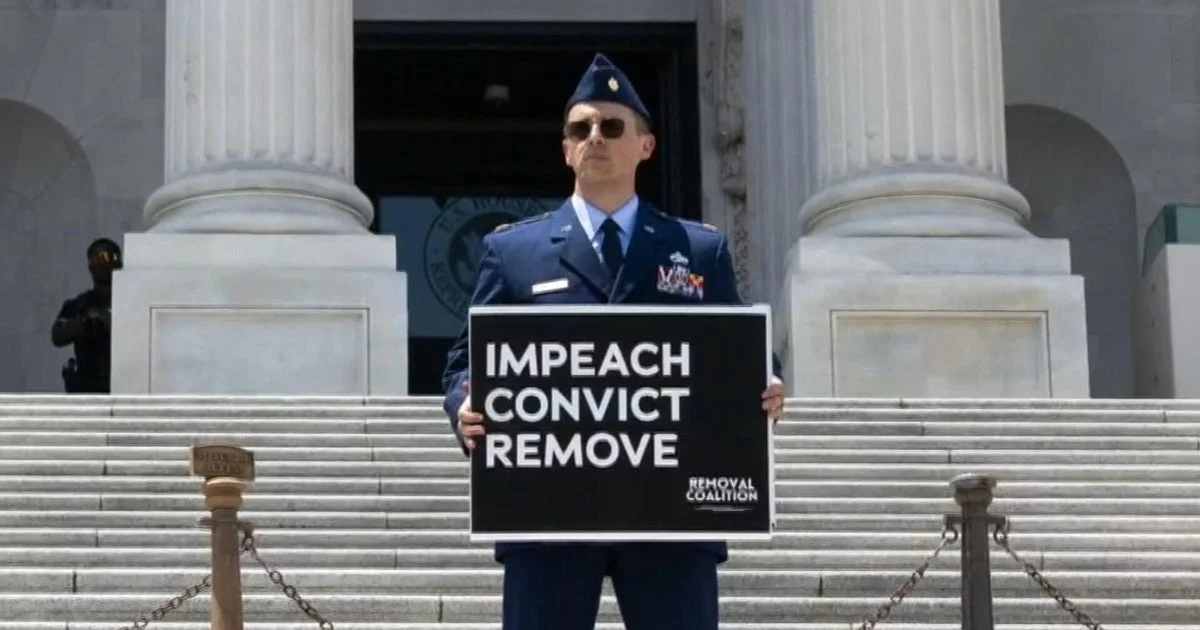
Major Jason Watson, a U.S. Air Force officer, is facing formal charges under the military justice system for publicly criticizing former President Donald Trump over the Iran war, marking a rare instance of an officer of his rank being charged for contemptuous speech toward an official under the Uniform Code of Military Justice (UCMJ).
What Happened
Watson was first detained on July 1, 2026, after protesting in uniform on the steps of the U.S. Capitol while holding a sign reading “Impeach. Convict. Remove.” The protest included a call for Trump’s impeachment. Following this, the 40-year-old major gave a CNN interview last week in which he criticized Trump as “not only a failure as president” but accused him of “flagrantly violating the Constitution, breaking the law, engaged in rampant corruption and killing Americans.”
These actions led to Watson being charged with three violations of Article 88 of the UCMJ, which prohibits commissioned officers from using “contemptuous words” against certain officials, including the president. Additional charges include disobeying orders and conduct unbecoming an officer, according to statements from Watson’s attorneys and CNN’s reporting.
Key Facts
- Major Jason Watson is one of the first officers of his rank to face Article 88 charges for contemptuous speech toward the president.
- Watson was detained twice: first on July 1 during a protest at the Capitol, then last week after the CNN interview.
- Article 88 violations include public use of contemptuous words toward the president.
- Additional charges involve disobeying orders and conduct unbecoming an officer.
- Air Force Secretary Troy Meink publicly underscored the expectation for all airmen to comply with laws, policies, and proper conduct regarding political participation.
What This Means
This rare military charge against Major Watson highlights the tension between free speech rights and military regulations that restrict political expression by uniformed officers. While the military imposes strict rules to maintain discipline and impartiality, Watson’s public protest and interview show how military personnel can find themselves at odds with these restrictions when expressing political dissent. For the broader public, the case serves as a high-profile example of the legal and institutional limits on active-duty service members’ engagement in political speech.
It also raises questions about how military justice balances respect for authority and constitutional rights, especially during politically charged times. Watson’s case could set precedents about the enforcement of Article 88 and the consequences officers face for public criticism of elected officials while in uniform, potentially influencing future military policy on political expression. For service members, it underscores the risks tied to public political activism in uniform.
Background
Under the Uniform Code of Military Justice, specifically Article 88, commissioned officers are prohibited from publicly using contemptuous words against certain civilian officials, including the president. This regulation exists to uphold military discipline and maintain the apolitical stance of the armed forces. Instances of charges under Article 88 are exceedingly rare, particularly for officers at the rank of major or higher.
Following Watson’s initial detention in July, Air Force Secretary Troy Meink reiterated that all airmen must adhere to laws and policies concerning personal conduct and political participation, highlighting the military’s commitment to enforcing these guidelines.
What Comes Next
Details about upcoming hearings or trial dates for Major Watson have not been disclosed. The military justice process will determine the outcome of the charges, with potential consequences ranging from reprimands to more severe penalties depending on the adjudication. Watson’s attorneys have affirmed his conviction in speaking out “so others wouldn’t have to,” indicating a likely legal challenge centered on the balance between free speech and military orders.
Sources
This article is based on reporting and publicly available information from the following sources:
Read more US News stories on Goka World News.