
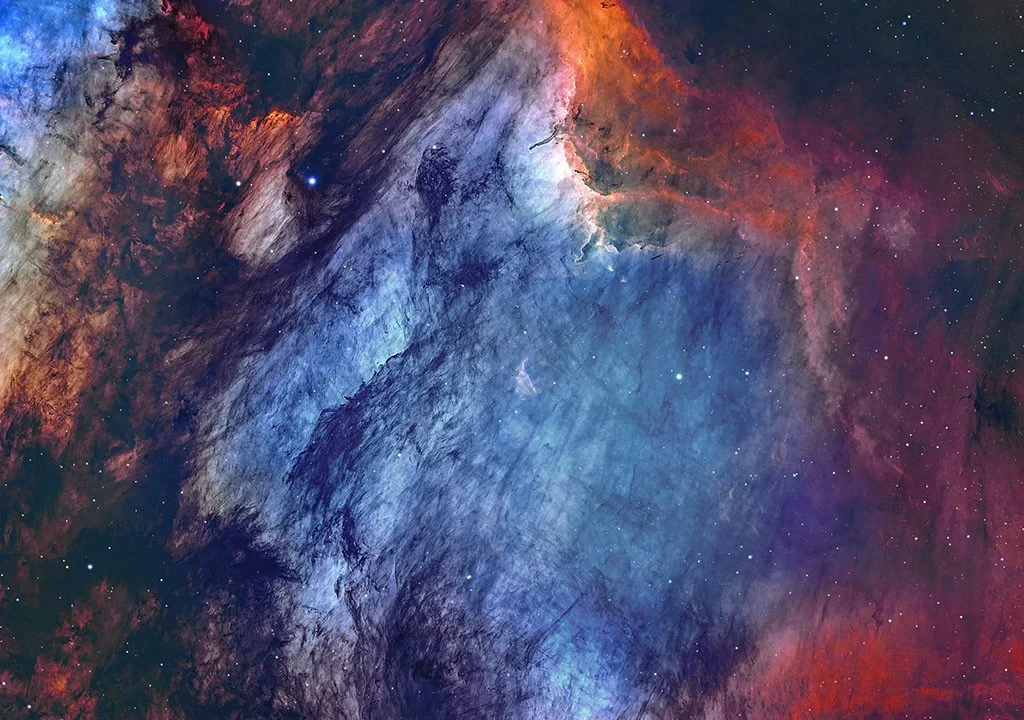
The Pelican Nebula (IC 5070) is undergoing a gradual transformation, as revealed in a detailed image produced by a 25-hour deep exposure taken from Utah, USA. Astronomers study this nebula intensively because it represents a dynamic environment where star formation and evolving gas clouds interplay, altering the nebula’s structure over time.
What Happened
The photograph highlights the Pelican Nebula, a prominent emission nebula located near the North America Nebula. It is separated from its larger neighbor by a thick molecular cloud filled with dark dust, designated as LDN 935. The image exposes intricate filamentary dust structures and a glowing ionization front, a boundary where light from newly formed, energetic stars ionizes the adjacent cooler gas clouds.
The ionization front, characterized by bright orange hues in the upper right of the image, marks the division between hot ionized gas and the cold molecular gas. Dense strands of cold gas, described as “tentacles,” remain within the nebula, indicating regions that have not yet been transformed by nearby stellar radiation. This ongoing process reflects the nebula’s active evolution.
Key Facts
The image was captured over 25 hours of exposure time, bringing out fine details in the nebula’s gas and dust components. The Pelican Nebula is officially designated IC 5070 and lies adjacent to the dark nebula LDN 935, which physically separates it from the North America Nebula. The bright ionization front observed is a direct result of radiation from young stars embedded within the nebula, signaling active star formation at work.
What This Means
The Pelican Nebula’s transformation is an excellent window into the life cycle of stellar nurseries. As young stars energize their surroundings, the conversion of cold gas into hot ionized gas reshapes the local environment, impacting future star formation potential. This gradual unfolding demonstrates how stars influence their birth clouds, driving chemical and physical changes over millions of years.
Understanding these processes helps astronomers analyze how stars like our Sun may have formed and how their initial environments evolve. For the public and the scientific community, detailed images such as this provide tangible evidence of star birth and nebular evolution, connecting cosmic phenomena to broader questions about the origins of solar systems and the conditions for planet formation.
Background
Prior studies have established the Pelican Nebula as a highly active star-forming region rich with emission and molecular clouds. It lies in the Cygnus constellation, near notable nebulae like the North America Nebula. Its proximity and active processes make it a frequent target for amateur and professional astronomers alike.
What Remains Unclear
While the image showcases vivid detail of the ionization front and dust structures, mission teams note that comprehensive analysis of the nebula’s dynamics, such as precise gas composition changes and full three-dimensional structure, remains ongoing. Future observations are expected to clarify how the balance of stars and gas will reshape the nebula’s appearance over the next millions of years.
Sources
This article is based on reporting and publicly available information from the following sources:
Read more Science Discoveries stories on Goka World News.