
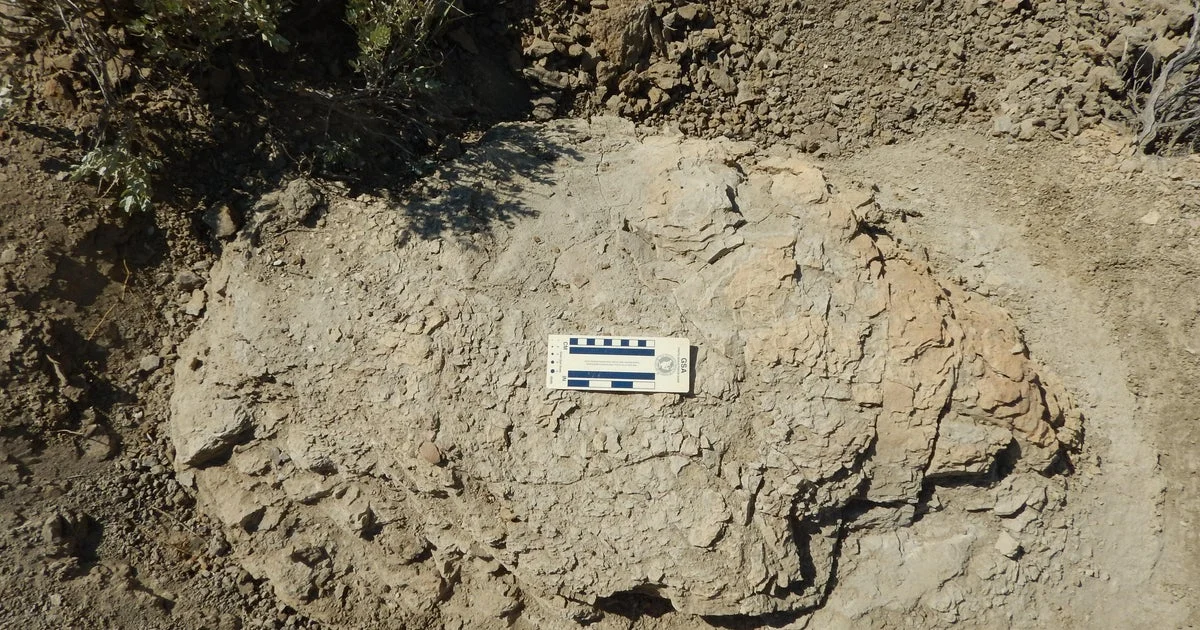
Paleontologists have identified the first ever trackway made by a full-grown Tyrannosaurus rex, consisting of four connected footprints discovered in the badlands of southwestern North Dakota, near the Montana border. This groundbreaking finding was detailed in a recent paper published in the Journal of Vertebrate Paleontology and sheds new light on the locomotion and behavior of one of the last dinosaurs before their extinction.
What Happened
In 2025, Kent Hups, a high school teacher volunteering on a dig led by researchers from the Denver Museum of Nature & Science, found four large, connected three-toed footprints in the Upper Cretaceous Hell Creek Formation close to Marmarth, North Dakota. These footprints, each approximately 3 feet long, form a trackway about 23 feet in length. The trackway represents the first known trail made by an adult T. rex, a species whose isolated adult footprints had been confirmed only twice before in New Mexico and Montana but never as a connected series showing movement.
Key Facts
The footprints date to roughly 66.5 million years ago, near the very end of the Cretaceous period, just before the mass extinction event widely attributed to an asteroid impact. By analyzing the spacing between the prints, researchers estimate the dinosaur was walking at a speed between 3.5 and 4.5 miles per hour despite weighing over seven tons. The attribution to Tyrannosaurus rex is based on footprint size and shape, as well as the high concentration of tyrannosaur bones found in the surrounding rock formation, which also yielded a juvenile specimen known as “Teen Rex” discovered nearby in 2022.
What This Means
This discovery provides a unique glimpse into the behavior of T. rex, moving beyond skeletal remains to capture actual moments of activity. The ability to track the dinosaur’s gait offers fresh data on how these massive carnivores walked and navigated their environment. For paleontologists, this trackway bridges a significant gap in understanding the locomotion mechanics of T. rex, contributing to broader knowledge about dinosaur biomechanics and their ecological role in the late Cretaceous landscapes. For the public and educators, it underscores the importance of scientific curiosity and field observation, revealing how amateur fossil hunters can contribute to major discoveries.
Moreover, this find enriches our understanding of the Hell Creek ecosystem shortly before the end-Cretaceous extinction, providing tangible evidence of how one of the apex predators moved and survived during a critical period of Earth’s history.
Background
The Hell Creek Formation is one of the most productive fossil sites for late Cretaceous dinosaurs, offering a window into the diversity of ecosystems just prior to the asteroid impact that caused the mass extinction of many species. While numerous dinosaur bones, including those of T. rex, have been found there, physical evidence of adult T. rex footprints has been exceedingly rare, limiting insights into the living behavior of these animals.
What Comes Next
Later this fall, three of the four footprints will be airlifted by helicopter to the Denver Museum of Nature & Science for further study and preservation. Researchers plan to analyze the trackway in unprecedented detail using advanced 3D scanning technologies to better understand the biomechanics of T. rex locomotion. This ongoing research will likely deepen scientific knowledge about the behavior and ecology of one of the most iconic dinosaurs in Earth’s history.
Sources
This article is based on reporting and publicly available information from the following source:
Read more Science Discoveries stories on Goka World News.