
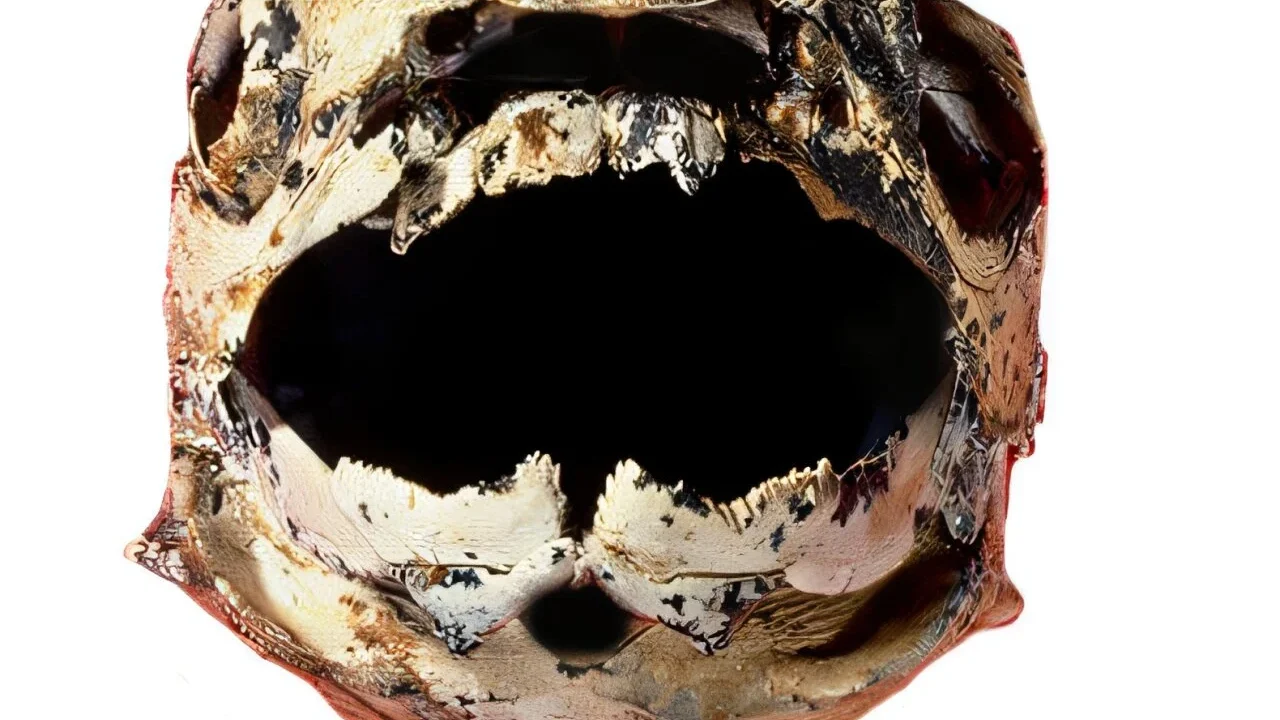
Researchers at Flinders University have identified two fundamentally different jaw adaptations among placoderms, the armored fish that first evolved jaws and teeth over 400 million years ago. Their study, published in Scientific Reports, confirms how these early vertebrates developed specialized biting mechanisms to consume armored prey in ancient reef environments in what is now northern Western Australia.
What Happened
Using an innovative combination of finite element analysis and 3D digital reconstruction, the team examined fossilized jaw bones from eight placoderm species dating back 385 million years. These simulations measured how the jaw structures sustained biting forces and related these mechanics to the complexity of their biting surfaces. The study revealed two distinct feeding adaptations: smaller placoderms possessed broad, flat crushing plates to pulverize prey, while larger species had evolved complex, tooth-like structures arranged along raised bony crests capable of piercing hard shells before crushing them.
Key Facts
The research showed that both the smallest and largest placoderm species held the strongest jaws for biting through tough, armored prey, although their methods differed substantially. Smaller species used nearly featureless flat plates to engulf and crush entire prey. In contrast, larger placoderms employed intricate dental surfaces resembling medieval armor-piercing weapons such as war hammers or poleaxes. These structures allowed them to puncture the prey’s protective armor and fragment it into manageable parts. The fossil specimens came from the world-renowned Gogo Formation in Western Australia, where Flinders University researchers have conducted extensive studies.
What This Means
This research sheds light on the evolutionary experimentation that early jawed vertebrates undertook to exploit the ecological niches of Devonian reef ecosystems. The two divergent jaw adaptations reflect different strategies for handling prey of varying sizes and armor thickness, revealing a more complex ecological landscape than previously understood. For modern science, understanding these distinct biomechanical approaches helps clarify the functional and evolutionary pressures that shaped the earliest vertebrate jaws—structures fundamental to vertebrate evolution and ultimately to the origins of the human body plan. The findings demonstrate that hard-object feeding was not a single evolutionary path but a multifaceted process with specialized adaptations, likely influencing predator-prey dynamics in ancient marine ecosystems.
Background
Placoderms are among the first vertebrates known to evolve jaws, representing a critical stage in vertebrate history. Their jaw structures differ markedly from those of modern animals, consisting not of a single lower jaw bone but paired bony plates supported by cartilage. This unique anatomy has previously limited understanding of how early jawed fishes functioned. The Gogo Formation fossil site has provided exceptional preservation of these ancient fish, enabling detailed morphological and biomechanical studies over recent decades.
The Bigger Picture
By linking jaw form and function through digital biomechanical modeling, this study contributes to the broader field of evolutionary biology and functional morphology. It highlights how ancient vertebrates navigated the challenges of feeding on armored prey, which may have driven the diversification of jaw types and biting mechanisms still echoed in modern fishes. This work also contextualizes placoderms as precursors to all jawed vertebrates, including humans, by elucidating how early jaw innovations supported ecological radiation in the Devonian period.
What Comes Next
The researchers plan to extend their finite element analyses to a wider range of placoderm taxa to better map the diversity of feeding adaptations over time. Further study of fossil specimens using these digital methods may clarify how biomechanical constraints influenced evolutionary pathways. Additionally, integrating these findings with ecological data from ancient reefs could refine models of Devonian marine ecosystems.
Sources
This article is based on reporting and publicly available information from the following sources:
Read more Science Discoveries stories on Goka World News.