
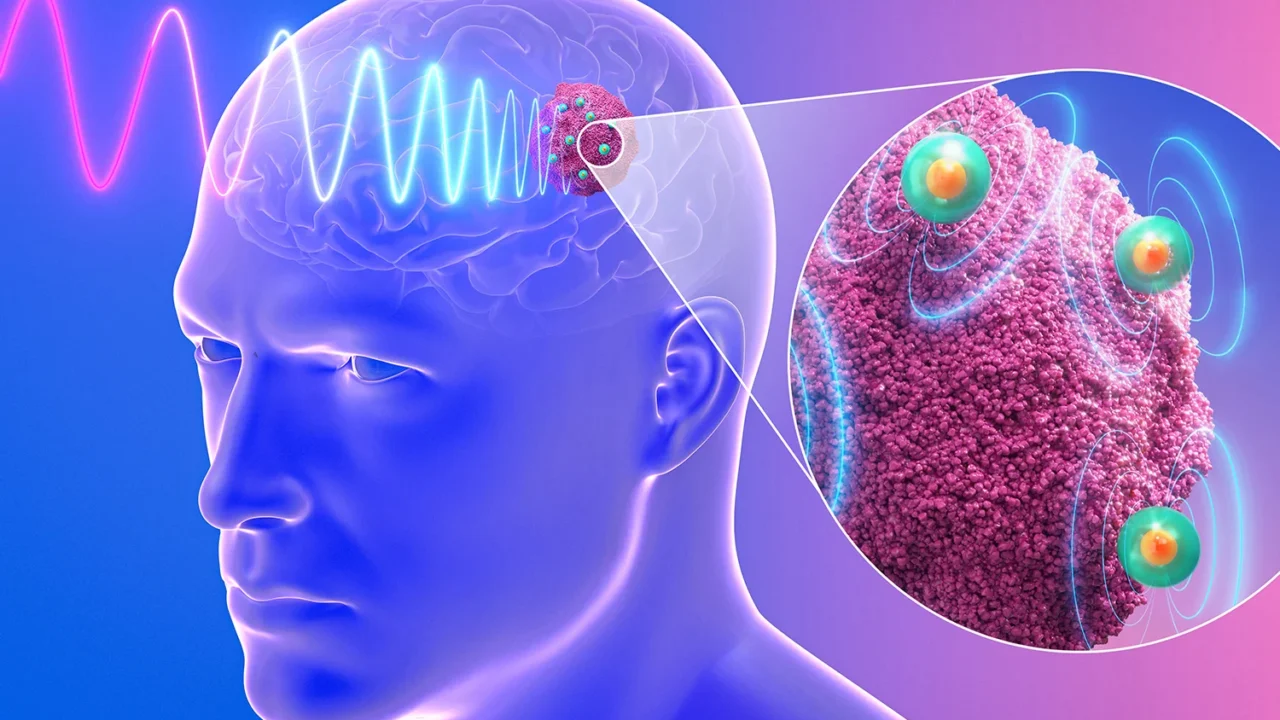
Scientists at the Massachusetts Institute of Technology (MIT) have made a notable advancement in tackling glioblastoma, a highly aggressive and treatment-resistant brain cancer. Their development of injectable nanoantennas, activated wirelessly by magnetic fields, enables targeted electric-field therapy that effectively kills drug-resistant glioblastoma cells while sparing healthy brain tissue. This breakthrough, published in Science Advances, offers potential for a safer and more precise brain cancer treatment.
What Happened
The MIT Media Lab team, led by associate professor Deblina Sarkar, created nanodevices roughly one-hundredth the width of a human hair, termed “HITMAN” (highly-localized electric-field-induced tumor therapy using magnetically actuated nanoantennas). The technology employs magnetostrictive materials within the nanoantennas activated by an externally applied low-frequency magnetic field (under 200 kHz), which penetrates the skull and brain tissue without generating heat damage.
Upon activation, mechanical deformation of a piezoelectric film in the nanoantennas generates localized electric fields that disrupt the bioelectric currents integral to glioblastoma cells’ function. Laboratory experiments using tumor cells derived from patients with chemotherapy-resistant glioblastoma, procured from Mayo Clinic, confirmed that HITMAN eliminated 52.2% of these cells — outpacing the standard chemotherapy drug temozolomide (TMZ) by over fivefold — without harming adjacent healthy neurons or astrocytes.
Subsequently, the team implanted these patient-derived tumor cells into mice brains to establish orthotopic animal models of glioblastoma. Treatment with HITMAN significantly inhibited tumor progression and extended the median survival of these mice by more than 50%, with no detectable toxicity to vital organs or surrounding healthy brain tissue. Crucially, experiments ruled out effects from the magnetic field alone or unactivated nanoantennas, confirming the therapy’s specificity.
Key Facts
The research, published on April 25, 2024, in the journal Science Advances, was conducted at the MIT Media Lab under the leadership of Dr. Deblina Sarkar and her Nano-Cybernetic Biotrek group. The study utilized tumor samples from chemotherapy-resistant glioblastoma patients at Mayo Clinic, with the nanoantennas measuring approximately 150 nanometers in diameter.
The HITMAN technology applies low-frequency magnetic fields capped at 200 kHz to avoid harmful tissue heating. The animal studies used orthotopic mouse models, widely considered the gold standard for preclinical brain tumor research.
What This Means
This innovative approach addresses the critical challenge of treating glioblastoma, a cancer notorious for its resistance to existing therapies such as chemotherapy, radiotherapy, and immunotherapy. By targeting the tumor’s intrinsic bioelectric properties via localized electric fields, HITMAN offers a spatially precise and minimally invasive treatment option, potentially reducing collateral damage to healthy brain structures.
The wirelessly activated nanoantennas could revolutionize clinical management by providing a novel modality to overcome drug resistance mechanisms, which pose a major hurdle in improving glioblastoma prognosis. Moreover, the significant decrease in cancer cell colony formation post-treatment suggests a potential to reduce tumor recurrence and metastasis, which are key obstacles in long-term patient survival.
For patients and clinicians, this technology could translate into improved quality of life and extended survival with fewer side effects, shifting the paradigm away from systemic toxic therapies toward targeted, nanomedicine-based interventions.
Background
Glioblastoma remains one of the deadliest brain cancers, infiltrating surrounding tissue and exhibiting robust resistance to conventional treatments. Complete surgical removal is often impossible due to its diffuseness, and therapies like chemotherapy and radiation frequently fail due to both intrinsic and acquired resistance. Past work has explored electric field therapies but lacked minimally invasive, highly localized delivery mechanisms with sufficient specificity for tumor cells.
The Bigger Picture
This research fits within a broader trend of employing nanoelectronics and bioelectric modulation to address challenging diseases in medicine. The MIT team’s prior development of “circulatronics” – living cell–integrated devices capable of traversing the blood-brain barrier — hints at future integration where such nanoantennas could be administered intravenously rather than via direct brain injection, enhancing patient comfort and therapy delivery logistics.
What Remains Unclear
The researchers note that further studies are needed to fully determine long-term safety, optimal dosing strategies, and potential immune interactions in humans. Additionally, clinical translation will require validation of efficacy and safety in human trials, which were not part of this preclinical study.
What Comes Next
Future plans include optimizing device administration methods, potentially leveraging earlier circulatronics technology for systemic delivery, and advancing towards clinical trials. The research team is also investigating the detailed molecular mechanisms triggered by this electric-field disruption in glioblastoma cells to refine treatment parameters.
Sources
This article is based on reporting and publicly available information from the following sources:
Read more Science Discoveries stories on Goka World News.