
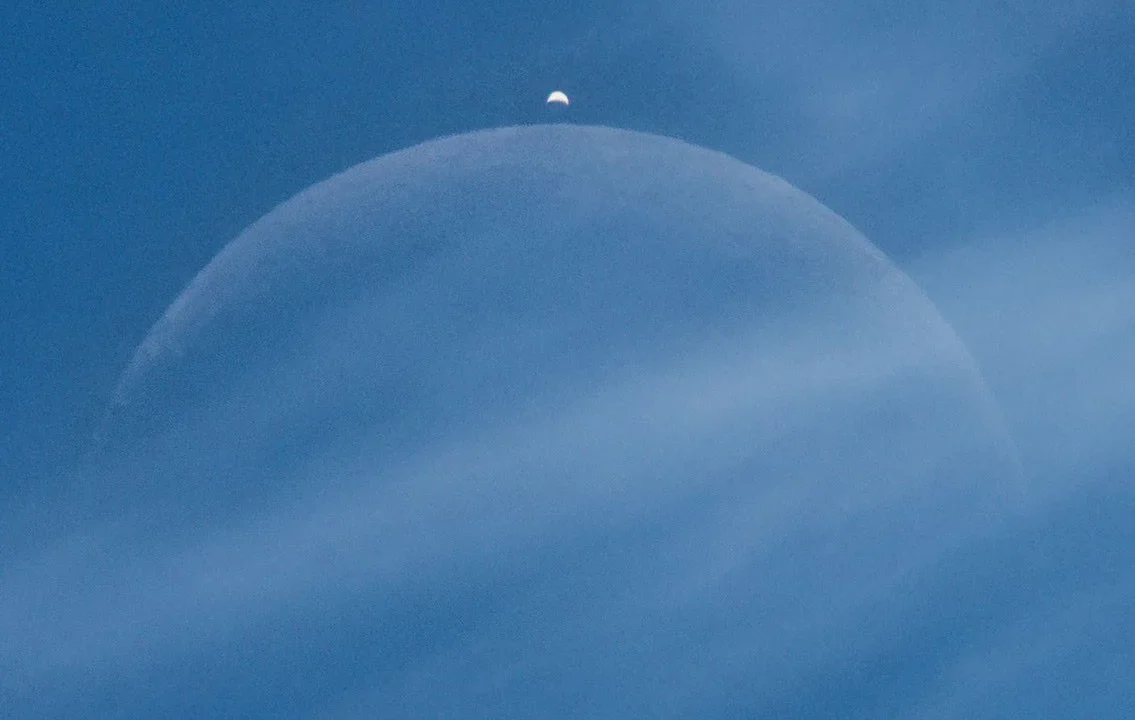
On September 15, 2026, a rare astronomical event unfolded over parts of Earth—an occultation where the Moon passed in front of the planet Venus, temporarily blocking it from view. This phenomenon, visible in daylight above the village of Cessy in France, was captured in a notable photograph featuring both celestial bodies displaying crescent phases.
What Happened
The daytime occultation occurred near noon as the slender crescent Moon moved across the sky, passing in front of Venus. The event was photographed by Arnaud Mariat, who observed that both the Moon and Venus showed distinct crescent shapes in the same exposure. The Moon appeared with about 10 percent of its surface illuminated by the Sun, while Venus showed a brighter crescent with approximately 25 percent illumination. The brightness difference is attributed to Venus’s proximity to the Sun and its high-albedo cloud cover compared to the Moon’s darker surface.
Key Facts
- Date of event: September 15, 2026
- Location of observation: near Cessy, France
- Observation time: around local noon
- Moon illumination: approximately 10 percent crescent
- Venus illumination: approximately 25 percent crescent
- Venus visibility: occultation visible to roughly 10 percent of Earth’s surface
- Event captured by: astronomer Arnaud Mariat
- Image featured on NASA’s Astronomy Picture of the Day (APOD)
What This Means
This daylight occultation offers a rare glimpse into celestial mechanics visible to the human eye without the need for specialized night-time observation. The event not only provides astronomers and enthusiasts an opportunity to study the interaction of solar system bodies during daytime but also illustrates the different illumination phases that Venus and the Moon present due to their position relative to the Sun and Earth. The distinction in crescent sizes and brightness enhances public interest in planetary movements and encourages broader awareness of ongoing, observable astronomical phenomena.
Moreover, capturing such an event in broad daylight underscores advances in observational techniques and public engagement with astronomy. It highlights the accessibility of space observation beyond specialized settings and nighttime hours, fostering a stronger connection between the public and space science.
Background
Occultations of planets by the Moon are relatively rare events, often only visible within limited geographic areas on Earth. They occur when the orbital paths of the Moon and a planet align precisely from Earth’s perspective, causing the Moon to temporarily block the planet’s light. Venus, the brightest planet in the night sky, often exhibits phases similar to the Moon’s due to its orbit inside Earth’s orbit, causing variations in reflected sunlight.
What Remains Unclear
This event was reported primarily through a single image and localized observation. Details about the duration of the occultation, precise orbital parameters at observation, and scientific data from other global observers have not been disclosed in the reviewed sources.
Sources
This article is based on reporting and publicly available information from the following sources:
Read more Space & NASA stories on Goka World News.