
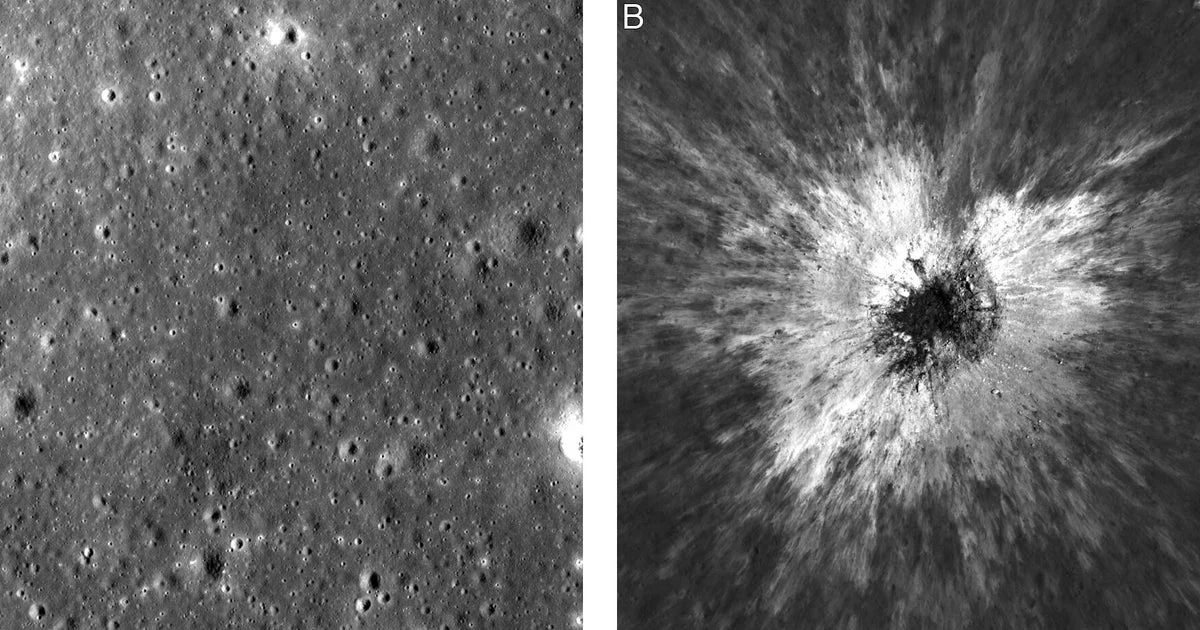
NASA’s Lunar Reconnaissance Orbiter (LRO) has identified a massive new impact crater on the moon that surpasses the size of the Roman Colosseum, revealing a rare and powerful collision that occurred in 2024. This recent discovery provides valuable information to support NASA’s preparations for establishing a crewed lunar base.
What Happened
The crater, located on the moon’s near side, was created by the impact of an asteroid or comet fragment approximately the size of a three- to six-story building. The strike took place between April 11 and May 22, 2024, but initially escaped detection by Earth- and space-based telescopes. The LRO, orbiting the moon since 2009, captured wide-angle images covering the site soon after the impact, but the new crater went unnoticed until researchers identified it in August 2025.
Subsequent high-resolution images obtained last fall and confirmed early this year detailed the crater’s dimensions: about 728 feet (222 meters) across—comparable to two football fields—and up to 141 feet (43 meters) deep, roughly the height of three stacked yellow school buses. The crater spans a region that disrupted the lunar surface across more than 66 miles (106 kilometers).
Key Facts
This crater is now the largest known impact site formed on the moon in recent times and is approximately three times larger than the previous record-holder discovered by the LRO around a decade ago. Researchers estimate that an impact of this magnitude occurs roughly once every 132 years, highlighting the rarity of this observation.
The crater has been named after Thomas McGetchin, the late former director of the Lunar and Planetary Institute in Houston, Texas. Scientific analysis revealed an unexpected pattern in how dust and rocky material were expelled from the site, indicating a higher ejection angle than anticipated.
Additionally, scientists identified a 4-mile-wide cold spot surrounding the crater, indicative of lunar soil disturbance. According to David Paige of the University of California, Los Angeles, co-author of one of the studies published in Science Advances, the impact essentially “gardens” the lunar regolith by overturning and mixing the surface sediments.
What This Means
This discovery offers crucial practical insights into the processes shaping the lunar surface, especially as NASA moves forward with ambitious plans to build a permanent human presence on the moon. Understanding the frequency and effects of such large impacts is essential for designing structures capable of withstanding ejected debris, which could pose a hazard to astronauts and equipment.
Moreover, the finding challenges previous assumptions about the moon’s surface stability. It suggests that the lunar soil is turned over and refreshed more rapidly than once thought, potentially every 80,000 years for the top inch, which implies that footprints and artifacts from past Apollo missions will not remain forever but will instead erode over geologic time.
Knowing the dynamics of recent impacts will allow engineers and mission planners to better assess risks and enhance protective measures for future lunar habitats, ensuring greater safety and longevity for the explorers who will inhabit them.
Background
NASA’s Lunar Reconnaissance Orbiter, launched in 2009, has continually mapped the moon’s surface in unprecedented detail, discovering numerous craters and features. Prior to this discovery, the largest crater newly recorded by LRO was a third the size of the newly found McGetchin crater. The moon itself bears ancient craters far larger—some over 1,500 miles in diameter—left by impacts billions of years ago.
The LRO data have improved scientists’ understanding of lunar geology and surface renewal processes, contributing to safer and more informed exploration efforts under NASA’s Artemis program.
What Comes Next
Researchers will continue analyzing impact ejecta patterns to assess potential hazards to the upcoming lunar base. The information gathered will inform the engineering designs for habitat protection against micrometeoroid impacts and debris ejection. NASA has prioritized this data to harden lunar structures and mitigate damage risks as human presence on the moon intensifies.
Sources
This article is based on reporting and publicly available information from the following sources:
Read more Space & NASA stories on Goka World News.