
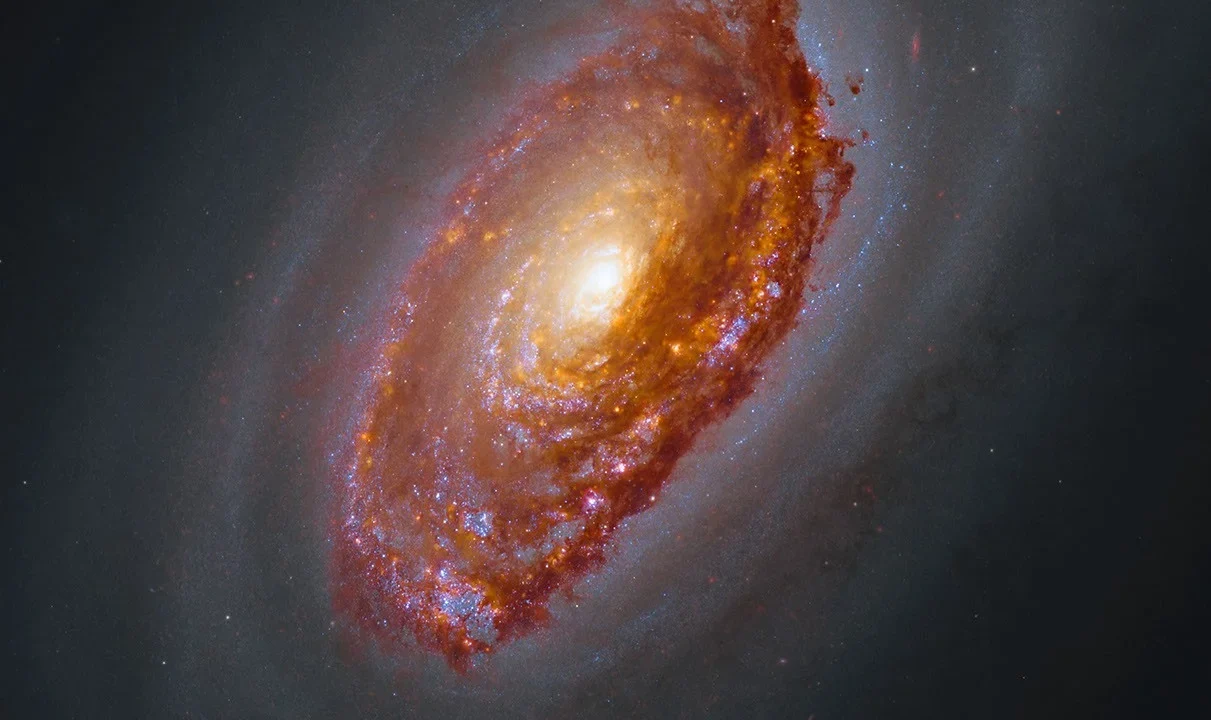
NASA’s James Webb Space Telescope has captured detailed infrared views of Messier 64 (M64), the nearby spiral galaxy also known as the Black Eye Galaxy. Unlike earlier Hubble images that show a dark dust lane obscuring its core, Webb’s observations reveal this dust glowing in the infrared, uncovering how it absorbs and re-emits light from newborn stars.
What Happened
On September 16, the Astronomy Picture of the Day (APOD) featured a composite image combining data from the Hubble Space Telescope and Webb’s Mid-InfraRed Instrument (MIRI). The new Webb data highlights the dust structures in red, which correspond to regions where dust absorbs ultraviolet light from young stars and re-emits it in the infrared. This provides a clearer perspective of star formation regions that are partially hidden in visible light images.
Key Facts
M64 is a spiral galaxy distinguished by its distinctive dark dust band partially obscuring its bright core, earning it the nickname “the Black Eye Galaxy.” Webb’s MIRI instrument detects the dust and its emissions in the mid-infrared spectrum. The galaxy shows a remarkable counter-rotation in its gases: the inner and outer gas regions orbit in opposite directions, leading to compressed gas flows. These collisions trigger enhanced star formation where the two gas currents meet. This opposing motion and starburst activity are believed to result from a past merger event with a smaller galaxy. These details about the dust composition, structure, and gas dynamics add crucial context to M64’s evolutionary history and offer comparative insight for studying spiral galaxies like the Milky Way.
What This Means
The Webb telescope’s ability to see dust glowing in the infrared transforms our understanding of galaxies like M64. While earlier observations showed dust as dark, blocking light, Webb reveals active processes inside these obscured regions—specifically newborn stars warming the dust. This refined view confirms that spiral galaxies are not always quiescent but can have dynamic, turbulent histories involving mergers that reshape their gas and star formation patterns.
This matters not only to astronomers studying galaxy formation but also to a broader scientific understanding of how galaxies evolve over billions of years. It suggests that mergers and colliding gas flows play a significant role in triggering bursts of star formation, influencing the chemical makeup and structure of galaxies. For the general public, these insights deepen appreciation of the cosmos’s complexity and the ongoing processes shaping galaxies beyond our own.
Background
M64’s counter-rotating gas regions have previously been recognized as strong evidence that spiral galaxies can experience mergers. This challenged the earlier notion that spiral galaxies lead predominantly peaceful lives. Webb’s new infrared data, combined with Hubble’s visible-light images, adds a crucial layer by revealing the interplay between dust and star formation, further documenting the aftermath of galaxy mergers.
What Comes Next
Astronomers plan to use the Webb data to conduct more detailed analyses of M64’s dust properties, gas motions, and star formation activity. This will improve models of how mergers influence galaxy evolution and provide benchmarks for studying other spiral galaxies. Ongoing Webb observation campaigns aim to map similar processes in multiple galaxies to build a comprehensive picture of galaxy dynamics in the nearby universe.
Sources
This article is based on reporting and publicly available information from the following sources:
Read more Space & NASA stories on Goka World News.